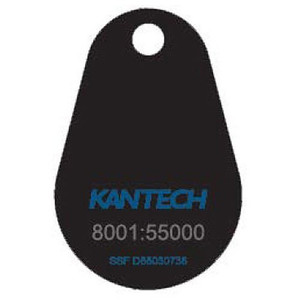
Kantech MT-2KDYE Dual Technology ioSmart 13.56 MHz Card
The Kantech MT-2KDYE is a contactless smart card operating at 13.56 MHz designed for multi-technology access control systems where facilities need to migrate from legacy proximity credentials to modern encrypted smart-card authentication without replacing existing infrastructure. It supports DESFire, MIFARE, and HID standards, enabling sites to run dual-credential ecosystems during transition phases. AES-128 encryption protects cardholder data and transaction integrity when connected to Kantech controllers, preventing credential cloning attacks that plague unencrypted proximity systems. The card is engineered for corporate, government, campus, and visitor badge deployments where identity verification and secure physical access must coexist.
Key Features
- Dual Technology Support: DESFire, MIFARE, HID, and 125kHz proximity in one card. Allows simultaneous legacy and modern credential workflows during phased system migrations.
- 13.56 MHz Contactless Interface: ISO 14443 Type A/B compliance. Read range up to 10cm, resistant to environmental interference and electromagnetic noise in industrial facilities.
- AES-128 Encryption: Protects card data and reader-to-controller communication. Eliminates cloning vulnerability inherent in unencrypted proximity cards (125kHz).
- Dye-Sublimation Photo ID Printing: Full-color, professional-grade card material compatible with Kantech personalization workflows. Integrates photo ID with embedded credential for single-badge deployments.
- Multi-Factor Authentication Capable: Pairs with optional integrated keypad readers for PIN + card workflows, satisfying NIST 800-53 and corporate zero-trust policies without added hardware complexity.
- Kantech Controller Integration: Works with KT-400, KT-2, and KT-1 platforms via RS-485, OSDP, or Wiegand protocols. Firmware-upgradeable; field-deployable with existing EntraPass or EntraPass GO platforms.
- Limited Lifetime Warranty: Manufactured in Canada with professional-grade durability stock, backed by Kantech's standard warranty coverage.
The MT-2KDYE bridges the gap between installed proximity readers and next-generation smart-card access control. Many facilities running mature Kantech KT-2 or KT-400 systems face a choice: replace working readers and controllers, or introduce credential cloning risk by staying on legacy 125kHz proximity indefinitely. This dual-technology card eliminates that false choice. Existing proximity readers continue to operate for visitors and contractors on legacy credentials; authorized employees are issued MT-2KDYE cards that readers with 13.56 MHz capability recognize. Kantech ioSmart reader hardware (mullion or single-gang, IP64/IP65 outdoor variants available) plugs into the same controller input as legacy readers, making the reader upgrade independent of the access control software migration timeline.
Integration with Kantech EntraPass and EntraPass GO platforms ensures credential issuance, revocation, and audit logging remain centralized. RS-485 or OSDP communication between controller and readers handles encryption key negotiation and transaction validation in real time. BLE (Bluetooth Low Energy) channel support enables SmartTap mobile credential mode for cardless access via smartphone when paired with cloud-based EntraPass GO, while card-based mode remains air-gapped and offline-capable. Configuration of encryption mode, communication protocol, and reader timeout thresholds occurs during system commissioning via Kantech tools — mismatched settings will result in read failures, so baseline site survey and controller firmware verification are essential before card deployment.
Dye-sublimation printing allows full-color photo ID integration at issuance, eliminating separate ID badge hardware and the overhead of managing two separate card stocks. The card's professional durability rating supports high-traffic environments (hospitals, universities, corporate campuses) where credentials undergo repeated insertion cycles and environmental exposure. Paired with multi-factor (PIN + card) reader variants, the MT-2KDYE satisfies government and regulated-industry badge policies without requiring a separate authentication layer.
The Kantech MT-2KDYE is ideal for mid-to-large deployments transitioning from proximity to encrypted smart cards, or for new installations prioritizing secure multi-factor workflows from day one. It is backward-compatible with installed Kantech proximity readers during phase-in, eliminating forklift hardware replacement and reducing deployment risk. For sites requiring NFC-based mobile credentialing alongside physical cards, this credential type supports both through a single controller configuration. Verify ioSmart reader availability and controller firmware version against the MT-2KDYE datasheet before specifying into new system designs or retrofit projects.
Marty AllisonPerspective based on aggregated IP Security Depot and affiliated engineering team experience.
We've deployed the Kantech MT-2KDYE across enterprise campuses, healthcare facilities, and government installations where legacy proximity infrastructure collides with modern credential security mandates. The dual-technology approach solves a real operational problem: you cannot flash-cut 500+ proximity readers on a live system. Instead, the MT-2KDYE allows credential-level migration while reader hardware upgrades happen on a measured timeline. A new hire gets a MT-2KDYE and touches any ioSmart reader installed to date; a contractor still using a proximity card works through legacy readers until facility policy forces retirement. This staggered transition dramatically reduces deployment bottleneck and risk. The encryption layer — AES-128 across the reader-to-controller link — eliminates the single worst vulnerability of proximity systems: field-level credential cloning with off-the-shelf USB readers and open-source tools. We've seen cloning vulnerabilities drive entire re-badging exercises costing six figures; the 13.56 MHz encrypted channel prevents that scenario entirely.
Technical Highlights:
- DESFire / MIFARE / HID Multi-Standard Support: The card recognizes and responds to three different authentication protocols within a single physical form factor. In practice, this means a single card stock accommodates legacy HID Prox readers, newer MIFARE installations, and DESFire-compliant systems — critical when acquiring facilities with heterogeneous reader bases or integrating with third-party badge printers that pre-encode MIFARE chips.
- AES-128 Encryption with Reader-to-Controller Handshake: Every transaction — card presented, data read, access decision — is encrypted and authenticated. Prevents mid-stream credential interception and replay attacks. Firmware-verified, so rogue readers cannot spoof legitimate credentials on the network.
- 13.56 MHz Contactless at 10cm Range: Shorter effective read distance than legacy 125kHz proximity (typically 20-30cm), but far more resistant to RF interference in electrically noisy environments (warehouses, manufacturing floors, hospitals with MRI shielding). The tradeoff is acceptable for controlled-environment deployments; outdoor or high-interference sites benefit measurably from the noise immunity.
- Dye-Sub Photo ID Printing: Full-color, high-resolution personalization at issuance eliminates the need for separate ID badge stock and separate hot-lamination equipment. Reduces issuance cycle time from 3-5 days (traditional photo ID + separate smart card) to 1 day, and cuts card inventory SKUs in half.
- BLE + Card Mode Dual Operation: The same card-encoded chip supports both physical card presentation and smartphone-based mobile credential when enrolled in EntraPass GO with BLE reader. Simplifies visitor / contractor workflows: they can use the physical card at any ioSmart reader, or invite a guest to authenticate via mobile credential without issuing a second card.
Deployment Considerations:
- Reader Hardware Mandatory: Standard proximity readers (HID Prox, Salto iClass, etc.) do not recognize 13.56 MHz signals. Verify that your facility's reader hardware roadmap includes ioSmart 13.56 MHz capable units before committing to MT-2KDYE card stock. Mixed reader populations are operationally acceptable during transition, but all-proximity reader sites require reader replacement before this card is usable.
- Firmware Baseline: Kantech controllers (KT-400, KT-2, KT-1) require minimum firmware versions to support ioSmart protocol negotiation. Request controller firmware revision from your system integrator before issuing MT-2KDYE cards. A controller running outdated firmware will fail to authenticate the card, creating false-rejection support tickets.
- Encryption Key Management: Each card is provisioned with an AES-128 key during issuance; controller and reader must be synchronized to the same key. Use Kantech EntraPass key management tools exclusively for provisioning. Manual key entry or third-party tools risk key misalignment and system-wide read failures.
- Communication Protocol Alignment: RS-485, OSDP, and Wiegand paths each carry credential data differently. OSDP is the most modern and secure; Wiegand is the legacy standard and has lower bandwidth. Confirm which protocol your controller uses and which your readers support before specifying. Multi-protocol readers exist but add latency and cost.
- Environmental Durability: The card itself is rated for typical indoor office and campus use. Harsh environments (bleach-heavy healthcare, salt-spray outdoor access, oil-industry facilities) require environmental enclosure or protective sleeve solutions. Standard PVC card stock is resilient but not rated for chemical solvents or extreme temperature cycling.
The MT-2KDYE is the credential of choice for mid-to-large Kantech deployments prioritizing secure credential transition without reader hardware forklift replacement, especially in regulated industries (healthcare, government, finance) where credential cloning vulnerability must be eliminated. For new-build systems where reader hardware can be specified from scratch, DESFire-only cards may offer simpler configuration; for retrofit and phased migration, the dual-technology flexibility and backward compatibility make this card the pragmatic standard. Explore the Kantech catalog for compatible reader hardware and controller platforms.