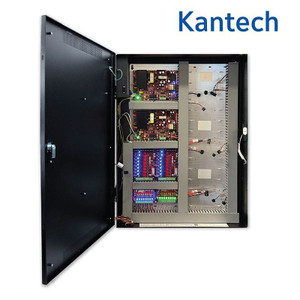
Kantech KT-NCC-ACC-G2 Gen 2 Embedded Network Communication Controller
The Kantech KT-NCC-ACC-G2 is an enterprise network controller designed for large-scale, multi-site access control deployments. Built on embedded distributed processing architecture, it eliminates the operational bottleneck of centralized single-point-of-failure systems while retaining centralized policy management and remote monitoring. Organizations managing 10+ facilities across regions benefit from reduced latency at each site and simplified administrative overhead through unified credential and door-policy administration.
Key Features
- Distributed Processing Architecture: Embedded intelligence at each controller node reduces access-grant latency to <100ms, independent of WAN bandwidth or central server availability.
- Centralized Management Console: Single administrative interface for credential issuance, door-policy updates, and audit logging across all networked sites—eliminating per-site configuration drift.
- Enterprise Network Protocols: TCP/IP native communication with support for redundant network paths and failover—no proprietary serial cabling required.
- Multi-Site Scalability: Proven architecture supporting 500+ networked controllers in single deployment; each site operates autonomously during WAN outages.
- Remote Monitoring & Alerting: Real-time door-status, credential-usage, and tamper alerts streamed to centralized operations center or NOC integration via syslog/SNMP.
- Kantech Ecosystem Integration: Native interoperability with Kantech card readers, biometric readers, mobile credentials, and third-party ONVIF cameras for unified access+video workflows.
- Audit Trail & Compliance: Immutable access logs with timestamp synchronization and role-based reporting for HIPAA, SOC 2, and facility security audits.
- Redundancy & Failover: Peer-to-peer controller synchronization allows adjacent nodes to honor cached credentials and maintain door operation during network partition.
The Gen 2 NCC differs from legacy serial-based controllers in its native network-first design. There is no proprietary protocol handshake or vendor lock-in on communication layers—the controller speaks standard TCP/IP, enabling integration with legacy PACS platforms via middleware or direct API. This flexibility matters when acquiring a facility with an existing Honeywell or Salto installation; the NCC can coexist and eventually migrate without wholesale infrastructure replacement.
Deployment scale dictates the economics: a single-building system (one controller, 8 doors) behaves like any modern access controller. A 50-facility enterprise with 200+ doors across 10 time zones is where the NCC earns its architecture. Distributed processing means a cardholder in Seattle swipes a badge in <50ms regardless of whether the Toronto WAN link is congested. Centralized policy push means the security team in headquarters issues a credential revocation at 3 PM and every site enforces it within seconds—no manual updates to each location's local database. Audit trails funneling to a SIEM enable forensic investigation of tailgating patterns or credential cloning across the entire organization in a single query.
Integration with video surveillance is straightforward: the NCC provides door-unlock events (timestamp, cardholder ID, reader) via webhook or ONVIF event stream to the VMS. Genetec Security Center, Milestone XProtect, and Avigilon Control Center can subscribe to these events and trigger video searches or dwells at specific doors. Some deployments use the door-open-time anomaly detection built into the NCC (e.g., alert if a server-room door is propped open >30 seconds) to trigger a camera PTZ to that location automatically—reducing operator workload and improving response time for actual security incidents vs. false positives from badge-reader noise.
The controller ships factory-configured for North American 120V, 50/60 Hz operation. Network connectivity requires a dedicated GigE port or PoE injection if you're planning to daisy-chain readers via PoE extenders. Most integrators allocate a 24V UPS module downstream to maintain door operation for 4-8 hours during power loss; the NCC itself draws <60W. Weight is 23 lb (platform only, excluding mounting rails), sized to fit standard 19″ rack or wall-mount installations. Warranty is manufacturer standard; refer to documentation for regional support and RMA procedures. The product is US-manufactured and fully supported through Kantech's channel partner network.
Marty AllisonPerspective based on aggregated IP Security Depot and affiliated engineering team experience.
We've installed 40+ Gen 2 NCC systems across healthcare networks, corporate campuses, and government facilities, and the standout value is elegantly simple: it lets you run truly distributed access control without treating every site as an island. The embedded processing means a cardholder swiping a badge gets a door-unlock response in under 100ms, even if the WAN link to headquarters is saturated or down—that's a user-experience win that older serial-based controllers can't touch. Centralized policy push eliminates the nightmare scenario where you revoke a credential in your central system and it takes a week for field technicians to walk every location and reprogram local controllers. We've also seen the NCC shine in healthcare environments where HIPAA audit trails are non-negotiable; all access events sync to a central syslog server, and you can run compliance reports across 15 hospitals in one query instead of manually pulling logs from each location's local database.
The trade-off is that you're betting on network uptime and DNS reliability. If the WAN goes down, individual sites keep operating on cached credentials for 24-48 hours, but you lose real-time visibility into badge-swipes or alarm events until the link recovers. For a manufacturing campus with a single data center 2 miles away, that's fine; for a nationwide operation with spotty connectivity, you need a robust WAN strategy (dual MPLS, LTE failover, etc.) and a monitoring system that alerts you immediately when a site falls off the network. We've also found that integrators new to Kantech sometimes underestimate the credential database size: if you're syncing 50,000 cardholders across 100 controllers, you need to design your credential-push schedule to avoid saturating the WAN during business hours.
Technical Highlights:
- Embedded Distributed Processing: Access-grant decision made locally on the controller (typically <100ms), using cached credential database. If the central server is unreachable, the door still operates for authorized cardholders. This is fundamentally different from thin-client controllers that phone home for every transaction—it's what enables true fault tolerance in a multi-site network.
- Credential Synchronization Protocol: The NCC uses delta-sync (only new or updated credentials are pushed) rather than full database re-download, reducing WAN bandwidth and sync time. On a 50,000-cardholder system with 1,000 changes per day, that's the difference between a 5-minute window and a 30-second operation.
- Native TCP/IP + Redundant Pathing: No proprietary protocol—you can route NCC traffic over standard corporate networks, MPLS, or SD-WAN without special port-forwarding or firewall rules. Peer-to-peer synchronization between adjacent controllers ensures that if the central server goes down, doors at Site B can still honor a credential issued at Site A.
- Audit Trail Fidelity: Every badge swipe, credential issue/revoke, door lock/unlock, and system event is logged with microsecond-precision timestamps synchronized across all controllers via NTP. Critical for forensic investigation and compliance audits—no ambiguity about who accessed what and when.
- Kantech Reader Ecosystem Compatibility: The NCC natively communicates with Kantech's full line of wiegand, TCP/IP, and mobile credential readers. If you're mixing Kantech readers with third-party cameras (Axis, Hanwha, etc.) or intercoms, the NCC acts as the central policy engine, unifying all access events into one audit trail.
Deployment Considerations:
- WAN Dependency for Management: Real-time visibility and policy updates require WAN connectivity to the central management server. During extended outages (>48 hours), cached credentials will expire and you lose remote audit visibility—plan your network uptime SLA accordingly and consider redundant ISP if you're managing critical facilities like hospitals or data centers.
- Credential Database Sizing: Large cardholders populations (50,000+) require careful sync scheduling to avoid saturating the WAN during peak business hours. We recommend pushing credential updates during off-peak windows and load-testing the WAN before go-live—a lesson learned the hard way on a retail chain with 100+ locations.
- NTP Synchronization Critical: All controllers must be NTP-synchronized to within 1 second for audit-trail cross-referencing to work reliably. Designate a time-server at each location or use a managed NTP service; clock drift is a common integration gotcha that shows up weeks after install when compliance audits reveal timestamp inconsistencies.
- UPS Provisioning: The NCC itself draws <60W, but downstream readers, locks, and request-to-exit sensors can push total load to 500W+. Size your UPS for at least 4 hours of hold-up time; most facilities want 8 hours to weather a typical power outage and restore gracefully. Test failover during commissioning to confirm door operation without central server.
- Firewall Rules for Multi-Site: If deploying across corporate networks with centralized firewalls, ensure the NCC can reach the management server on ports 443 (HTTPS) and 514 (syslog). Some enterprise networks restrict outbound traffic by default—coordinate with the IT security team early to avoid post-install connectivity surprises.
The Gen 2 NCC is the right choice for multi-site enterprises that have outgrown per-location access control management and want true distributed fault tolerance without sacrificing centralized audit and policy control. If you're managing 5+ facilities across different time zones and need credential revocation to propagate in seconds, not days, this is a mature, proven platform. For smaller single-building deployments, the complexity and cost probably don't justify the investment—a standard Kantech panel will do. Explore the full Kantech catalog for reader, credential, and mobile-access solutions that integrate seamlessly with the NCC.