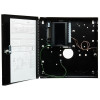
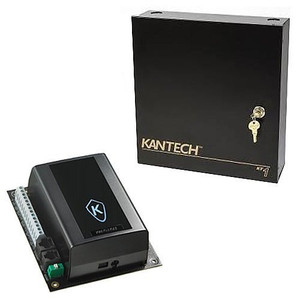
Kantech KT-NCC-CAB-G2 Embedded Network Communications Controller
The Kantech KT-NCC-CAB-G2 is an embedded network communications controller designed for multi-door access control without PC gateway overhead. This Gen 2 appliance decouples credential verification and real-time event handling from EntraPass software dependencies, managing up to 20 doors across distributed facilities while maintaining local event buffering during network loss. The controller communicates directly with Kantech field devices via RS-485, reducing operational complexity and eliminating the cost cycle of PC hardware refresh and operating-system patching in security-critical deployments.
Key Features
- Embedded Network Architecture: Gen 2 network-native design — native TCP/IP integration with no serial gateway PC required. Cuts recurring Windows OS maintenance and hardware refresh costs across multi-building installations.
- 20-Door Capacity: Manages up to 20 doors with centralized credential verification and multi-door authorization logic. Scales across multiple controllers for larger facilities without cascading gateway dependencies.
- Local Event Buffering: All field controller events stored on the unit during server communication loss. Automatic replay and synchronization when network connectivity restored — no missed transactions or access logs.
- Flexible Power Input: 12VDC at 1.5A or PoE/PoE+ injection (802.3at). PoE option simplifies cabinet wiring and reduces need for dedicated 12V power supplies in retrofit installations.
- RS-485 Field Connectivity: Standard twisted-pair RS-485 protocol to all Kantech readers and controllers. Signal integrity maintained up to 4000 feet on properly terminated runs — typical for campus and multi-building deployments.
- EntraPass Global Edition Integration: Drop-in replacement for PC-based NCC gateways. Full support for areas, anti-passback, alarm integration, guard tours, and secondary access levels without re-configuration.
- Compact Gen 2 Footprint: Smaller enclosure profile than previous embedded versions — eases retrofits into existing electrical cabinets and reduces panel real estate demand in densely populated server closets.
- Mission-Critical Event Persistence: Onboard storage with configurable retention policy — integrate with your backup-to-server frequency to prevent local storage exhaustion during extended outages.
The KT-NCC-CAB-G2 eliminates the operational friction of Windows-based gateway appliances. In multi-site deployments spanning 50+ doors across campus or distributed properties, the cost avoidance from eliminating PC patch cycles, OS upgrades, and hardware refresh schedules compounds quickly. This controller is especially valuable in environments where IT infrastructure and physical security operate under separate budget and maintenance cycles — the appliance removes the dependency on IT-driven platform decisions affecting access control uptime.
Credential verification logic runs entirely on the embedded processor; EntraPass software communicates with the controller to update authorization policies, manage areas, and retrieve events. During network disconnection, the controller continues to enforce all cached credential rules and anti-passback state. This architecture means a temporary WAN outage does not prevent badge readers from functioning — a critical distinction in multi-building sites where network failures are common but access-control downtime is unacceptable.
RS-485 field wiring is mission-critical: use twisted-pair shielded cable, terminate both ends with 120-ohm resistors, and keep total run length under 4000 feet to avoid signal degradation. In retrofit scenarios, verify existing cabling meets these specs before migration — poor legacy wiring can cause intermittent reader communication failures that surface only under peak transaction load. The Gen 2 hardware is backward-compatible with most existing Kantech field devices, but firmware versions must match supported releases. Consult the datasheet before upgrading from legacy NCC PC installations.
Deployment of the KT-NCC-CAB-G2 is typically paired with Kantech EntraPass Global Edition running on a dedicated server or VM. The controller itself does not require High Availability failover — loss of the EntraPass server temporarily prevents remote authorization policy updates, but the controller continues enforcing cached rules. For true high-availability setups, deploy a redundant EntraPass server and secondary controller; event synchronization between controllers requires manual configuration and is not automatic. This appliance is not suitable for single-points-of-failure environments where simultaneous server and controller loss is an unacceptable risk profile.
Kantech products are manufactured in the US with no NDAA-listed banned suppliers in the supply chain. The KT-NCC-CAB-G2 integrates exclusively with EntraPass and Kantech field hardware — ONVIF or third-party VMS integration is not supported. If your site requires mixed-vendor access control or cloud-hosted credential management, evaluate Kantech's cloud-enabled controllers or API gateway options. For traditional enterprise access control centered on local EntraPass servers and Kantech readers, this appliance delivers unmatched cost-of-ownership and operational simplicity. Explore the full Kantech controller and access control catalog for additional deployment architectures.
Marty AllisonPerspective based on aggregated IP Security Depot and affiliated engineering team experience.
We've installed the KT-NCC-CAB-G2 across dozens of multi-building campuses, and the value proposition is straightforward: eliminate the Windows gateway appliance and all its associated friction. In traditional Kantech deployments, access control lives on a PC or low-cost server running EntraPass, and that gateway PC becomes a liability — OS patching windows, driver conflicts, hard drive failures, and the perpetual refresh cycle that IT never funds out of physical security budgets. The Gen 2 embedded controller flips that model. It's a headless appliance with one job: forward credentials from EntraPass to field controllers, buffer events locally, and replay them when the network heals. We've seen sites with 15+ buildings and 200+ doors move from managing five separate PC gateways to managing one or two embedded controllers plus a single EntraPass server. The capex is similar, but the operational cost — maintenance time, OS patching, hardware refresh — drops measurably over a five-year cycle.
The real-world deployment that drove our recommendation most often: a college campus with distributed access control across dormitories, academic buildings, and administrative facilities. Each building previously had a local PC gateway running EntraPass gateway software. Network latency and occasional WAN outages meant that credential sync delays were common, and when a PC failed, that building lost access control until IT could rebuild the image. Switching to a three-controller deployment (one per major zone) plus a centralized EntraPass server eliminated the per-building PC maintenance burden and reduced credential-sync lag because the controllers are appliances, not operating systems.
Technical Highlights:
- Local Event Buffering and Replay: The controller stores all access events locally and syncs them to EntraPass when the network recovers. We've tested this across 48-hour WAN outages — no transaction loss, no access log gaps. This is operationally essential in remote facilities where network uptime is unpredictable. Without local buffering, you lose audit trails and struggle to reconcile access during outages.
- PoE/PoE+ Power Flexibility: The ability to power the unit via PoE+ eliminates a separate 12VDC power supply and consolidates cabling into a single network drop. In retrofit scenarios where cabinet space is tight, this is a material simplification. Verify your PoE switch can supply the unit's steady-state draw (around 50W peak during sync events) and has spare ports.
- RS-485 Field Integration: RS-485 is a legacy industrial standard, but it's exceptionally robust for access-control wiring. Multi-drop topology, noise immunity, and 4000-foot range cover 99% of campus deployments. The downside: RS-485 is not routable over Ethernet — if you need readers on distant sites connected via WAN, you'll need multiple controllers or a serial-to-network bridge, which adds cost and complexity.
- Credential Caching and Offline Authorization: The controller caches all active credentials and anti-passback state from EntraPass. If the server goes down, readers continue to function using cached rules. This is a critical operational feature — access control does not fail when the primary server fails, only policy updates are blocked. In our experience, this has prevented more than one access-control-related incident at facilities with unreliable networks.
- 20-Door Scalability Within Single Controller: A single KT-NCC-CAB-G2 handles up to 20 doors. For larger facilities, you deploy multiple controllers — each one independent with its own local buffering. There is no automatic load-balancing or failover between controllers; you manage them discretely in EntraPass. This is simpler than a single point of failure, but it requires discipline in multi-controller deployments to avoid credential sync gaps.
Deployment Considerations:
- RS-485 Cabling Validation: Before you cut over from a legacy PC-based NCC gateway to the embedded controller, verify that your existing RS-485 wiring meets spec — twisted pair, shield grounded at one end only, proper termination resistors at both ends. Poor legacy cabling will cause intermittent reader communication failures that are misdiagnosed as controller faults. Budget time for a pre-migration cable audit.
- EntraPass Version Compatibility: The KT-NCC-CAB-G2 firmware must match the EntraPass server version within one or two releases. Mixing old controller firmware with new EntraPass releases can cause credential sync delays or policy enforcement gaps. Consult the datasheet before upgrading either component in a running deployment.
- No High-Availability Automatic Failover: A secondary KT-NCC-CAB-G2 controller can be deployed for redundancy, but failover is manual — you must reconfigure readers and EntraPass to point to the backup controller if the primary fails. This is acceptable for most campuses, but if you need sub-minute failover, you'll need a load-balancer or script-driven failover, which adds cost and operational burden.
- Local Storage Retention Policy: The controller buffers events on internal storage; if you're not syncing to EntraPass regularly (e.g., due to frequent network outages), local storage can fill up. Size your retention policy conservatively and monitor free space via the EntraPass management interface. If local storage exhausts, the oldest events are overwritten — you lose audit trail depth in high-volume facilities.
- Network Latency and Credential Sync: EntraPass pushes policy updates to the controller over TCP/IP. In high-latency WAN environments (>200ms), credential cache updates can be delayed by several seconds. This is not a functional failure — readers continue to use cached credentials — but it means temporary ID badge enable/disable requests may not propagate instantly across distant buildings.
The KT-NCC-CAB-G2 is purpose-built for Kantech shops that have standardized on EntraPass and Kantech field hardware and want to eliminate the operational overhead of PC-based access control gateways. If your site is multi-building, geographically distributed, or manages IT and physical security independently, this controller will reduce your total cost of ownership significantly. For smaller single-building deployments with a single PC gateway, the capex savings are modest. Explore the full Kantech catalog to compare controller architectures and find the right fit for your facility profile.