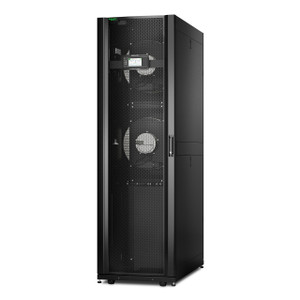
APC by Schneider Electric ACRD200 InRow RD 300mm Fluid-Cooled Air Cooling System
Overview
The ACRD200 is a 300mm-wide InRow RD fluid-cooled air cooling system designed to drop directly into a row of 42U racks — placing the cooling source within meters of the heat load rather than across a raised-floor plenum. That proximity eliminates the hot/cold air mixing that undermines traditional perimeter cooling, giving you a predictable, manageable thermal architecture instead of a best-guess one. The unit runs on 230V AC, draws 4,600W of power, and removes up to 10.92 kW of heat — a ratio that matters when you're specifying against dense compute or high-density data center cooling requirements. If your current cooling strategy relies on room-level units and you're watching inlet temps climb, the ACRD200 addresses the root problem by changing where the cooling happens, not just how much of it you apply.
Key Features
- 10.92 kW Cooling Capacity: At that removal rate, the ACRD200 can handle a fully loaded 42U rack of mid-density servers without throttling — meaningful if you're deploying GPU nodes, high-core-count CPUs, or stacked 1U/2U servers that collectively push past what perimeter units can reliably reach.
- 2,290 CFM Maximum Airflow: Moving nearly 2,300 cubic feet of air per minute means the unit can flush heat from even a densely populated row before it has a chance to recirculate. This is the spec to check against your actual rack watts-per-foot calculation.
- 300mm Form Factor — 42U Compatible: At 11.8 inches wide and 78.4 inches tall, the ACRD200 fits cleanly into a standard 42U row without consuming a full rack bay — it slots in as a column-unit between racks. Depth is 42.1 inches, matching typical 1000mm-deep rack enclosures.
- Fluid-Cooled Architecture: Rather than relying on refrigerant circuits and compressors, the InRow RD transfers heat to a facility chilled-water or glycol loop. This eliminates on-unit compressor noise and mechanical wear, and means cooling capacity scales with your chilled-water plant — not with adding more standalone DX units.
- Microprocessor Controller with Active Capacity Adjustment: The onboard controller monitors server inlet temperatures and adjusts cooling output in real time. You're not setting a static fan speed and walking away — the unit responds to load changes and keeps inlet temps within spec automatically. Visibility into operational health is built in, so you can see unit status without relying solely on external BMS polling.
- 4,600W Power Consumption at 230V AC: Single-phase 230V input keeps the electrical infrastructure simple in European and international data center environments. At 4,600W draw, plan for a dedicated 32A circuit per unit — the power consumption is real and needs to be in your rack PDU and UPS calculations.
- In-Row Deployment Eliminates Air Mixing: Traditional perimeter or overhead cooling lets hot exhaust recirculate before it reaches the cooling unit. By positioning the ACRD200 within the row — aligned with the APC by Schneider Electric InRow ecosystem — you enforce a direct hot-aisle/cold-aisle separation at the source. The result is measurable improvement in PUE for dense rows compared to room-based approaches.
- 438 lb Installed Weight: Factor this into your raised-floor or slab load rating before specifying. At nearly 440 pounds, the ACRD200 requires proper floor planning — particularly on raised floors with tile ratings under 2,000 lbs/sq ft.
Integration and Compatibility
The ACRD200 integrates into APC's InRow cooling family, designed to work alongside InRow RC and InRow RP units in mixed or phased deployments. The microprocessor controller supports centralized monitoring, and the unit is compatible with APC's EcoStruxure IT infrastructure management platform for facility-level visibility. The fluid loop requires a facility-side chilled-water or glycol supply — coordinate supply/return temperatures and flow rates with your mechanical engineer before finalizing the installation design. The 230V AC single-phase input is standard in EU and international data centers; North American deployments will require a step-up transformer or dedicated 230V feed. Verify your facility's chilled-water plant capacity before adding ACRD200 units — each unit places a real demand on the loop that compounds across a multi-unit row deployment. For broader power and UPS planning, account for the 4,600W draw per unit in your UPS sizing calculations.
Frequently Asked Questions
Q: What is the cooling capacity of the ACRD200?
A: The ACRD200 removes up to 10.92 kW of heat from the IT space at a maximum airflow of 2,290 CFM.
Q: What power supply does the ACRD200 require?
A: The unit requires 230V AC single-phase input and draws up to 4,600W. Plan for a dedicated 32A circuit in your electrical design.
Q: What rack height is the ACRD200 compatible with?
A: The ACRD200 is designed for use in rows of 42U rack enclosures and stands 78.4 inches tall with a 300mm (11.8 inch) width profile.
Q: Does the ACRD200 use a compressor or fluid cooling?
A: The InRow RD series uses fluid cooling — it connects to a facility chilled-water or glycol loop rather than using an on-board refrigerant compressor. This reduces mechanical wear and scales with your plant capacity.
Q: What is the warranty on the ACRD200?
A: The ACRD200 carries a 1-year manufacturer warranty per the product documentation.
Q: How much does the ACRD200 weigh, and are there floor load considerations?
A: The unit weighs approximately 438 lbs installed. Verify your raised floor tile ratings or slab capacity before placing the unit — this weight requires explicit floor load planning, especially on raised-floor environments.
The ACRD200 is one of those units where the spec that matters most isn't the headline cooling number — it's the 300mm form factor. At 11.8 inches wide, this unit physically fits between standard rack columns without consuming a bay, which is the only way in-row cooling actually works at scale. I've seen facilities spec in-row units and then discover the aisle geometry doesn't accommodate them; with the ACRD200, that 300mm profile is what makes or breaks the row layout before you ever power it on.
Technical Highlights:
- 10.92 kW removal at 2,290 CFM: That airflow volume means the unit is moving enough air to strip heat from a fully loaded 42U row in a single pass — you're not relying on multiple recirculation cycles to hit your target inlet temp.
- Fluid-cooled, no on-board compressor: Connecting to a chilled-water loop means no refrigerant management, no compressor cycling noise in the data hall, and cooling capacity that scales with your plant — not with adding more standalone DX units and their associated maintenance overhead.
- Microprocessor-controlled active adjustment: The controller doesn't just report — it actively trims cooling output to match real-time server inlet temps. In a mixed-load environment where compute density changes shift by shift, this prevents both over-cooling (wasted energy) and under-cooling (thermal throttling) without manual intervention.
Deployment Considerations:
- The 230V AC, 4,600W draw requires a dedicated circuit — don't share this with rack PDUs. In North American facilities without native 230V infrastructure, budget for transformer costs in your total deployment estimate.
- At 438 lbs, the ACRD200 needs explicit floor load sign-off before placement — particularly on raised floors. Get the floor tile rating confirmed before the unit ships, not after it arrives on the loading dock.
The ACRD200 is the right specification for a greenfield high-density compute row — purpose-built colocation pods, GPU cluster deployments, or HPC rows — where the thermal load per rack exceeds what perimeter cooling can reliably manage and where a chilled-water plant is already in place to serve the fluid loop.