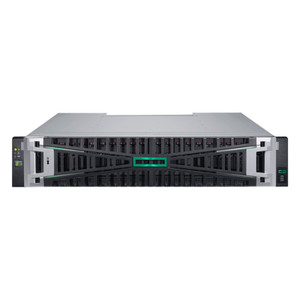
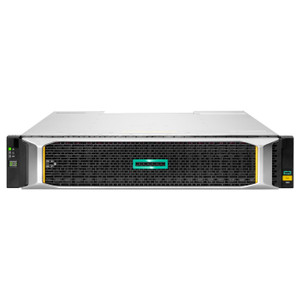
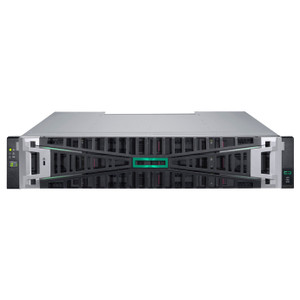
HPE P89071-B25 MSA 2070 LFF Dual-Controller 12Gb SAS Storage Array
The HPE MSA 2070 LFF is a 2U rack-mount storage array built for midrange enterprise workloads where dual-path SAS reliability, petabyte-scale capacity, and broad OS compatibility matter more than all-flash price tags. The P89071-B25 ships with two 12 Gb SAS controllers — each with 4 host ports — giving you eight total host-side connections and an active-active architecture that eliminates single points of failure at the controller layer. If you're sizing storage for a virtualization cluster, a secondary backup target, or a surveillance video repository that needs to grow over time, this platform is worth a close look at the HPE storage line.
Key Features
- Dual 12 Gb SAS Controllers (8 Host Ports Total): Two controllers, 4 ports each, means you wire redundant paths from every host — no single cable or controller failure takes down access. At 12 Gb SAS per port, you're well above the throughput ceiling most LFF spinning-disk arrays can saturate, so the fabric won't be your bottleneck as drives age or workloads grow.
- Up to 12 LFF Drives in the Base Array: The 2U base enclosure holds up to 12 large-form-factor HDDs or SSDs. LFF drives typically offer higher per-drive capacity at lower cost per terabyte compared to SFF — the right call when sequential throughput and raw capacity outweigh IOPS density requirements.
- Scalable to 2.88 PB: Add up to 9 expansion enclosures — either 2U 12-drive LFF or 2U 24-drive SFF, in any combination — and the array scales to roughly 2.88 PB usable (dependent on drive selection and RAID policy). That headroom means you commission this platform once and grow it in place rather than forklift-replacing hardware as retention requirements increase. See the full range of storage arrays for comparison models.
- Mixed LFF/SFF Expansion Flexibility: The ability to add SFF enclosures alongside LFF gives you a tiering path — spin up a few SFF SSD shelves for hot data or frequently-accessed indexes while keeping bulk capacity on LFF HDDs. You're not locked into a single drive geometry as workloads evolve.
- Broad OS Compatibility: Validated against Windows Server 2016/2019/2022, VMware vSphere 6.7, Red Hat Linux 8, and SUSE SLES 15 — the major hypervisor and OS stacks in enterprise data centers. If your environment runs any of these, driver and multipath support is confirmed. For edge-case OS versions, HPE SPOCK is the authoritative compatibility matrix. Consult your storage planning guide before committing to a non-listed OS.
- 2U Rack Footprint: Two rack units for the base array keeps it rack-efficient. If you add all 9 expansion shelves (each also 2U), the full stack is 20U — plan your rack layout before ordering if you're near capacity. Pair with a compatible rack enclosure sized for the full expansion depth.
Integration and Compatibility
The P89071-B25 (often searched as P89071 B25) integrates with the standard SAS host bus adapter ecosystem. Hosts connect via 12 Gb SAS HBAs — confirm your server's HBA model against HPE SPOCK for supported combinations. The dual-controller design supports multipath I/O on all listed operating systems; configure MPIO or DM-Multipath on the host side before presenting LUNs to avoid single-path exposure.
Expansion enclosures connect via SAS expander daisy-chain — cabling topology matters at scale. Review HPE's cabling guides for the specific mix of LFF and SFF shelves you plan to deploy; incorrect daisy-chain order can limit effective bandwidth to downstream shelves. For environments where the MSA 2070 will serve as a secondary storage tier beneath a primary NVMe array, the 12 Gb SAS backplane is adequate for sequential video, backup, and archival workloads but is not the right fit for sub-millisecond OLTP latency requirements.
Frequently Asked Questions
Q: How many host ports does the P89071-B25 provide?
A: The P89071-B25 includes two 12 Gb SAS controllers, each with 4 host ports, for 8 total host-side SAS connections. This supports redundant dual-path cabling from multiple hosts simultaneously.
Q: What is the maximum raw storage capacity of the MSA 2070 LFF with full expansion?
A: With up to 9 additional expansion enclosures (2U 12-drive LFF and/or 2U 24-drive SFF in any combination), the array can scale to approximately 2.88 PB depending on drive selection and RAID configuration.
Q: What operating systems are supported by the P89071-B25?
A: Validated OS support includes Windows Server 2016, 2019, and 2022; VMware vSphere 6.7; Red Hat Linux 8; and SUSE SLES 15. For additional or newer OS versions, consult HPE SPOCK for the authoritative compatibility matrix.
Q: Can I mix LFF and SFF expansion enclosures on this array?
A: Yes. The MSA 2070 supports adding up to 9 expansion enclosures in any combination of 2U 12-drive LFF and 2U 24-drive SFF shelves, giving you the flexibility to tier storage types as workloads evolve.
Q: What rack space does the base MSA 2070 LFF array require?
A: The base array occupies 2U. Each expansion enclosure also uses 2U, so a fully expanded configuration (base + 9 shelves) requires up to 20U of rack space.
Q: Is the P89071-B25 suitable for surveillance video storage?
A: Yes. The LFF drive support, multi-petabyte scalability, and dual-controller redundancy make this a practical fit for large-scale surveillance video repositories where sequential write throughput and capacity density matter more than low-latency random I/O.
The P89071-B25 is the configuration I reach for when a customer needs a proven dual-controller SAS platform with genuine multi-petabyte growth headroom and doesn't want to pay all-flash prices for workloads that are 90% sequential. The 2x 12 Gb SAS controllers with 4 ports each give you 8 host connections in 2U — enough to serve multiple hosts with full redundant pathing without buying a separate SAN switch for most mid-tier deployments.
Technical Highlights:
- Dual-Controller Redundancy: Two independent 12 Gb SAS controllers means a single controller failure doesn't interrupt I/O — hosts fail over to the surviving controller automatically when multipath is configured correctly on the host side.
- 2.88 PB Expansion Ceiling: Nine expansion shelves in any LFF/SFF mix is a meaningful headroom figure — most surveillance, backup, and archive workloads won't hit the ceiling before the hardware reaches end-of-support life, which reduces the risk of a forced mid-lifecycle forklift upgrade.
- Broad Hypervisor Validation: VMware vSphere 6.7, Windows Server 2022, Red Hat 8, and SUSE SLES 15 cover the overwhelming majority of enterprise virtualization stacks, so you're not working with community-tested drivers — these are validated combinations.
Deployment Considerations:
- Confirm your SAS HBA model in HPE SPOCK before ordering — the array itself is solid, but mismatched HBA firmware versions have caused intermittent path failures in practice. Don't skip the compatibility check even if the HBA brand looks right.
- If you're planning the full 9-shelf expansion, map your rack layout before the first shelf arrives — 20U of storage plus cabling clearance is a real space commitment, and retrofitting cable management after the fact is avoidable pain.
This platform is a strong fit for enterprise surveillance video repositories and virtualization secondary storage in environments running 20–200 cameras or more, where write-heavy sequential workloads, long retention windows, and the need for non-disruptive capacity growth are the actual design constraints — not IOPS per dollar.