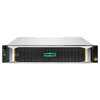
HPE P89130-B25 MSA 1060 SFF Dual-Controller SAS Storage Array
The HPE MSA 1060 — model P89130-B25 — is a 2U rack-mounted entry storage array built around dual 12 Gb SAS 2-port controllers, delivering a starting capacity footprint that scales to 2.95 PB with expansion enclosures. It targets SMB data centers, remote office deployments, and workloads running on mainstream operating systems where a compact, dual-controller SAN makes more sense than scaling up to a full mid-range array. If you need resilient shared storage without the licensing overhead and complexity of larger platforms, this is the tier to evaluate.
Overview
The P89130-B25 ships in a 2U chassis supporting up to 24 small form factor (SFF) drive bays, accommodating a mix of HDD and SSD depending on workload profile — sequential-heavy workloads can lean on spinning media for cost efficiency, while latency-sensitive applications benefit from an all-SSD configuration in the same chassis. Base array capacity reaches 737 TB; adding up to three HPE MSA 2060 expansion enclosures — available in 24-bay SFF or 12-bay LFF configurations — pushes usable raw capacity to 2.95 PB. That expansion ceiling matters for environments expecting to grow over a 3-to-5-year horizon without replacing the controller head.
Key Features
- Dual 12 Gb SAS 2-Port Controllers: Two independent controllers provide both performance headroom and fault tolerance. If one controller fails, the surviving unit continues serving I/O — a non-negotiable requirement for any shared storage serving production workloads. The 12 Gb SAS fabric doubles the per-lane bandwidth of the older 6 Gb generation, which matters when driving high-density SSD configurations where the interconnect is the bottleneck.
- 2U SFF Chassis with 24 Drive Bays: The small form factor drive profile keeps the physical footprint at 3.5 × 17.5 × 20.0 inches. SFF bays support higher drive counts per rack unit than LFF alternatives, so you can pack more capacity or IOPS density into a constrained colocation or edge rack without adding shelves.
- Scalable to 2.95 PB via Expansion Enclosures: The base 737 TB array is meaningful on its own, but the real value is the linear expansion path. Three additional HPE MSA 2060 enclosures scale capacity nearly four-fold without replacing the controller infrastructure you already paid for. Budget the expansion enclosures at procurement time if the project roadmap shows data growth.
- Mixed HDD and SSD Drive Support: All 24 SFF bays support both spinning and solid-state drives, so you can tier storage within a single enclosure — SSDs for the hot dataset, HDDs for warm or archival tiers — without buying a second system.
- Broad OS Compatibility: The array is validated against Windows Server 2022, 2019, and 2016; VMware vSphere 6.7; Red Hat Enterprise Linux 8; and SUSE SLES 15. For VMware shops in particular, shared SAN storage on a validated platform simplifies the vSAN alternative discussion. Verify current support matrix on HPE SPOCK before committing to a version not listed here.
- 2U Rack Form Factor: The 2U profile integrates cleanly into standard 19-inch racks alongside compute nodes. At 20 inches deep, verify front-to-back clearance in your specific cabinet before installation — shallow-depth racks used in some branch office deployments may require a cable management shelf behind the unit.
Integration & Compatibility
The P89130-B25 (often searched as P89130 B25) is compatible with the HPE MSA 2060 expansion enclosure family in both SFF 24-bay and LFF 12-bay configurations, allowing storage architects to mix drive form factors across the expansion shelf while keeping the controller head unified. Validated host OS support spans the major enterprise platforms — Windows Server, VMware vSphere, RHEL, and SUSE SLES — covering the majority of production server environments in mid-market data centers. For environments outside the listed OS versions, consult the HPE storage array SPOCK database for updated interoperability data before purchase.
Frequently Asked Questions
Q: How many drives does the HPE MSA 1060 P89130-B25 support in the base chassis?
A: The base chassis supports up to 24 SFF drive bays, accommodating a mix of HDD and SSD drives.
Q: What is the maximum capacity of the P89130-B25 with full expansion?
A: With up to three HPE MSA 2060 expansion enclosures attached, the total raw capacity reaches up to 2.95 PB. The base array alone supports up to 737 TB.
Q: What expansion enclosures are compatible with the HPE MSA 1060?
A: The HPE MSA 2060 expansion enclosure is compatible in two configurations: a 24-bay SFF model and a 12-bay LFF model. Up to three expansion enclosures can be added.
Q: Which operating systems are supported by the HPE MSA 1060?
A: Validated OS support includes Windows Server 2022, 2019, and 2016; VMware vSphere 6.7; Red Hat Enterprise Linux 8; and SUSE SLES 15. HPE SPOCK should be consulted for the most current interoperability matrix.
Q: How much rack space does the P89130-B25 require?
A: The array occupies 2U in a standard 19-inch rack. Physical dimensions are 3.5 × 17.5 × 20.0 inches (H × W × D).
Q: Does the HPE MSA 1060 have redundant controllers?
A: Yes. The P89130-B25 ships with two 12 Gb SAS 2-port controllers. Dual-controller architecture provides controller-level fault tolerance — if one controller fails, the other continues serving host I/O.
The P89130-B25 is the model I recommend when a client needs dual-controller SAS resilience in a 2U footprint without stepping into mid-range pricing. The pair of 12 Gb SAS 2-port controllers is the headline spec here — not because 12 Gb is exotic, but because having two of them means you are not planning around a single point of failure at the controller layer. That is the first question I ask any customer running shared storage on a production cluster.
Technical Highlights:
- Dual 12 Gb SAS Controllers: Two independent controllers at 12 Gb SAS means each path delivers double the bandwidth of the 6 Gb generation. More practically, it means a controller maintenance window or hardware failure does not take the array offline.
- 2.95 PB Expansion Ceiling: Starting at 737 TB and scaling to 2.95 PB by attaching up to three MSA 2060 enclosures is a real multi-year capacity runway. Size your switch fabric and cabling plant for the full expansion count at initial deployment — retrofitting cabling later in a live rack is avoidable friction.
- 24 SFF Drive Bays in 2U: Small form factor bays in a 2U chassis gives you the density to run a high-IOPS all-SSD profile or a mixed tiered layout in a footprint that fits most 1-post or 2-post telco racks as well as standard 4-post data center cabinets.
Deployment Considerations:
- Verify cabinet depth before racking — at 20 inches deep, this unit needs a standard 4-post rack with at least 24 inches of usable depth; shallow branch-office cabinets may not clear the rear cable plant.
- VMware vSphere 6.7 is the listed validation level; if your environment has moved to vSphere 7.x or 8.x, cross-check HPE SPOCK before committing — do not assume upward compatibility without a verified entry in the matrix.
This array is the right fit for a VMware or Windows Server cluster at a regional data center or a large branch office where shared block storage needs to stay online through a controller failure and has a realistic path to multi-petabyte scale over the next several years — without the cost and complexity of a full mid-range platform.