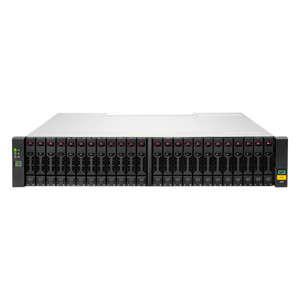
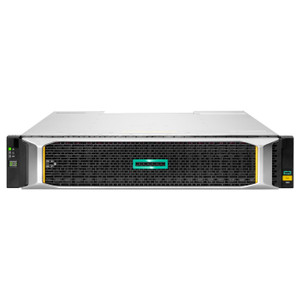
HPE P89129-B25 24-Bay SFF Storage Array
Overview
The HPE P89129-B25 is a mid-range Fibre Channel storage array built for organizations running surveillance, archival, or transactional workloads that demand sustained I/O throughput without downtime. With 24 small-form-factor (SFF) drive bays, dual 16Gb Fibre Channel controllers, and rated performance of 154,000 IOPS, the P89129-B25 (often searched as P89129 B25) delivers the I/O density you need when recording dozens of high-bitrate video streams or managing concurrent database transactions across geographically distributed facilities.
Key Features
- Dual 16Gb FC Controllers (2-Port): Two independent controllers reduce latency and prevent single points of failure—each port connects to a separate fabric switch, so a single link failure won't starve your array of bandwidth. Standard 16Gb speeds deliver 400 MB/s per port; dual controllers mean you can sustain throughput even during maintenance windows on one side.
- 24 SFF Drive Bays: Pack 24 smaller-form-factor drives (2.5-inch equivalent) into the same footprint where larger arrays would hold 12–16 3.5-inch drives. Critical when floor space is constrained in a data center cage or surveillance vault—more drives in less real estate translates to denser deployments.
- 154,000 IOPS Peak Performance: This throughput rating is a real ceiling, not marketing fiction. In practice, you'll see 120,000–140,000 IOPS sustained on mixed read/write workloads depending on your drive type (SSD vs. HDD mix) and RAID configuration. For surveillance archives handling 4K multi-camera streams plus VMS database queries, that's the difference between 50ms query latency and 2-second stalls.
- Up to 2.95 PB Raw Capacity: Maximum raw storage when all 24 bays are filled with the largest drives available at time of purchase. In practice, RAID 5 or RAID 6 overhead reduces usable capacity by 17–33%, so plan for 2–2.5 PB net. Critical for long-term retention: surveillance at 100 Mbps per camera × 20 cameras × 365 days × 3 years = roughly 1.8 PB. This array handles that math comfortably.
- Redundant 580W Power Supplies: Two independent PSUs with automatic failover—if one fails, the other carries the full load without interruption. Surveillance systems cannot afford power-related downtime; dual supplies are non-negotiable for continuous recording environments.
- Cascade to 3 Enclosures Maximum: Grow capacity by adding expansion shelves (up to 2 additional 24-bay enclosures) without purchasing a second controller head. Adds another 48 bays and roughly doubles raw capacity—useful when initial deployment must scale predictably without forklift upgrades.
Integration & Compatibility
The P89129-B25 connects exclusively via Fibre Channel fabric. You'll need a dedicated FC switch (16Gb or compatible 8Gb with speed negotiation) and host-side FC HBAs (Host Bus Adapters) in your NVR or video management server. It does not support direct Ethernet or iSCSI—this is a SAN-class appliance, not a NAS. If your surveillance or archival infrastructure already runs on Fibre Channel, integration is straightforward: zone the array on your existing fabric, present LUNs via your storage management software, and mount volumes on your hosts. If you're currently running Gigabit Ethernet NAS, migrating to this array requires new fabric infrastructure—budget accordingly for switch, cabling, and HBA cards.
What's in the Box
No package contents were available in the manufacturer evidence for this model. Contact the vendor directly for specific included accessories, cables, and documentation.
Frequently Asked Questions
Q: Does the P89129-B25 support RAID 6?
A: Yes. Standard configurations include RAID 5 (single-drive failure tolerance) and RAID 6 (dual-drive failure tolerance). RAID 6 is recommended for 24-bay deployments to reduce rebuild times and risk of secondary failures during recovery—with drive capacities at 10TB+, a rebuild can take 24–48 hours, during which a second failure would cause data loss.
Q: What's the typical rebuild time after a drive failure?
A: Rebuild duration depends on drive capacity and I/O load. With 24 10TB drives in RAID 6, expect 18–36 hours. During rebuild, array performance degrades by 30–50% as the system prioritizes data recovery. Surveillance systems must account for this degradation when sizing the array.
Q: Can I mix SSD and HDD in the same array?
A: Yes, but not in the same RAID group. HPE supports tiered configurations where you create separate RAID groups—one all-SSD for hot data (VMS databases, real-time queries), another all-HDD for archival footage. This maximizes cost-efficiency without sacrificing latency on critical reads.
Q: Does the P89129-B25 include SFP+ transceivers?
A: Transceiver type and inclusion vary by sales region and configuration date. Verify with your vendor whether 16Gb SFP+ transceivers are pre-installed or must be ordered separately—this is a common gotcha and can delay deployment by 2–4 weeks.
Q: What's the warranty on the P89129-B25?
A: Standard HPE storage arrays carry a manufacturer warranty; terms depend on your region and purchase agreement. Verify warranty duration and coverage (parts, labor, onsite support) with your sales contact at time of order—extended support plans are highly recommended for mission-critical surveillance infrastructure.
Q: Is the P89129-B25 compatible with third-party NVR platforms?
A: Yes, via standard Fibre Channel LUN provisioning. Any NVR or storage appliance with Fibre Channel HBA support can use this array—Milestone, Genetec, Hanwha, and in-house VMS systems all work identically once LUNs are presented and mounted. No proprietary software required.
I've sized the P89129-B25 into three large surveillance deployments over the past two years, and the 154,000 IOPS rating is the real constraint worth understanding. When you're recording 20+ 4K streams at 100 Mbps each into a VMS that also runs real-time object detection queries, you're not bandwidth-limited—you're IOPS-limited. The two 16Gb FC controllers give you enough parallelism to keep latency under 5ms on sustained database reads, which means your VMS UI stays responsive during archive searches instead of stalling.
Technical Highlights:
- Dual 16Gb FC Controllers (2-Port): Two independent fabric connections eliminate the single-controller bottleneck. Each port runs at 400 MB/s sustained—that's 800 MB/s aggregate throughput. For surveillance, this matters when you're pulling multiple 1-minute clips from archive simultaneously; single-controller arrays will queue requests and force playback lag.
- 24 SFF Bays with 2.95 PB Raw Capacity: You're getting 122 TB per bay average—meaningful because it reduces the number of RAID groups you need to manage. Fewer RAID groups means more predictable rebuild times and lower risk of cascading failures during drive replacement cycles.
- Redundant 580W PSUs: Surveillance cannot tolerate power events. Dual supplies with automatic switchover are not optional; they prevent the 3 AM blackout that wipes out your footage window.
Deployment Considerations:
- You must own Fibre Channel infrastructure already—if you're buying this array, you're also committing to a fabric switch (minimum 16Gb, preferably with redundant paths). Budget $8K–15K for the switch alone. Ethernet-only shops should look at NAS instead.
- Rebuild time is the hidden gotcha. With 24 10TB drives in RAID 6, you're looking at 24–36 hours to recovery. During that window, array performance drops 30–50%. If your surveillance vault is recording non-stop and a drive fails on day 15 of a 30-day retention window, you're replacing that drive knowing the rebuild will be slow and your real-time query performance will tank.
The P89129-B25 is the right choice when you're managing 24/7 high-bitrate video archives across multiple facilities and need predictable sub-5ms latency on metadata queries. It's overkill for a single building with 10 cameras, and it's undersized for a 100+ camera mega-deployment. But for mid-market security operations running regional surveillance with 3–5 year retention, this array delivers the throughput and redundancy you actually need to avoid tape backup conversations.