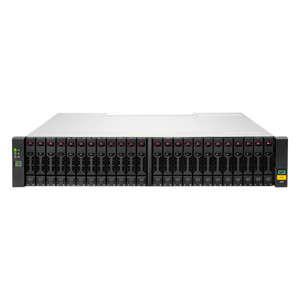
HPE P89059-B25 MSA 2060 LFF Fibre Channel Storage Array
The HPE MSA 2060 LFF (P89059-B25) is a mid-range SAN storage array purpose-built for organizations requiring high-performance block storage with redundant Fibre Channel connectivity and scalable capacity. This controller configuration pairs dual 16Gb Fibre Channel 4-port controllers with twelve 3.5-inch LFF (Large Form Factor) drive bays, delivering 395,000 IOPS and supporting up to 9 expansion enclosures for capacity growth without controller replacement.
Key Features
- Dual 16Gb FC 4-Port Controllers: Two independent controller paths ensure no single point of failure in your SAN fabric. Each controller owns 2 FC ports (4 total), allowing active/active load balancing or N+1 failover — critical for 24/7 operations where even brief controller downtime cascades across your infrastructure.
- 395,000 IOPS Performance: Sustained 395K IOPS means predictable latency under load for databases, transaction processing, and video surveillance backends running parallel read/write workloads. This spec translates directly to how many concurrent streams (camera ingestion, archival retrieval) the array handles without queue buildup.
- 12 LFF Drive Bays: The 12-bay chassis accepts 3.5-inch SAS/NL-SAS drives up to 20TB each, supporting configurations from mixed-speed (SSD + HDD tiering) to all-HDD for cost-optimized surveillance retention. LFF form factor means superior thermal management and lower cost-per-TB than SFF alternatives.
- 7.37 PB Max Raw Capacity: With 9 expansion enclosures daisy-chained via SAS, total raw capacity reaches 7.37 petabytes without adding controllers. For surveillance retention at scale (hundreds of cameras, 30+ day holding windows), this capacity range eliminates the need for separate archive appliances.
- 2x580W Redundant Power Supplies: N+1 power redundancy means a single PSU failure does not halt I/O or force a graceful shutdown. Hot-pluggable design allows in-service replacement — no downtime for power supply maintenance or upgrade.
- 10GbE iSCSI and 12Gb SAS Host Connectivity: Beyond Fibre Channel, the P89059-B25 accepts 10GbE iSCSI initiators and supports SAS-attached hosts. This multi-protocol flexibility lets you connect VMware vSphere clusters (iSCSI), bare-metal surveillance NVRs (Fibre Channel), and legacy SAS-attached backup appliances from a single array without protocol conversion overhead.
Integration and Compatibility
The P89059-B25 integrates into existing SAN fabrics via standard 16Gb Fibre Channel. VMware vSphere, Hyper-V, Linux iSCSI initiators, and appliance-based surveillance platforms all connect through industry-standard protocols — no proprietary drivers or compatibility certifications required beyond baseline Fibre Channel or iSCSI support. Expansion enclosures (JBOD) connect via 12Gb SAS, preserving controller ports and allowing capacity growth independent of host fabric expansion.
The array supports snapshots, replication, and thin provisioning via onboard controller firmware — no additional licensing for basic data protection. For multi-site surveillance deployments, asynchronous replication to a remote P89059-B25 or compatible HPE MSA array protects against datacenter loss.
Frequently Asked Questions
Q: Does the P89059-B25 support mixed SSD and HDD configurations for tiering?
A: Yes. The 12 LFF bays accept any mix of SAS SSD and NL-SAS HDD. Typical tiering deploys fast SSD for hot metadata and recent camera feeds (current week), with NL-SAS HDD for longer-term archival (weeks 2–4). The array's RAID and thin-provisioning policies automate data movement between tiers.
Q: What is the warranty on the P89059-B25?
A: Manufacturer warranty details are available from your reseller or HPE account team. Standard enterprise warranties cover parts and labor; support tiers (4-hour, next-business-day, etc.) are configurable at purchase.
Q: Can the P89059-B25 be used in a synchronous replication setup?
A: Synchronous replication depends on network latency and bandwidth. Over local area network (same campus), synchronous mirroring to a remote array minimizes RPO to near-zero. Over WAN links, asynchronous replication is standard practice. Consult HPE pre-sales engineering for your specific distance and latency profile.
Q: How many cameras can the P89059-B25 support in a surveillance backend?
A: Camera throughput depends on frame rate, resolution, compression, and retention days. A typical 4MP 30fps stream consumes ~15 Mbps. At 395K IOPS and multi-megabyte I/O sizes, the P89059-B25 sustains hundreds of concurrent ingest streams. The actual limit is drive bandwidth and capacity, not controller IOPS. Contact pre-sales engineering with your camera codec and retention policy for a detailed sizing.
Q: What expansion enclosures are compatible with the P89059-B25?
A: HPE MSA expansion enclosures (12Gb SAS-attached JBOD) are compatible. Standard LFF JBOD enclosures with 24 or 60 bays extend the array. Verify the specific enclosure model with your reseller — JBOD compatibility spans generations, but SAS firmware revision alignment may apply.
Q: Is the P89059-B25 NDAA Section 889 compliant?
A: NDAA and TAA compliance depend on component sourcing and final assembly location. Contact HPE or your reseller with your security compliance requirements — NDAA-compliant configurations may require lead-time and specific component selections.
The HPE P89059-B25 is a purpose-built SAN appliance for mid-scale surveillance and mission-critical data workloads that demand both performance and redundancy. The dual 16Gb FC controllers with 4 ports each, paired with 395,000 sustained IOPS, mean this array doesn't become a bottleneck when you scale from dozens to hundreds of simultaneous camera streams.
Technical Highlights:
- 395K IOPS across dual controllers: Eliminates queue latency during peak ingest (all cameras recording simultaneously) and parallel archive retrieval. For surveillance backends with 200+ cameras recording 24/7 at 4MP 30fps, this performance ceiling prevents the "slow playback" problems you'd hit with undersized arrays.
- 16Gb Fibre Channel dual-path: Active/active failover means a controller or even fabric switch loss doesn't silence ingest. Your surveillance NVRs stay connected to at least one controller path without intervention — critical for compliance-driven industries where recording gaps trigger alarms.
- 12 LFF bays + 9 expansion enclosures (7.37 PB raw): A single P89059-B25 with one expansion JBOD handles 500+ high-resolution cameras at 30 days retention without adding controllers. Expansion is SAS-attached, so you don't consume additional Fibre Channel fabric ports as capacity grows.
Deployment Considerations:
- SAS fabric cabling between the main array and JBODs must meet HPE's length and termination specs — budget for certified SAS cables (typically 3–6 meters). Field experience shows routing these cables through existing cable trays is straightforward, but tight racks require pre-planning.
- The 2x580W PSU redundancy protects against single power loss, but generator or UPS sizing must account for the full array + host servers + fabric switches in your datacenter plan. A brief power glitch that triggers UPS cutoff will cause storage disconnect for all hosts unless your UPS holds both the array and the Fibre Channel switches.
Position the P89059-B25 for deployments with 200–500 mid-to-high-resolution cameras, multi-site synchronous replication, and the need for zero-downtime controller maintenance. If you're running a single-datacenter setup with <100 cameras and can tolerate brief snapshots for PSU swaps, a smaller HPE MSA variant saves capital. If you need petabyte-scale retention for compliance (financial services, healthcare), the P89059-B25 with expansion enclosures grows with you without controller replacement.