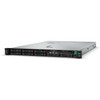
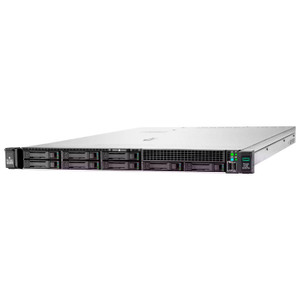
HPE P39366-B21 ProLiant DL365 Gen10+ 1U Rack Server
The HPE ProLiant DL365 Gen10+ (P39366-B21) is a 1U rack server built around AMD's EPYC 7262 processor — a 16-core, 3.2 GHz platform that delivers dense compute in a single rack unit. With 32GB of DDR4 Smart Memory installed, eight small-form-factor drive bays, and a 500W HPE FlexSlot power supply, this configuration targets workloads that need reliable throughput without consuming multiple rack units. It fits naturally into compact equipment rooms, branch server closets, and edge deployments where rack space is constrained but processing headroom matters. P39366-B21 (often searched as P39366 B21) ships as a validated HPE factory configuration.
Overview
The ProLiant DL365 Gen10+ line is HPE's AMD-EPYC-based answer to single-socket workloads that outgrow traditional Xeon configurations in core-count efficiency. The 7262 specifically offers 16 cores at a 3.2 GHz base — a practical frequency for latency-sensitive applications like video management software, edge analytics engines, or database workloads that can't tolerate the clock-speed penalty that comes with higher core counts. The 1U chassis keeps the footprint narrow, which matters in co-location environments billed by the rack unit and in field-deployed edge racks where depth and weight are real constraints. At 50 lbs and 39 inches deep, plan accordingly for rail kit selection and two-person installation.
Key Features
- AMD EPYC 7262, 16 Cores at 3.2 GHz: Higher per-core frequency than the many-core EPYC variants — the right trade-off when your application scales vertically before horizontally. Video management systems, encoding pipelines, and edge analytics engines typically benefit more from clock speed than raw core count.
- 32GB HPE DDR4 Smart Memory (1P): Sufficient headroom for a VMS instance managing 32–64 camera streams at moderate bitrates, or a database backend handling concurrent read-write workloads. Memory is expandable via the DL365 Gen10+ DIMM slots — verify slot count and maximum supported capacity for your scaling plan.
- 8x Small Form Factor Drive Bays: Eight SFF bays in 1U give you meaningful storage density without expanding to a 2U chassis. Paired with the HPE Smart Array P408i-a SR Gen10 controller, you can configure RAID 5 or RAID 6 across SAS or SATA drives — appropriate for continuous-write workloads like 24/7 video retention or transactional databases needing parity protection.
- HPE Smart Array P408i-a SR Gen10 Controller: An enterprise-class storage controller with read/write cache and support for SAS and SATA devices. The SR (Smart Array) designation means it handles RAID offload in hardware, reducing CPU overhead on storage-intensive workloads — important when the EPYC cores are already tasked with compute.
- 128MB L3 Cache: The EPYC 7262's large L3 cache reduces memory latency for data sets that fit within cache — relevant for analytics workloads processing repeated lookups on smaller data structures.
- HPE iLO Standard (Embedded Remote Management): iLO is HPE's out-of-band management interface. It allows you to power-cycle, view console, and monitor hardware health remotely without OS involvement — essential for servers deployed in remote edge locations or unmanned equipment rooms where physical access is impractical.
- HPE 1GbE 4-Port OCP3 Adapter: Four gigabit Ethernet ports ship in the OCP3 slot, providing enough bandwidth for most VMS or edge server deployments. The OCP3 format keeps the adapter replaceable without a riser card, and the base slot leaves three expansion slots available for additional NICs, HBAs, or GPU cards depending on your workload requirements.
- 1U Rack Form Factor, 3 Expansion Slots: Three PCIe expansion slots in a 1U chassis is a practical count — enough to add a higher-bandwidth NIC, a GPU for inference workloads, or additional storage. Verify slot type and length against your add-in card requirements before ordering.
- 500W HPE FlexSlot Power Supply: A single 500W FlexSlot PSU covers the base configuration. If uptime requirements are critical, evaluate whether a second PSU in the FlexSlot bay is warranted — redundant power is not included in this configuration and should be scoped during deployment planning.
Integration and Compatibility
The DL365 Gen10+ integrates with HPE's broader management ecosystem: HPE OneView (requires download) handles multi-server orchestration and lifecycle management from a single pane of glass, while iLO Advanced (requires a license purchase) adds enhanced features including graphical remote console, power capping, and Federation management across iLO-enabled servers. The server's OCP3 NIC slot accepts HPE OCP3-compatible adapters, allowing network upgrades without touching the PCIe expansion slots. For storage expansion, the P408i-a controller supports HPE Smart Carrier drives with predictive failure alerting. Confirm VMS or application vendor certification for AMD EPYC Gen3 platforms before deploying production workloads — most enterprise VMS vendors (Milestone, Genetec, Avigilon) publish validated server configurations.
Frequently Asked Questions
Q: What processor does the HPE P39366-B21 ship with?
A: The P39366-B21 ships with a single AMD EPYC 7262 processor — 16 cores, 3.2 GHz base clock, 128MB L3 cache.
Q: How much memory does the P39366-B21 include, and is it expandable?
A: It ships with 32GB of HPE DDR4 Smart Memory. The DL365 Gen10+ platform supports additional DIMM slots for expansion — consult the HPE QuickSpecs for the maximum supported capacity for this chassis.
Q: Does the P39366-B21 include redundant power supplies?
A: No. This configuration includes a single 500W HPE FlexSlot Power Supply. If your deployment requires power redundancy, a second FlexSlot PSU should be added and verified against the chassis power bay configuration.
Q: What storage controller is included, and what RAID levels does it support?
A: The HPE Smart Array P408i-a SR Gen10 Controller is included. It supports hardware RAID including RAID 0, 1, 5, 6, and 10 across SAS and SATA drives in the eight SFF drive bays.
Q: How is the P39366-B21 managed remotely?
A: Remote management is via HPE iLO Standard, which is embedded — no separate hardware required. It provides out-of-band power control, hardware health monitoring, and console access. iLO Advanced features require a separately purchased license. HPE OneView is available for multi-server orchestration and requires a separate download.
Q: What is the physical footprint of the P39366-B21?
A: The server occupies 1U of rack space. Physical dimensions are 39 inches deep x 23 inches wide x 9 inches tall, and it weighs 50 lbs. Plan for appropriate rail kit selection and two-person installation at this weight class.
The P39366-B21 is a purpose-built 1U platform I'd steer toward edge VMS deployments and branch-office server rooms where rack density is the binding constraint and you still need genuine compute — not a thin client or a NUC. The EPYC 7262's 3.2 GHz base clock is the spec that matters here: it's the higher-frequency end of the EPYC 7002 line, which translates to better per-stream responsiveness in video analytics and transcoding workloads compared to the many-core, lower-clock EPYC variants.
Technical Highlights:
- AMD EPYC 7262 at 3.2 GHz: 16 cores at higher base frequency means the platform handles latency-sensitive workloads — VMS decoders, real-time analytics, database queries — without the clock-speed penalty of 32- or 64-core EPYC configurations that trade frequency for core density.
- HPE Smart Array P408i-a SR Gen10: Hardware RAID offloads parity calculations from the EPYC cores, which matters on 24/7 write-intensive workloads like continuous video retention across all eight SFF bays. The SR controller also supports predictive drive failure alerting via Smart Carrier drives.
- Embedded iLO Standard: Out-of-band management without an add-in card means remote power cycling and hardware health visibility even when the OS is unresponsive — the baseline requirement for any server deployed in an unmanned equipment room or remote edge site.
Deployment Considerations:
- The single 500W FlexSlot PSU is the configuration as shipped — if your site's uptime SLA requires N+1 power, scope the second PSU before deployment, not after. The FlexSlot bay supports a second PSU but it is not included here.
- At 39 inches deep and 50 lbs, verify your rack's depth clearance and cable management scheme before ordering rail kits. Many shorter 4-post racks in edge/branch deployments top out at 28–32 inches usable depth.
This is the right platform for a branch security operations node running 30–60 camera streams on Milestone or Genetec where the site has a standard 19-inch rack, limited U-space, and needs a server the remote hands team can manage from headquarters via iLO without dispatching a technician.