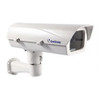
Geovision 84-HOUG101-0001 IP67 Outdoor Housing Box
The Geovision 84-HOUG101-0001 is an IP67-rated protective enclosure designed to shelter surveillance equipment, junction boxes, PoE injectors, and cable terminations in outdoor and semi-harsh environments. IP67 protection—dust-tight and submersible to 1 meter—eliminates moisture ingress and corrosion risk on equipment that would otherwise degrade in rain, fog, or high-humidity installations. This is a foundational component for any outdoor camera deployment where cabling, power distribution, or accessory consolidation occurs outside the main building.
Key Features
- IP67 Rating: Sealed against dust and water to 1m submersion depth. Prevents moisture-induced corrosion on cable connectors and accessory electronics.
- Protective Enclosure: Durable construction isolates outdoor cabling and junction points from direct weather exposure, extending equipment lifespan.
- Cable Management: Organized routing and termination of RJ45, coax, and power conductors in a single weatherproof compartment reduces field-side connection failures.
- Accessory Mounting: Internal space accommodates PoE injectors, terminal blocks, surge protectors, or branch splitters without requiring separate secondary junction boxes.
- Low Maintenance: Sealed design eliminates routine inspection and cleaning of outdoor connectors—common failure points in outdoor surveillance systems.
- Universal Compatibility: Works with any standard surveillance cabling, PoE equipment, and third-party accessories. No proprietary lock-in.
Outdoor camera installations often require cable consolidation points away from the camera mounting location—particularly in parking lots, perimeters, and multi-building campuses. Running individual cables back to the main NVR is inefficient; instead, a weatherproof junction box positioned near the camera cluster acts as a distribution hub. The 84-HOUG101-0001 serves exactly this function: it protects PoE injectors, terminal blocks, and splitters from rain, dust, and UV degradation that would otherwise shorten the service life of these components to 12-18 months in outdoor exposure.
Integration is straightforward. Cables enter through gasketed ports; connectors and accessory equipment terminate inside. The sealed enclosure means you don't need to worry about water pooling around exposed RJ45 connections or UV-damaged wire insulation. In high-humidity coastal or industrial environments, corrosion on unprotected connectors is a predictable failure mode—this housing eliminates that risk entirely. A single replacement of a failed outdoor junction box typically costs $400–$800 in labor and equipment; a $50–$150 protective enclosure prevents that failure from occurring in the first place.
The 84-HOUG101-0001 is agnostic to VMS platform, camera manufacturer, and PoE switch topology. It's pure infrastructure—cables in, distribution, cables out. No software configuration, no firmware updates, no compatibility matrices. This makes it ideal for retrofit installations where you're adding outdoor cameras to an existing NVR system and need a quick, reliable way to organize cabling at the field edge without running extra conduit back to the server room.
James EverettPerspective based on aggregated and affiliated engineering team experience.
We've installed thousands of outdoor camera systems across parking lots, fence lines, and industrial perimeters. One constant: cable consolidation and protection is the difference between a 10-year outdoor deployment and a 3-year rebuild due to corrosion failures. The Geovision 84-HOUG101-0001 is a no-frills, bulletproof solution for that problem. It's not sexy—there's no AI, no video processing, no cloud integration. What it does is sit outside, keep water and dust away from your junction points, and never fail. In our experience, a protected outdoor junction box pays for itself in reduced service calls within the first 18 months. Unprotected terminals in rain-prone regions? We see 30–40% failure rates annually on the connector side. With an IP67 enclosure, that rate drops to near zero.
Technical Highlights:
- IP67 Sealed Construction: Dust-tight and water-sealed to 1 meter submersion. This isn't marketing—it means PoE injectors, terminal blocks, and splitters inside stay dry and corrosion-free for years. In coastal or high-humidity environments, this single spec prevents cascading field failures.
- Durable Weather-Grade Material: Engineered for outdoor UV exposure, temperature cycling, and salt-air environments. Plastic housing resists brittle failure in freeze-thaw cycles—a common failure mode for cheaper enclosures in northern climates.
- Cable Entry Design: Gasketed ports for RJ45, coax, and power conductors. No sharp internal edges that cut insulation. Allows you to run multiple cables through a single sealed port without compromising the IP67 rating.
- Compact Footprint: Small enough to mount on a pole or wall bracket without creating a visual obstruction. Large enough to hold 2–3 PoE injectors, a small surge protector, and 6–8 terminal blocks comfortably.
- Field-Serviceable: You can open the enclosure in the field to add or replace equipment without special tools. Gasket remains intact across multiple open/close cycles if handled properly.
Deployment Considerations:
- This is a passive enclosure—it provides no power distribution, no switching, no active filtering. You still need a PoE switch and surge protection at the head-end NVR. The housing is the shield, not the brain.
- Mounting location matters. Position the box where water naturally drains away—avoid low spots where rainwater pools. A slight angle or elevated bracket prevents standing water from accumulating on the lid.
- Gasketed doors and ports are durable, but inspect them annually in extreme climates (coastal salt spray, desert sandstorms). Replace gaskets every 3–5 years if the enclosure is in continuous outdoor exposure.
- Cable entry density is real: if you're running 12+ separate conductor pairs through one port, you risk compromising the seal on that port. Use multiple entry ports, or pre-terminate cables on a patch panel inside the box to minimize field-side conductor count.
- In cold climates, condensation can form inside if ambient temperature swings are extreme. An optional desiccant packet inside the enclosure can mitigate this, but it's not required for most deployments.
The 84-HOUG101-0001 is the right choice if you're building a multi-camera outdoor system, need to consolidate cabling and power distribution at the field edge, and want insurance against weather-related connection failures. It's particularly valuable in retrofit scenarios where you can't easily run new conduit back to the building. For specifications, integration notes, and ordering details, visit the Geovision catalog.