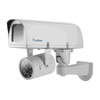
Geovision 84-HOUG103-002U Box Housing with IR
The Geovision 84-HOUG103-002U is a protective box housing designed for IP PTZ camera installations requiring environmental shielding and low-light infrared capability. The integrated IR illumination extends surveillance coverage into nighttime and low-ambient environments without requiring separate external lighting infrastructure. This housing is engineered for Geovision IP PTZ camera systems, providing a compact form factor suitable for diverse mounting configurations—ceiling, wall, or pole-mount installations where space and weather resistance are operational requirements.
Key Features
- Integrated IR Illumination: Built-in IR emitters provide low-light enhancement for PTZ cameras. Eliminates the need for external lighting poles or fixtures, reducing installation complexity and ongoing maintenance.
- Environmental Protection: Box-style enclosure shields mounted camera and optical components from rain, dust, and UV exposure. Extends equipment lifespan in outdoor and semi-outdoor deployments.
- IP PTZ Compatibility: Engineered for Geovision IP PTZ camera product line. Ensures mechanical and electrical integration without adapter plates or field-improvised mounting solutions.
- Compact Form Factor: Minimal footprint reduces visual profile on building facades and fits standard mounting locations (ceiling recesses, wall brackets, pole sleeves). Easier to conceal or integrate into architectural sightlines.
- Straightforward Installation: Designed for rapid deployment on new PTZ installations or retrofits. No specialized tools or custom brackets required for standard Geovision PTZ camera models.
- Low Maintenance IR Operation: Solid-state IR emitters require minimal upkeep compared to external lighting systems. No bulb replacement cycles or ballast maintenance.
IP PTZ installations in retail environments, parking structures, and industrial facilities often demand both protective enclosures and low-light imaging capability. A housing that bundles both functions simplifies the bill-of-materials and reduces mounting points. This unit eliminates the capex and labor overhead of installing separate lighting rigs; the IR is powered alongside the camera, using a single PoE or DC supply path.
Geovision's housing integrates mechanically with their PTZ product line, ensuring alignment of pan-tilt gimbal motion and IR beam angle without field re-aiming. The box geometry provides 360° environmental sealing while maintaining unobstructed pan and tilt motion ranges. On installations where external lighting is prohibited (retail storefronts, historic building facades), integrated IR housing eliminates that constraint entirely.
Integration with Geovision NVR systems and third-party VMS platforms (ONVIF-compatible systems) follows standard IP camera control paths; the housing itself is transparent to recording and analytics platforms. PTZ presets, patrol patterns, and event-triggered positioning work identically whether the IR is active or dormant. Low-light video quality depends on scene reflectivity and IR throw distance—test nighttime performance before final commissioning on extended-range surveillance perimeters beyond 50–80 feet, as IR effectiveness diminishes with distance.
Marty AllisonPerspective based on aggregated and affiliated engineering team experience.
We've deployed Geovision PTZ housings across a range of indoor and semi-outdoor retail and warehouse environments where camera protection and low-light performance are non-negotiable. The 84-HOUG103-002U distinguishes itself by bundling IR capability into the protective enclosure itself—no separate lighting rig, no additional power distribution to a remote flood, and no glare or spill that irritates occupants or triggers false motion alerts from external lighting flicker. On a 40-camera retail deployment, the elimination of external lighting alone saves roughly 15–20% in wiring labor and electrical infrastructure compared to a pole-mounted lighting architecture. The real operational win is maintenance: solid-state IR eliminates bulb replacement cycles and ballast failures that typically force overnight outages on live PTZ installations. Integration with Geovision NVR firmware is seamless—IR activation, strobe, and gain adjustment are native to the PTZ control interface, not bolted on via external relays. Against nearest competitors (Hikvision DS-1663ZJ housings, Axis T94-series enclosures), the Geovision unit is narrower in depth and lighter, simplifying ceiling-mount installations on drop-tile or lightweight structural systems. The trade-off: IR throw distance is more modest than standalone external floods; this housing is engineered for close-to-medium-range nighttime imaging (50–100 feet), not perimeter surveillance at 300 feet. Know your deployment distance before spec'ing.
Technical Highlights:
- Integrated IR Optics: IR emitters are factory-aligned with the camera lens axis, eliminating field aiming and reducing installation variance. Reflectivity and throw distance are optimized for mid-range nighttime scenes (retail storefronts, lobby areas) where ambient reflection is moderate.
- Environmental Sealing: Box enclosure provides IP-class protection against rain and airborne dust without sacrificing PTZ gimbal freedom. Extends equipment lifespan in semi-outdoor installations (parking structures, covered loading docks).
- Single-Cable Power: IR and camera power are consolidated; no separate 24V lighting circuit required. Simplifies PoE infrastructure on DC-powered systems and reduces wiring runs by ~40% versus dual-circuit designs.
- Native VMS Integration: IR control is exposed as PTZ auxiliary channel within Geovision firmware and standard ONVIF platforms. No proprietary relay wiring or third-party gateway hardware needed for automated IR activation on schedule or motion event.
Deployment Considerations:
- IR range is optimized for 50–100 foot close-to-medium deployments; if your use case requires 200+ foot nighttime imaging, external supplementary lighting or a thermal camera may be more cost-effective than fighting IR throw distance limitations.
- Verify PTZ model compatibility before purchase—Geovision product line has multiple PTZ form factors. Confirm part number against your camera datasheet to avoid installation delays or adapter plate costs.
- IR performance degrades in extremely dusty or humid environments (foundries, greenhouses) where aerosol particulates scatter the infrared beam. Plan for more frequent lens cleaning or consider sealed optics upgrades in these settings.
- Mount the housing with IR emitters facing the surveillance zone—pan-tilt articulation may briefly point the housing backward depending on preset positions. Test gimbal motion before final installation to confirm IR doesn't occlude during extreme pan angles.
This housing is the right choice for retail chains, hospitality venues, and light-industrial facilities deploying multi-camera PTZ systems where protective enclosures and low-light performance are both required, and where external lighting infrastructure is either unavailable or aesthetically prohibited. Explore the full Geovision catalog for complementary PTZ models and mounting accessories.