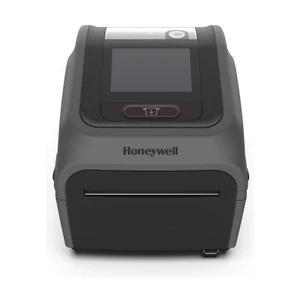
Honeywell PC45D110000201 B1 Direct Thermal Industrial Label Printer
The Honeywell PC45D110000201 B1 is a compact, production-grade direct thermal printer engineered for high-volume labeling in warehouse, manufacturing, distribution, and logistics environments. It delivers consistent, scannable output for shipping labels, compliance documentation, product identification, and asset tracking without the consumable cost or ribbon-management overhead of thermal transfer technology.
Key Features
- Direct Thermal Printing (203 or 300 DPI, user-selectable): Skip the ribbon cartridges. Direct thermal eliminates consumable costs and maintenance cycles — meaningful savings across hundreds of labeling jobs daily. Choose 203 DPI for standard clarity on 4×6 shipping labels or step up to 300 DPI when barcode density or fine detail matters (smaller QR codes, dense 2D matrix codes). Resolution switching doesn't require a printer swap.
- Maximum Print Width 102 mm (4.0 inches): Covers the vast majority of warehouse label stock — standard 4×6 shipping labels, 4×5 compliance stickers, narrow shelf labels. If you need wider media (6 inches or more), this isn't the match; consider a larger desktop model in the thermal printer family.
- WiFi 5 (802.11 a/b/g/n/ac) + Ethernet (10/100 Mbps) + USB 2.0 + Bluetooth 5.1: Deploy wirelessly in warehouse aisles without losing the stability of hardwired Ethernet at the dock. WiFi 5 multi-band reduces congestion in busy facilities with dozens of mobile devices. Bluetooth 5.1 allows direct pairing to inventory tablets or handheld scanners for small-footprint labeling stations. Ethernet provides fallback in high-noise RF environments or where wired deployment is enforced by IT policy.
- HTTPS Encryption for Network Communications: Credentials and print job data traverse the network encrypted, meeting enterprise security audit requirements without added integration complexity. This reduces friction when deploying into regulated supply chains or healthcare logistics.
- Compact Desktop Form Factor (10.7 kg / 23.6 lbs): Fits standard desk or shelf space alongside shipping stations. No integrated display simplifies the footprint and eliminates a common failure point, though configuration requires network access and management tools (WMS integration or cloud print portal).
- LPR (Line Printer Remote) Analytics & Remote Monitoring: Monitor print queue depth, job success/failure, and consumable status remotely. Early warning on jams or thermal head wear prevents surprise downtime during peak volume periods — critical when a single printer failure backs up dozens of shipments.
- Android-Compatible Mobile Device Integration: Pair mobile devices for label preview and job submission directly from warehouse management or ERP applications, reducing dependency on fixed workstations and enabling operators to print labels from anywhere on the dock or receiving area.
Integration & Deployment Considerations
The PC45D110000201 B1 integrates into WMS (Warehouse Management System), ERP (Enterprise Resource Planning), and cloud-based print management platforms via standard protocols—Ethernet, WiFi, and USB. Its multi-connectivity strategy addresses both modern wireless deployments and legacy enterprise infrastructure, reducing the risk of stranded hardware during network transitions. The dual-resolution capability (203/300 DPI) means you can start with standard density, then reconfigure for higher detail without swapping hardware.
Direct thermal's zero-ribbon footprint is especially valuable in high-velocity environments where label volume and speed matter more than durability—once a label ships or goes to inventory, it's consumed. However, for applications requiring labels that survive months of shelf life, harsh chemical exposure, or extreme temperature swings (cold-chain logistics, outdoor equipment tagging), thermal transfer with wax-resin ribbon delivers superior longevity; evaluate your label retention requirements before committing to direct thermal. Label selection and thermal technology trade-offs are worth a brief review if you're new to the format.
When to Choose a Different Model
If your labeling volume is under 100 labels per day or you're printing only occasional asset tags, an entry-level compact desktop model may reduce capital cost. If you require print widths of 6 inches or wider (pallet labels, large compliance stickers), step up to a wider desktop or industrial series in the Honeywell industrial printer catalog. If label durability over months is a requirement, consider thermal transfer models with ribbon capability — the consumable cost trades off against label lifespan and chemical resistance.
Frequently Asked Questions
Q: Can the PC45D110000201 B1 work with my existing WMS or ERP platform?
A: Yes. The printer integrates via standard protocols—Ethernet, WiFi, USB—and supports LPR (Line Printer Remote) for remote queue management. Most modern WMS and ERP systems include driver support for Honeywell thermal printers. Verify your platform's documentation or contact your integration partner to confirm driver availability for this model.
Q: What's the difference between 203 DPI and 300 DPI printing on the PC45D110000201 B1?
A: 203 DPI provides standard label clarity suitable for most 4×6 shipping labels and standard barcodes. 300 DPI delivers finer detail, making it ideal for dense 2D codes (QR, Data Matrix) or when label space is tight. You can switch resolutions via software without changing any hardware.
Q: Is the PC45D110000201 B1 suitable for cold-chain or outdoor asset tagging?
A: Direct thermal labels are designed for short-term use—once a label ships or is consumed, it's no longer in the supply chain. For outdoor tagging or labels that need to survive months in cold storage or harsh chemical environments, thermal transfer with wax-resin ribbon offers superior durability. Evaluate your label retention timeline before choosing direct thermal.
Q: Does the printer support mobile device printing?
A: Yes. Bluetooth 5.1 allows direct pairing to Android tablets and handheld scanners, enabling label submission from warehouse management apps without requiring a fixed workstation. WiFi 5 also supports wireless printing from cloud-based label management portals.
Q: What happens if I lose WiFi connectivity?
A: The PC45D110000201 B1 supports Ethernet fallback (10/100 Mbps) and USB direct connection, so you have multiple paths to the printer. If you're in a high-noise RF environment or require guaranteed connectivity, deploy the printer wired via Ethernet at a dock station and use USB or wireless backup for secondary areas.
Q: Does the printer include an integrated display or keypad?
A: No. The PC45D110000201 B1 has no built-in display, which reduces its footprint and eliminates a common failure point. Configuration and job submission are handled via network management tools, mobile apps, or your WMS/ERP platform.
Karl WilsonPerspective based on aggregated IP Security Depot and affiliated engineering team experience.
The PC45D110000201 B1 is a pragmatic choice for high-velocity warehouse and fulfillment operations where direct thermal's zero-consumable footprint and selectable 203/300 DPI resolution make financial and operational sense. The dual-band WiFi 5 (802.11 a/b/g/n/ac) with 10/100 Mbps Ethernet and Bluetooth 5.1 gives you flexibility to deploy at dock stations, mobile stations, or mixed environments without a network redesign. That multi-path connectivity strategy significantly reduces the risk of a single printer becoming a bottleneck during peak labeling periods.
Technical Highlights:
- Selectable 203/300 DPI Resolution: Start at 203 DPI for standard barcodes and standard-density labels (4×6 shipping labels are the norm here). If barcode scanning fails or you need finer QR code density, reconfigure to 300 DPI via software—no printer replacement required. This flexibility is valuable when requirements tighten mid-deployment.
- Multi-Connectivity (WiFi 5 + Ethernet + USB + Bluetooth 5.1): WiFi 5 dual-band reduces congestion in RF-heavy warehouses with dozens of concurrent mobile devices. Ethernet (10/100 Mbps) provides rock-solid throughput at fixed dock stations and serves as failover if WiFi degrades. Bluetooth 5.1 pairs directly to handheld scanners and tablets for mobile label stations. This redundancy means a single RF outage doesn't halt operations.
- HTTPS Encryption for Network Communications: Print job data and credentials are encrypted in transit, meeting SOC 2 and most supply-chain audit requirements without adding integration overhead. This is table-stakes in regulated verticals (pharma, food & beverage, defense contracting) and eliminates a common friction point during compliance reviews.
- 102 mm (4.0-inch) Print Width: Covers 95% of standard warehouse label stock (4×6 shipping labels, 4×5 compliance stickers, narrow shelf labels). If your facility needs 6-inch pallet labels or wide compliance stickers, the PC45D110000201 B1 is not a fit—plan for a wider desktop or industrial-series printer instead.
- Compact Desktop Form (10.7 kg / 23.6 lbs): Fits beside a shipping station without dominating desk real estate. No integrated display or keypad simplifies the design and eliminates a likely failure point (displays are common trouble spots), but it means configuration and queue management depend on network access and WMS/ERP integration.
Deployment Considerations:
- Label Durability Trade-off: Direct thermal is a one-way ticket—labels fade and may become unreadable after months in sunlight or extreme heat/cold. If your labeling application requires a label to survive outdoor storage, cold-chain logistics, or chemical exposure, thermal transfer with wax-resin ribbon is the correct choice. Understand your label lifespan requirement before committing to direct thermal.
- Zero-Consumable Cost Benefit Requires High Volume: Direct thermal saves money on ribbon cartridges only if you're printing hundreds of labels daily. If your facility averages fewer than 50 labels per day, the capital cost of a thermal printer may not amortize quickly against the ribbon savings. For low-volume operations, consider a lower-cost entry-level model.
- Network Configuration Dependency: The PC45D110000201 B1 has no local display or standalone control interface. All setup, firmware updates, and job troubleshooting route through network tools, your WMS, or a cloud print portal. If your IT team is unfamiliar with network printer provisioning, budget for a brief integration and training phase.
- WiFi 5 vs. Ethernet Latency: In high-congestion RF environments (busy warehouses with dozens of active devices), WiFi latency can introduce queuing delays during peak print volume. For mission-critical dock stations, always deploy the PC45D110000201 B1 wired via Ethernet and reserve WiFi/Bluetooth for secondary or mobile labeling points.
The PC45D110000201 B1 excels in fulfillment centers, distribution hubs, and manufacturing plants where label volume is steady and durability requirements are short-term (labels are consumed as goods ship). Pair it with Ethernet at fixed stations and WiFi for mobile carts, and you eliminate a class of printer-related bottlenecks common in under-provisioned facilities.