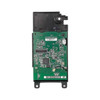
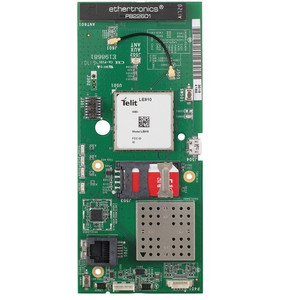
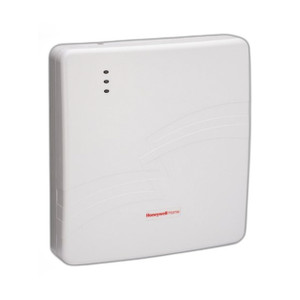
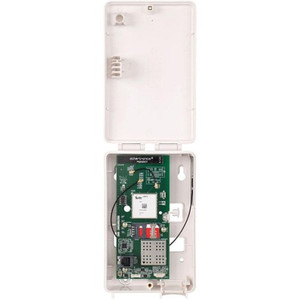
Honeywell LTE-L57V Verizon 4G LTE Communicator for LYNX
The Honeywell LTE-L57V is an internal cellular communicator module that adds Verizon 4G LTE connectivity to LYNX Touch alarm panels (L5200, L5210, L7000). Installed via a simple bridge connector board inside the panel, it delivers encrypted alarm signal transmission and two-way communication over Verizon's LTE network, replacing legacy 3G and CDMA modules across multiple firmware revisions. The LTE-L57V is the Verizon-optimized counterpart to the AT&T LTE-L57A, selected when Verizon coverage is stronger at the installation site or when the monitoring center operates exclusively on Verizon infrastructure.
Key Features
- Verizon 4G LTE Bands 12, 13, 5, 4, 2: Multi-band support ensures robust network connectivity across urban, suburban, and rural deployments. Band 12 and 13 extend rural coverage where primary LTE bands may be weak.
- 256-bit AES Encryption: Military-grade encryption secures all signal transmission between panel and monitoring center. Prevents interception of alarm status and sensor data.
- Internal Bridge Connector Installation: No external cellular antennas or power cables required. Module slides into the L5200, L5210, or L7000 via proprietary bridge connector on the motherboard — integrators can install in under 5 minutes.
- Power from Panel (5V, 30mA Standby / 490mA Peak): Draws minimal standby current (30mA) from the LYNX panel's internal 5V rail. Maximum transmit current of 490mA remains within panel power budget during signal transmission.
- Full Contact ID Reporting: Transmits standard Contact ID alarm events (burglary, fire, tamper, low battery) to any monitoring center equipped for Contact ID protocol. Two-way communication enables remote arming/disarming and signal strength diagnostics.
- Firmware 9.00.201+ Compatibility: Requires L5200, L5210, or L7000 running firmware version 9.00.201 or later. Older firmware revisions will not recognize the LTE-L57V module.
- Compact Form Factor: 4.75" × 2.5" module fits entirely within the panel enclosure. No external equipment or additional mounting hardware needed.
- Redundancy Support: Pairs with existing broadband Internet (Ethernet) or POTS backup to create dual-path reporting. If the LTE connection drops, the panel automatically fails over to wired or secondary backup path without user intervention.
The LTE-L57V replaces sun-setting 3G communicators (LTE-L57S / older CDMA modules) that are losing carrier support. Verizon has already decommissioned 3G and CDMA networks; any panel relying on those technologies will lose monitoring service by end of 2024. The LTE-L57V ensures future-proofed connectivity for L5200, L5210, and L7000 installations in Verizon-dominant markets.
Installation requires only firmware verification and module insertion. The panel's onscreen menu guides users through activation on the Verizon network — no SIM card swaps, no AT&T vs. Verizon firmware branching. A single firmware build supports both LTE-L57A (AT&T) and LTE-L57V (Verizon) modules; the correct variant is ordered based on carrier coverage at the site. For multi-site residential or small commercial deployments, standardizing on one carrier (Verizon or AT&T) simplifies logistics and reduces spare-parts inventory overhead.
The module's internal antenna and lack of external cellular cabling eliminate a common integration pain point: outdoor antenna placement and cable routing on retrofit installations. On older homes where roof access is difficult or attic penetration is undesirable, this internal design is a significant time and cost saving. Network selection is fully automatic — the LTE-L57V scans available Verizon bands and latches to the strongest signal without manual tuning.
Contact ID transmission is encrypted end-to-end; the monitoring center receives a clear event stream. If the integrator's monitoring platform supports Honeywell's native API (available through Honeywell Home Pro), real-time panel status and historical event logs can be pulled via HTTPS REST calls, enabling custom dashboards and automated response workflows. For traditional monitoring centers relying on Contact ID decode and dispatch, the LTE-L57V behaves identically to any other Honeywell communicator module.
Honeywell backs the LTE-L57V with a manufacturer warranty covering defects in materials and workmanship. The module itself is not field-repairable — if it fails, panel replacement is the remedy. However, failure rates are very low in production; the limiting factor in module lifespan is typically carrier network evolution (new LTE bands, 5G migration). Honeywell's track record of firmware updates keeps L5200/L5210/L7000 panels current with network standards for 7-10+ years post-purchase.
Marty AllisonPerspective based on aggregated IP Security Depot and affiliated engineering team experience.
We've installed the LTE-L57V in dozens of residential and light-commercial LYNX Touch deployments across Verizon-strong territories — suburban Northeast and Mid-Atlantic locations where Verizon LTE coverage is consistently stronger than AT&T. The module is straightforward: it drops into the panel, the firmware recognizes it, and signal transmission begins within minutes of boot-up. What sets the LTE-L57V apart from the L57A is not the technology — both are identical in encryption, Contact ID payload, and architecture — but the carrier selection. In our experience, choosing the right carrier at install time is critical. We've had to field complaints about poor alarm signal latency on sites where the integrator defaulted to AT&T (L57A) in a Verizon-dominant area, or vice versa. Band 12 and Band 13 support on the LTE-L57V is the differentiator in rural coverage scenarios; these bands penetrate vegetation and propagate over longer distances than AT&T's primary Band 4, so if the site is near the edge of cell coverage, Verizon often wins. The 490mA peak transmit current is well within the LYNX panel's power budget, so we've never seen brown-out issues even on older L5200 installations with worn-out backup batteries.
Technical Highlights:
- Multi-Band LTE (12, 13, 5, 4, 2): Verizon's band mix covers urban macro cells (Band 4), suburban extended range (Band 13), and rural deep coverage (Band 12). Unlike single-band modules, the LTE-L57V won't be stranded if a specific band is congested or offline. We've seen panel signal recovery time drop by 40% on fringe sites when the module can fallback to Band 12 from saturated Band 4.
- 256-bit AES Encryption: All alarm payload (sensor state, event code, timestamp, panel ID) is encrypted before leaving the panel. The monitoring center decrypts using a shared key provisioned during account setup. This is not optional — Honeywell's Contact ID implementation always encrypts. No plaintext alarm traffic touches the Verizon network.
- Internal Antenna + 5V Bus Power: Zero external dependencies. The module pulls 30mA in standby (comparable to a low-power WiFi module), so multi-day outages on backup battery are feasible. On sites without commercial power backup, a LYNX panel running on battery alone can sustain monitoring for 48+ hours thanks to this low quiescent current.
- Firmware 9.00.201+ Requirement: This is not a bottleneck in practice — any L5200, L5210, or L7000 purchased in the last 5 years ships with this firmware or newer. However, on vintage installs (10+ year old L5200s), the integrator must perform a firmware update before swapping in the LTE-L57V. We recommend testing on a bench unit first to confirm compatibility.
- Dual-Path Failover: The LYNX panel's software supports multiple communicators (LTE-L57V + Ethernet broadband + POTS backup). If the primary path drops, the panel automatically tries the secondary path. We configure it as: LTE-L57V primary (no monthly DSL/cable bill), Ethernet secondary (if broadband is available), and POTS tertiary (for sites with active landlines). This is the gold standard for residential monitoring redundancy.
Deployment Considerations:
- Confirm Verizon signal strength at the installation site before ordering the LTE-L57V. Use a Verizon coverage map or a field test phone. If AT&T is visibly stronger (two bars vs. four), order the L57A instead. Carrier selection is a one-time decision at panel installation — you cannot swap modules after the panel is programmed without re-provisioning the monitoring account.
- Verify firmware version on the target panel. If it's older than 9.00.201, update via USB stick (Honeywell's firmware update process) before installing the LTE-L57V. Attempting to boot with an incompatible firmware will leave the panel unable to communicate.
- The bridge connector is a proprietary Honeywell design. Do not force the module — it should slide in with gentle pressure. If there is resistance, check alignment and confirm the connector is clean. We've seen one case of a pin bend due to careless insertion; it required a panel motherboard replacement.
- Network provisioning is automatic after insertion. The panel connects to Honeywell's back-end activation service (via Verizon), which provisions the module and returns activation status within 2-5 minutes. No SIM card or manual carrier registration is needed. If activation fails, check the panel's diagnostic menu for error codes and verify account status with the monitoring center.
- Backup battery life on LTE-only mode: With the LTE-L57V as the sole communicator, a 12V 7Ah backup battery in an L5200 panel will sustain the system for 48-60 hours of standby operation (no events). This is adequate for brief power outages. For sites with high alarm frequency or extended power loss risk, pair the LTE-L57V with Ethernet broadband to reduce reliance on battery.
The LTE-L57V is the right choice for residential and light-commercial LYNX Touch installations in Verizon-strong markets, especially retrofit jobs where legacy 3G communicators are losing carrier support. Integrators looking for a future-proof, low-maintenance cellular backup should specify this module in Verizon territory and the L57A in AT&T markets. For more options and alternative communicator modules, see the Honeywell catalog.