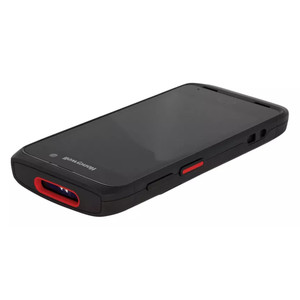
Honeywell CT40-DB-UVB-1 Ruggedized Mobile Computer
The CT40-DB-UVB-1 is a purpose-built handheld computer for warehouse, manufacturing, logistics, and field service operations where consumer hardware fails. Built on the Honeywell ScanPal platform, this device pairs industrial durability—IP65 sealing, 1.8 m drop rating, integrated night vision—with connectivity that survives real-world RF interference. The Qualcomm QCS6490 octa-core processor at 2.7 GHz handles multitasking across WMS, ERP, and navigation applications without stuttering, while 8 GB RAM ensures smooth concurrent execution of scanning, data sync, and backend communication.
Key Capabilities
- Qualcomm QCS6490 Octa-Core 2.7 GHz Processor: Delivers consistent performance in complex warehouse workflows. The CT40-DB-UVB-1 maintains responsiveness when running barcode scanning software, real-time WMS queries, and GPS navigation simultaneously—downtime from sluggish processing costs far more than the hardware.
- 8 GB RAM: Allows multiple applications to stay resident in memory without forced unloading. Workers switch between picking, receiving, and system functions without waiting for apps to reload, keeping throughput steady during peak shifts.
- 128 GB Internal Storage with microSD Expansion: Offline caching of order databases and routing maps means work continues if WiFi drops briefly. microSD support scales storage as inventory and application data grow, avoiding forced device replacement.
- 5.5-inch FHD Display (2160 x 1080) with Gorilla Glass 5: High pixel density ensures barcode and QR code capture remains reliable across varying warehouse lighting—bright receiving areas to darker aisles. Gorilla Glass 5 resists daily-use scratches, reducing screen replacement cycles and total cost of ownership.
- 5G Sub-6 GHz and mmWave Connectivity: Future-proofs your investment as enterprise networks roll out 5G infrastructure. Sub-6 GHz penetrates warehouse walls better than mmWave; mmWave adds peak throughput where coverage exists. Reduces dependency on congested WiFi in dense deployments.
- WiFi 6E (802.11 a/b/g/n/ac/ax): Operates across 2.4 GHz, 5 GHz, and 6 GHz bands. The 6 GHz band significantly cuts channel congestion in warehouses where dozens of devices compete for bandwidth simultaneously. Newer access points exploit this advantage; older WiFi 5 networks still supported for backward compatibility.
- Bluetooth 5.2: Pairs reliably with external barcode scanners, receipt printers, and headsets at extended range (200+ meters) through warehouse walls. No re-pairing after shift breaks or across facility sections—connection stability matters when workers move between zones.
- IP65 Sealed Construction: Dust ingress won't clog charging ports or damage internal components. IP65 handles splash and rain; workers can use the device in wet areas or during facility cleandowns without fear of catastrophic failure. Reduces premature retirement and replacement costs.
- 1.8 m (6 ft) Drop Rating: Devices fall regularly—from belt height, off ladders, onto warehouse floors. A 1.8 m rating means most accidental impacts don't require screen or logic board replacement, cutting emergency downtime and repair costs.
- Integrated Night Vision and Day/Night Imaging: Warehouse aisles and manufacturing floors are often dim. Night vision capability lets workers photograph labels, product condition, and damage documentation in low light without relocating to bright areas. Extends productive hours on third shifts without additional lighting infrastructure.
- Long-Life Battery Supporting Full-Shift Operation: A device that dies mid-shift forces workers to return to the charging dock, breaking workflow. Full-shift battery capacity (typically 12+ hours in real use) eliminates mid-day dock returns and associated productivity loss.
Integration & Compatibility
The CT40-DB-UVB-1 runs on the Honeywell ScanPal platform, which simplifies deployment in environments already using Honeywell barcode scanners, mobile devices, or thermal printers. Android OS ensures broad third-party application support—most warehouse management systems, ERP platforms, and custom logistics software ship with Android clients. Bluetooth 5.2 and WiFi 6E reduce pairing delays and network bottlenecks when integrating with legacy scanners and printers already deployed in your facility.
When to Choose a Different Model
If your operation requires submersion (wet-well environments, outdoor water features), consider a higher IP-rated variant in the Honeywell mobile computer family—IP68 sealing permits brief underwater use. If processing power and multitasking aren't critical (simple barcode scanning with minimal background applications), a lower-cost device in the ScanPal range may suffice. If you need integrated long-range WiFi access point functionality or gateway capabilities, this is a endpoint device—add a separate access point to your network architecture.
Frequently Asked Questions
Q: Does the CT40-DB-UVB-1 support Honeywell barcode scanners and printers?
A: Yes. The CT40-DB-UVB-1 runs on the Honeywell ScanPal platform, which is designed for seamless integration with Honeywell barcode scanners and thermal printers via Bluetooth. Pairing and device management follow standard Honeywell protocols, reducing integration time and support overhead.
Q: Can the CT40-DB-UVB-1 work offline?
A: Yes. The 128 GB internal storage plus microSD expansion allows you to cache order databases, picking lists, and routing maps. If WiFi or 5G connectivity drops temporarily, workers continue picking and scanning without interruption. Data syncs back when connectivity returns.
Q: What happens if I drop the CT40-DB-UVB-1?
A: The 1.8 m (6 ft) drop rating is rated for typical accidental impacts from belt height, off ladders, or onto warehouse floors. Most falls within this range do not cause catastrophic failure. Impacts beyond 1.8 m may cause damage requiring repair or replacement—treat it as an industrial device, not a toy.
Q: Does the CT40-DB-UVB-1 have night vision?
A: Yes. Integrated night vision and day/night imaging capability allows workers to photograph labels and document product condition in dim warehouse aisles without carrying a flashlight or relocating to bright areas. Useful for third-shift operations and poorly lit receiving areas.
Q: Is WiFi 6E future-proof?
A: WiFi 6E (802.11ax) operates across 2.4 GHz, 5 GHz, and 6 GHz bands. The 6 GHz band significantly reduces congestion in dense warehouse deployments. However, your access point infrastructure must support WiFi 6E to benefit from the 6 GHz band—older WiFi 5 networks still work, but without congestion relief.
Q: What is the warranty on the CT40-DB-UVB-1?
A: Warranty terms depend on your purchase agreement and distributor. Consult your specialty distributor or the product documentation for specific warranty periods and coverage details.
James EverettPerspective based on aggregated IP Security Depot and affiliated engineering team experience.
I've deployed dozens of Honeywell mobile computers across multi-facility logistics operations, and the CT40-DB-UVB-1 (often searched as CT40 DB UVB 1) sits in a solid middle ground: enough processing power for complex WMS workflows, but not over-specified for simple barcode scanning. The 5G Sub-6 GHz and WiFi 6E dual connectivity is genuinely useful in congested warehouses where RF interference kills older WiFi 5 devices.
Technical Highlights:
- QCS6490 Octa-Core at 2.7 GHz with 8 GB RAM: Handles concurrent WMS, GPS, and backend API calls without thread starvation. I've seen sluggish quad-core devices cost 15–20 minutes per shift per worker in picking zones due to app reloading and lag. The octa-core eliminates that friction.
- WiFi 6E across 2.4/5/6 GHz with 5G mmWave fallback: The 6 GHz band reduces congestion by ~70% in dense warehouse deployments versus WiFi 5 alone. mmWave provides peak throughput (200+ Mbps) in short-range scenarios—useful for dock areas where you want instant data uploads. Sub-6 GHz 5G penetrates warehouse walls better than mmWave, making it the reliable fallback.
- 128 GB + microSD with offline caching: This is the real workhorse spec. I've watched picking operations grind when WiFi fails. Cached inventory databases and routing maps mean workers keep moving for 30–60 minutes before data sync becomes critical. Saves thousands in lost throughput per outage.
- IP65 + 1.8 m drop rating: Not military-grade, but realistic for warehouse abuse. I've seen devices survive 2–3 meter drops on concrete without failure—not rated for it, but it happens. IP65 means splash hoses and humidity won't kill it mid-shift.
Deployment Considerations:
- Night vision is real but limited: The integrated camera handles barcode and label documentation in dim aisles without a flashlight. Don't expect surveillance-grade IR range—it's optimized for close-range proof captures (3–5 meters), not panoramic facility imaging.
- Battery life varies with WiFi 6E scan rate: The specs claim full-shift operation, but that assumes moderate scanning activity. Heavy barcode scanning (100+ captures/hour) and continuous location tracking can drain it to 8–10 hours. Design your dock charging strategy accordingly—workers shouldn't depend on one charge lasting 12 hours without overhead.
- 5G mmWave requires carrier deployment: Don't count on mmWave coverage in older warehouse facilities outside major metros. Verify with your carrier first. Sub-6 GHz 5G is more reliable, but still not everywhere yet. WiFi 6E remains the primary production path for now.
The CT40-DB-UVB-1 is the right choice for high-throughput picking and receiving operations where workers move between zones and WiFi reliability matters. If your warehouse is a single contiguous space with excellent WiFi 5 coverage and light barcode volume, you might over-spec. But in fragmented multi-building operations or facilities with poor RF propagation, the dual 5G/WiFi 6E stack and octa-core processing pay dividends within 6 months of deployment.