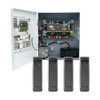
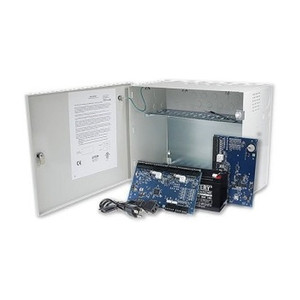
Honeywell MPA4MPXPSU 4-Door Access Control System
Overview
The Honeywell MPA4MPXPSU is a wired 4-door access control platform built for mid-to-large commercial facilities requiring centralized credential management and deterministic lock control. Unlike wireless or hybrid systems, the MPA4MPXPSU's hardwired topology eliminates RF interference concerns — critical in industrial facilities, data centers, and hospitals where environmental noise from equipment or RF shielding can degrade wireless performance. The controller manages credential verification and relay-based lock activation across four independent door zones, each with isolated outputs and status feedback. This means you deploy one controller instead of four single-door units, reducing installation labor and simplifying credential policy management across a facility.
Key Features
- 4-Door Control Architecture: Manages four independent access points simultaneously, each with dedicated relay output for electronic strikes, magnetic locks, or motorized mechanisms — avoiding the per-door controller clutter that slows retrofit projects.
- Hardwired Topology: Eliminates wireless latency and RF interference; every credential read and lock command executes with deterministic timing, important for time-critical secure zones and facilities subject to environmental RF shielding (Faraday-cage server rooms, RF-contaminated industrial floors).
- Multi-Protocol Credential Support: Accepts proximity cards, smart cards, and emerging mobile credential formats via standard reader interface modules — allows you to retain existing reader infrastructure during controller upgrades without wholesale credential replacement.
- Relay-Based Lock Control: Direct 24VDC relay outputs for any electric strike or electromagnetic lock; no proprietary lock ecosystem lock-in, and integrates with existing mechanical security specifications without rewiring.
- Real-Time Access Logging: Timestamped event records for every access attempt — credential ID, door zone, lock confirmation — stored locally on the controller and readable by enterprise management platforms for compliance audits and incident investigation.
- Local Decision Logic: Credential validation and lock sequencing execute on the controller itself; if the WAN drops or the management server goes offline, doors continue to unlock for authorized credentials without network dependency — a failsafe posture for facilities that can't tolerate extended lockout.
- Door and Lock Status Monitoring: Sensor inputs report door ajar state and lock position feedback in real-time; integrates with third-party access management and SIEM platforms to detect forced entry, prop-open conditions, or lock solenoid faults before they become security incidents.
- RS-485 and TCP/IP Integration: Serial multi-device networking (RS-485) for small deployments; networked variants support TCP/IP for centralized monitoring on enterprise security platforms — standard ONVIF-adjacent protocols avoid proprietary middleware cost.
- Field-Installable DIN-Rail Form Factor: Mounts on standard industrial DIN rail; modular reader and lock interface connectors allow expansion or retrofit without pulling new wiring or replacing the entire enclosure — critical for phased facility upgrades.
- Failsafe/Failsecure Modes: Configurable lock behavior during power loss or communication failure — failsafe (unlock on power loss) for life-safety; failsecure (lock on power loss) for high-security zones — no need for separate controllers per security posture.
Integration & Compatibility
The MPA4MPXPSU connects to standard commercial access management platforms via RS-485 (serial multi-device) or TCP/IP networking. It accepts input from Honeywell and third-party proximity readers, smart card readers, and mobile credential modules without requiring proprietary integration drivers. Relay outputs work with any 24VDC electric strike or electromagnetic lock listed in standard commercial specifications — no proprietary lock hardware required. Integration with third-party access management software, Honeywell security panels, and enterprise SIEM systems follows industry-standard protocols, avoiding vendor lock-in for future upgrades or platform migration. Status inputs and relay outputs are fully configurable, allowing integrators to adapt the controller to custom door control sequences (e.g., two-factor unlock, timed relay sequencing, interlocked airlock operation).
Deployment Scenarios
Typical installations include main entrance and secondary egress control in office buildings and industrial facilities, departmental access restrictions across corporate multi-building campuses, secure server room and data center entry points, multi-tenant building access management with per-tenant credential policy, and pharmacy/controlled-substance storage in healthcare facilities. The 4-door capacity eliminates the cost and commissioning burden of deploying separate single-door controllers. Wired architecture is essential in RF-contaminated environments (near wireless communication equipment, industrial RF welders) and in facilities subject to regulatory network isolation (HIPAA, NIST SP 800-82 critical infrastructure). Local decision logic also makes the MPA4MPXPSU attractive for facilities with intermittent WAN connectivity or those requiring failsafe egress during network outages.
Frequently Asked Questions
Q: Does the MPA4MPXPSU require a separate management server?
A: No. The controller executes credential validation and lock logic locally. A management server or access management platform (such as a third-party VMS or Honeywell security panel) is optional and used for centralized policy, reporting, and audit trail consolidation. Standalone operation is supported; doors remain functional even if the management platform is offline.
Q: What reader types are compatible with the MPA4MPXPSU?
A: The controller accepts input from proximity card readers, smart card interfaces, and multi-protocol reader modules. It is not limited to Honeywell readers. Verify electrical input specifications (voltage, signal type) from your reader manufacturer for compatibility with the MPA4MPXPSU input modules.
Q: Can the MPA4MPXPSU control motorized locks or only electric strikes?
A: The relay outputs can drive any 24VDC locking mechanism (electric strikes, magnetic locks, motorized bolts, solenoid-based exit devices) as long as the coil draw does not exceed the relay rating. Confirm current draw specifications with your lock manufacturer before integration.
Q: How does the MPA4MPXPSU handle power loss?
A: Failsafe and failsecure lock modes are configurable per door. Failsafe mode unlocks the relay on power loss (life-safety egress); failsecure mode keeps the lock energized (requires UPS or battery backup) for high-security zones. Local logic is retained across power cycles due to onboard battery or capacitive hold-up.
Q: Does the MPA4MPXPSU integrate with third-party access management software?
A: Yes. RS-485 and TCP/IP variants support integration with third-party platforms via industry-standard protocols. Confirm protocol support (RS-485 serial, TCP/IP) with your access management vendor before procurement.
Q: Is the MPA4MPXPSU suitable for outdoor mounting?
A: The controller is designed for indoor DIN-rail mounting in an electrical enclosure. For outdoor access points, house the MPA4MPXPSU in a rated outdoor electrical enclosure and run conduit to outdoor reader and lock hardware.
Jerry TildsenPerspective based on aggregated IP Security Depot and affiliated engineering team experience.
The MPA4MPXPSU is a solid choice if you're upgrading facility access on a wired backbone and can't tolerate wireless latency or RF interference. The key differentiator here is the hardwired relay architecture — every door's lock state is confirmed in real-time without polling delays, and the controller continues to enforce credential rules even if your management server goes dark. That's not a small thing in healthcare, data centers, or industrial facilities where intermittent WAN connectivity or equipment RF noise is a known problem.
Technical Highlights:
- Local Credential Decision Logic: The MPA4MPXPSU validates credentials and executes lock relay commands on the controller itself, not on a remote server — meaning access decisions complete within milliseconds of a card swipe, and facilities remain operational during network outages or WAN congestion.
- Four Independent Relay Outputs: Each of the four doors gets its own isolated 24VDC relay, eliminating single points of failure in the lock circuit and allowing per-door failsafe/failsecure configuration without additional hardware.
- Multi-Protocol Reader Input: Accepts proximity, smart card, and mobile credential interfaces through standard input modules — no forced replacement of working reader infrastructure, and reduces integration cost when upgrading from older single-door controllers.
- RS-485 and TCP/IP Variants: Serial multi-device networking for small facilities, networked variants for enterprise integration — standard protocols mean you're not locked into a single vendor's management platform or forced to license proprietary middleware.
Deployment Considerations:
- The controller requires DIN-rail mounting in an indoor electrical enclosure. If you have outdoor reader or lock hardware, plan for conduit runs and outdoor-rated junction boxes — the MPA4MPXPSU itself is not weatherproof.
- Relay current ratings must be verified against your lock coil specifications. High-power solenoid locks (e.g., fail-secure electromagnetic locks with high holding current) may require external relay buffers or UPS backup to maintain lock state during power loss. Confirm current draw with the lock OEM before final design.
- Local decision logic requires at least one battery or hold-up capacitor to retain configuration and unlock authorized credentials during brief power interruptions. Some configurations may require UPS support for extended outages.
Choose the MPA4MPXPSU for multi-door facilities where RF interference or intermittent WAN connectivity is a known constraint, or where regulatory requirements (HIPAA, NIST SP 800-82) mandate local failsafe egress logic independent of a centralized server. It's less flexible than cloud-managed access platforms but far more resilient in RF-hostile or network-unstable environments.