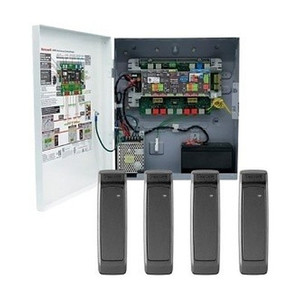
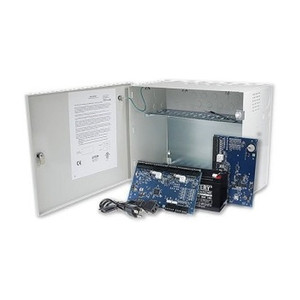
Honeywell MPA2MPXPSU 2-Door Access Control System
The Honeywell MPA2MPXPSU is a wired 2-door access control platform engineered for commercial facilities requiring stable, centralized credential management across dual entry points. Unlike wireless systems, the MPA2MPXPSU eliminates RF interference and network latency — you get continuous availability without dependency on mesh networking or cellular fallback. Built for integrators deploying mid-scale access infrastructure, this controller manages simultaneous authentication and door actuation at two separate locations from a single hardwired control point.
Overview
The MPA2MPXPSU delivers access control in a wired architecture, which means no dropped signals, no battery-dependent readers, and predictable system behavior across 24/7 operation. Wired systems impose installation overhead — you'll need conduit runs and structured cabling to each door — but that tradeoff buys you deterministic response times and zero ambiguity about reader status. The 2-door capacity serves facilities with immediate access requirements at two separate locations: separate secure zones, dual lobby readers, departmental entry points, or distributed warehouse staging areas. This is your foundation controller; you can add companion modules to expand beyond two doors if the facility grows.
Key Features
- Wired Connectivity Architecture: Hardwired control bus eliminates wireless dead zones and RF interference. You avoid the diagnostics nightmare of wireless dropout — every reader communicates on predictable, hardened pathways. Installation requires conduit work, but operational simplicity justifies the upfront labor.
- 2-Door Simultaneous Management: Control and monitor two independent access points from a single controller unit. Both doors respond to the same credential database, so policy changes propagate instantly across all connected readers — no synchronization delays.
- 125KHz Proximity Credential Support: Works with standard commercial proximity cards and existing 125KHz reader infrastructure. If your facility already deployed proximity badge systems, the MPA2MPXPSU plugs into that ecosystem without retrofit. Upgrading to higher-frequency or biometric readers requires reader replacement, not controller replacement.
- Commercial-Grade Electric Strike / Magnetic Lock Outputs: Standard relay outputs drive electric strikes and magnetic locks without intermediary interfaces. You interface directly to common door hardware, reducing bill-of-materials complexity and integration points.
- Centralized Policy Management: Single administrative console coordinates access rules across both doors. Revoking a credential instantly denies entry at both points; issuing temporary access (contractor badges, shift-based permissions) applies uniformly.
- Integration with Security Ecosystem: Compatible with standard commercial access control monitoring platforms and conventional security cabinets. Integrators experienced with wired door controllers will recognize the architecture and integration patterns immediately.
- Modular Expansion Path: Foundation system for two doors; compatible expansion controllers extend management to additional entry points without replacing the core platform. Scaling from two to four or six doors follows a predictable module-addition pattern.
Integration & Compatibility
The MPA2MPXPSU operates on a wired control bus architecture typical of commercial access control ecosystems. Credential readers must operate at 125KHz proximity frequency for direct compatibility; readers supporting other frequencies (13.56MHz, biometric, PIN pad) require intermediate protocol converters or reader replacement. Door control outputs are standard relay formats compatible with electric strikes rated 12VDC or 24VDC and electromagnetic locks commonly deployed in commercial facilities. Management integration follows conventional supervised security software patterns — no specialized VMS or IP-centric architecture required. A security integrator commissioning the system will configure door unlock schedules, credential assignment, and audit logging through standard access control administrative interfaces.
Deployment Considerations
Wired deployment demands infrastructure planning: conduit routing between the controller and each remote reader, cable pulls through existing facility pathways, and electrical work to provision power and relay circuits. Facilities with existing security infrastructure — conduit banks, equipment rooms, UPS integration — benefit from leveraging installed pathways. New construction or major renovation cycles are ideal times to install wired access control; retrofit into older buildings requires surface-mounted conduit or concrete core drilling, both labor-intensive. The MPA2MPXPSU requires standard commercial power and benefits from UPS backup to maintain access control during utility events. Plan power provisioning and battery sizing as part of the facility security infrastructure.
Frequently Asked Questions
Q: Does the MPA2MPXPSU require an internet connection or cloud service?
A: No. The MPA2MPXPSU operates on wired hardwired control — no internet, cloud API, or cellular dependency. Access decisions execute locally at the controller. Audit logging and remote administration may integrate with on-premises security software, but core door control functions operate standalone.
Q: Can I expand beyond 2 doors?
A: Yes. The MPA2MPXPSU is a foundation platform. Compatible expansion controllers can be added to manage additional doors. Consult with an integrator for multi-door scaling architecture specific to your facility layout.
Q: What happens if power is lost?
A: Without UPS backup, the system loses power and relay outputs de-energize. Electric strikes typically fail-secure (locked); magnetic locks typically fail-open (unlocked). UPS integration is standard practice for access control deployments to maintain controlled access during power events — specify UPS capacity during system design.
Q: What type of power does the MPA2MPXPSU require?
A: Standard commercial power input (12VDC or 24VDC depending on configuration). Consult the datasheet for exact supply specifications and power draw during normal operation and door actuation.
Q: Is the MPA2MPXPSU suitable for outdoor doors?
A: The controller itself is designed for interior mounting in a cabinet or security enclosure. Remote readers and door hardware can be deployed outdoors; specify weatherproof reader housings and outdoor-rated electric strikes rated for your climate. The controller manages those devices from an interior protected location.
Q: Can I integrate the MPA2MPXPSU with existing access control software?
A: Compatibility depends on the software platform and the system's API/integration protocol. Confirm integration support with both the controller manufacturer and your security software vendor before deployment. Standard commercial access control platforms typically support wired controller architectures; cloud-only VMS platforms may not.
Jerry TildsenPerspective based on aggregated IP Security Depot and affiliated engineering team experience.
I've evaluated the Honeywell MPA2MPXPSU in several mid-scale facility upgrades, and the wired architecture is the defining characteristic. This controller eliminates the wireless diagnostic overhead that consumes real integration time on distributed systems. The 125KHz proximity credential support anchors it to legacy commercial badge infrastructure — if your facility has existing 125KHz readers, the MPA2MPXPSU integrates without reader retrofit.
Technical Highlights:
- Wired Control Bus: No mesh network, no RF site surveys, no interference mitigation. Every reader communicates on hardwired pathways. You trade installation labor (conduit runs, cable pulls) for operational simplicity and predictable response times. Worth the upfront cost in facilities with existing cable infrastructure.
- 2-Door Simultaneous Management: Both doors respond to the same credential database. Revoking a badge happens instantly across both points — no synchronization lag or database replication delays. Useful for facilities where credential lifecycle (issuance, revocation, temporary access) demands immediate propagation.
- 125KHz Proximity Standard: Locks you into existing 125KHz reader ecosystems. Upgrading to 13.56MHz or biometric authentication requires reader replacement at each door, not controller upgrade. Plan credential technology evolution upfront; controller replacement is expensive later.
Deployment Considerations:
- Wired systems demand conduit planning and electrical coordination. Retrofit into older facilities without existing security conduit means surface-mounted cable trays or core drilling — both add labor and complexity. Ideal for new construction or major renovation cycles.
- UPS integration is mandatory for access control systems. Specify battery backup during design; a power loss without UPS means doors revert to fail-safe state (typically locked for electric strikes, open for magnetic locks). Plan for this behavior in your security policy.
- Expansion beyond two doors requires additional controllers and coordination across multiple wired buses. Don't treat this as a simple add-on; plan your door growth scenario upfront and right-size the foundation controller deployment.
The MPA2MPXPSU is the right choice for mid-scale facilities with two critical access points, existing 125KHz credential infrastructure, and willingness to invest in hardwired conduit pathways. It's not suitable for facilities requiring frequent reader relocation, biometric/multi-factor credential technology, or wireless flexibility. Use this controller as a foundation for commercial access control where stability and integration simplicity outweigh wireless convenience.