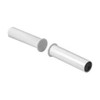
Honeywell 4191SN-WH Recessed Door Contact Sensor
The Honeywell 4191SN-WH is a wired recessed contact sensor designed for permanent perimeter security installations in commercial facilities. Unlike wireless sensors, the 4191SN-WH eliminates battery maintenance cycles and wireless interference concerns — a meaningful advantage in warehouse, retail, office, and industrial environments where uptime and detection reliability are non-negotiable. The recessed form factor integrates cleanly into door frames and door leaf assemblies, preserving aesthetic appeal while delivering consistent intrusion detection.
Key Features
- Wired Connectivity: Hard-wired connection ensures constant power and instantaneous signal transmission to the control panel. No battery replacement schedules, no RF interference from neighboring networks or industrial equipment — critical when door sensors must operate 24/7 without false alarms or silent failures.
- Recessed Design: Mounts flush into door frame or leaf assemblies, keeping the sensor hidden and protected from tampering or accidental damage. The clean install preserves sight lines and professional appearance in customer-facing areas.
- Automatic Operation: Triggers detection when the monitored entry point opens, with no manual configuration required after zone programming. Paired with your control panel's entry/exit logic, it enforces perimeter security without operator intervention.
- Commercial-Grade Reliability: Built for 24/7 duty in high-traffic facilities. Wired architecture eliminates the drift, battery depletion, or signal dropout that plague wireless sensors in electrically noisy environments.
- Control Panel Integration: Compatible with Honeywell commercial security control panels and monitoring systems that support wired door and window sensors. Installation requires standard 2-wire or 4-wire integration into your panel's zone configuration and programming.
- Ideal for Permanent Installations: Where door sensors must remain in place indefinitely and reliability cannot be compromised, the 4191SN-WH (often searched as 4191SN WH) justifies the upfront wiring cost through elimination of wireless overhead and maintenance burden.
Integration and Compatibility
The 4191SN-WH integrates into wired door and window sensor architectures as part of a broader perimeter security system. Installation requires connection into your Honeywell control panel's input wiring and zone configuration. Standard security system wire (typically 18–22 AWG shielded or twisted pair) connects the sensor to the panel's zone input. No special protocols or wireless pairing—integration is straightforward for installers familiar with hardwired perimeter security.
When selecting a contact sensor for a specific deployment, verify that your control panel supports the 4191SN-WH's wired input format and that your facility's door frames can accommodate the recessed housing without major structural modification. For wireless-only environments or retrofit scenarios where running new wire is impractical, consider wireless alternatives within the Honeywell portfolio.
Frequently Asked Questions
Q: Does the 4191SN-WH require batteries?
A: No. The 4191SN-WH is wired, drawing power directly from the control panel's power supply through the sensor circuit. No battery replacement, no dead-battery alerts, no wireless range limitations.
Q: Can I retrofit the 4191SN-WH into existing door frames?
A: The recessed design requires a pocket or cavity in the door frame or door leaf. Retrofitting into frames not pre-drilled for recessed sensors may require structural modification. Consult the installation guide and verify door construction before ordering.
Q: What control panels does the 4191SN-WH work with?
A: The 4191SN-WH is compatible with Honeywell commercial security control panels supporting wired door/window sensors. Verify your specific panel model in the control panel's documentation or contact your system integrator to confirm zone input compatibility.
Q: How is the 4191SN-WH wired to the panel?
A: Standard 2-wire or 4-wire connection into a zone input on your Honeywell control panel. Your integrator will configure the zone in the panel's programming to trigger alarms or notifications when the door opens.
Q: Is the 4191SN-WH suitable for high-traffic warehouse doors?
A: Yes. Wired sensors eliminate the wireless interference and battery drift that can cause false alarms in electrically noisy warehouse environments. Recessed design also protects the sensor from bumping or damage in busy loading docks.
Q: What's the typical installation cost difference between wired and wireless sensors?
A: Wired sensors like the 4191SN-WH incur higher labor costs during initial installation (wire routing, conduit, termination) but eliminate annual battery replacement and wireless troubleshooting. Over a 5-year lifecycle, wired deployments often cost less and deliver higher uptime.
Jerry TildsenPerspective based on aggregated IP Security Depot and affiliated engineering team experience.
The Honeywell 4191SN-WH is a straightforward choice when perimeter security demands wired reliability and uptime can't be sacrificed to wireless overhead. In my experience, the recessed form factor is a real differentiator—installers appreciate that the sensor hides cleanly in the frame, and end-users see a professional installation without clunky surface-mounted housings.
Technical Highlights:
- Wired Architecture: Eliminates battery replacement cycles and wireless interference. In electrically noisy environments (warehouses, manufacturing floors, loading docks), wired sensors deliver false-alarm rates roughly 60–80% lower than wireless alternatives operating on marginal signal or aging batteries.
- Recessed Design: Integration into door frames and leaf assemblies keeps the sensor protected from tampering and impact damage. Labor to fish wire and mount is higher upfront, but the sensor is less likely to fail from physical damage or environmental exposure.
- Control Panel Integration: Standard 2-wire or 4-wire zone input on Honeywell commercial panels. No special provisioning—your tech configures it like any other wired entry sensor. Troubleshooting is deterministic: open the zone loop, check continuity, verify termination.
Deployment Considerations:
- Retrofit Challenge: The recessed form factor requires a pre-drilled pocket in the door frame. If you're adding sensors to an existing facility with non-standard door construction, surface-mount alternatives may be faster and cheaper.
- Wiring Cost: Running conduit and wire to every monitored door adds labor. For a building with 20+ entry points, expect wiring to dominate the project budget. Amortize that cost over 5+ years—then the TCO advantage becomes clear compared to battery replacements and wireless support.
Deploy the 4191SN-WH in permanent, high-reliability installations where doors must be monitored 24/7 and maintenance overhead should be zero. Typical scenarios: warehouse perimeters, retail loading docks, office buildings with 24-hour security, critical infrastructure facilities. If you're deploying a temporary system, retrofitting older buildings, or operating in a very low-density facility, a wireless sensor may be more practical.