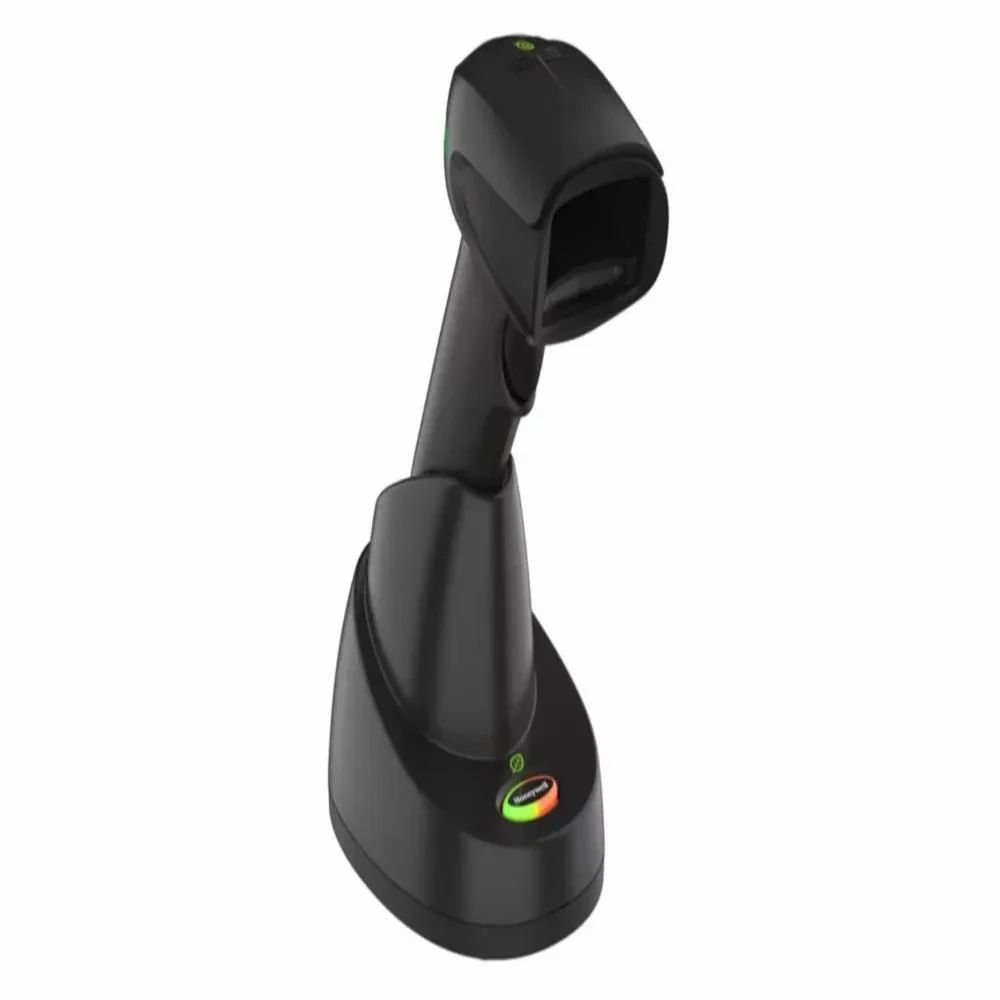
Honeywell 2100ISR-3USBN Xenon XP 1952g 2D Area Imager Scanner
The Honeywell 2100ISR-3USBN is a professional-grade area imager barcode scanner built for high-volume retail, warehouse, and field operations where scan reliability and durability directly impact throughput. Unlike basic 1D pencil-beam scanners, the Xenon XP 1952g captures both linear and 2D barcodes across a 2.5 to 50.8 cm working range—meaning you can scan items at the counter or reach into bins during inventory without repositioning. The combination of Bluetooth wireless connectivity plus legacy USB support eliminates the false choice between modern flexibility and existing infrastructure integration.
Key Features
- Area Imager (1D/2D Capable): Decodes EAN, UPC, Code 128, QR Code, and Data Matrix barcodes without configuration or hardware swaps. One device handles the barcode mix typical in retail and logistics operations, reducing scanner proliferation and operator training overhead.
- IP65 Environmental Rating: Dust and splash protection without enclosure overkill. Handles warehouse moisture, dock hoses, and occasional spills without the firmware quirks or connector corrosion common in lower-rated devices. Operationally this means fewer warranty claims and unplanned downtime in wet receiving areas.
- Bluetooth 4.2 Wireless Connectivity: Frees operators from cable tether, eliminating missed scans due to tangled cords and the latency of docked systems. In fast-moving picking and cross-dock operations, wireless range and pairing simplicity reduce per-scan cycle time by seconds—meaningful at high transaction volumes.
- Dual Connectivity (Bluetooth + USB): Pair wirelessly to modern WMS tablets or connect USB to legacy POS terminals without hardware replacement. Sidesteps forced infrastructure overhaul when migrating between systems.
- 2.0 m (6.5 ft) Drop Rating: Survives falls from waist height onto concrete or steel. In high-motion warehouses, this durability trades against repeat procurement and downtime. Cheaper alternatives incur repair costs that offset initial savings within 18–24 months of daily operation.
- Working Range 2.5–50.8 cm (1–20 in): Close-proximity checkout scanning and extended-distance inventory operations use the same device. Reduces SKU complexity in tool carts and mobile stations, versus maintaining separate close-range and long-range scanners.
- First-Pass Read Optimization: Designed for scan-and-move workflow. Minimizes re-scan time and operator frustration in high-throughput lines where every tenth of a second compounds across thousands of transactions daily.
Integration & Deployment Context
The 2100ISR-3USBN integrates into third-party WMS platforms via standard USB HID or Bluetooth serial emulation. Wireless pairing operates on Bluetooth 4.2 spectrum, reducing access-point congestion compared to WiFi scanners—a real advantage in dense retail or warehouse environments where channel saturation throttles devices. For organizations mixing legacy serial/USB checkouts with modern tablet-based inventory systems, dual connectivity avoids forced infrastructure overhaul and lets you phase in upgrades incrementally.
The IP65 rating makes this scanner suitable for receiving docks, refrigerated areas, and outdoor yard operations—environments where consumer-grade imagers fail within weeks. Field-deployable teams benefit from the 2.0 m drop rating and wireless freedom; dock supervisors avoid cable management complexity.
When to Choose a Different Model
If your primary requirement is 1D-only scanning at fixed checkout stations, a basic laser scanner reduces cost without capability loss. If you need vehicle-mount or long-range outdoor reading beyond 50 cm, or if your application requires real-time on-device inventory lookup, consult the broader Honeywell barcode portfolio for ruggedized long-range or display-integrated variants. For applications combining scanning with data capture or mobile inventory transactions, evaluate mobile computers or tablet-pairing ecosystems instead.
Frequently Asked Questions
Q: Does the 2100ISR-3USBN work with my existing retail POS terminal?
A: Yes. The scanner supports both USB and Bluetooth connectivity, so it can pair wirelessly with modern WMS tablets or connect via USB to legacy POS systems without additional drivers or adapters. You can switch connectivity modes without opening the device.
Q: What symbologies does the 2100ISR-3USBN decode?
A: The area imager engine reads EAN, UPC, Code 128, QR Code, and Data Matrix in a single device. No separate laser or imager needed for different barcode types.
Q: Will the 2100ISR-3USBN survive daily drops in a warehouse environment?
A: The 2.0 m (6.5 ft) drop rating covers falls from waist height onto concrete or steel. Repeated drops from higher distances or onto edges may cause damage. In continuous high-impact settings, periodic inspection is recommended.
Q: Can I use the 2100ISR-3USBN in a wet dock or refrigerated area?
A: Yes. The IP65 rating means dust and splash protection without enclosure—suitable for moisture, occasional hose-downs, and temperature swings typical of receiving and cold-storage zones. It is not fully submersible.
Q: What is the wireless range of the Bluetooth connection?
A: Bluetooth 4.2 typically provides 50–100 m line-of-sight range depending on obstacles. In warehouse environments with metal racks and RF interference, effective range is typically 30–60 m. For fixed checkout stations, distance is rarely a constraint.
Q: Does the 2100ISR-3USBN require any special licensing or subscription?
A: No. The scanner operates as a standalone barcode decoder. WMS integration and licensing depend on your backend systems, not the scanner itself.
Ted PerryPerspective based on aggregated IP Security Depot and affiliated engineering team experience.
The 2100ISR-3USBN (often searched as 2100ISR 3USBN) hits a practical middle ground for distributed retail and logistics teams: it's rugged enough for dock and yard work, wireless-capable without the complexity of WiFi handoff, and symbology-flexible enough to handle mixed barcode environments without operator retraining. The IP65 rating and 2.0 m drop spec aren't marketing gestures—they directly reduce warranty claims and unscheduled downtime in real warehouse operations.
Technical Highlights:
- 2.5–50.8 cm Working Range: Covers both counter-level checkout scanning and mid-reach bin picking in a single device. Operators don't swap scanners; you reduce SKU complexity in tool carts and cut training overhead for rotating or seasonal staff.
- Bluetooth 4.2 + USB Dual Connectivity: Pair wirelessly to tablet-based WMS without abandoning USB tethering for legacy POS. Phase migrations incrementally—no forced infrastructure overhaul, no stranded devices mid-lifecycle.
- IP65 Environmental Rating + 2.0 m Drop: Real durability for dock, refrigerated, and outdoor yard zones. Consumer imagers fail fast in these environments; the 2100ISR-3USBN survives waist-height drops and moisture exposure that would strand cheaper alternatives within months.
- Area Imager, Multi-Symbology (EAN, UPC, Code 128, QR, Data Matrix): One engine decodes the barcode mix typical in retail and 3PL operations. No fallback to manual entry or device-switching delays.
Deployment Considerations:
- Bluetooth range in dense metal-rack environments (steel shelving, RF interference) typically drops to 30–60 m. Line-of-sight range is higher but not guaranteed in real warehouses. Test coverage before deploying fleet-wide.
- The 50.8 cm maximum range handles standard bin depth and shelf height, but vehicle-mounted or outdoor long-range applications require a different model. Be explicit about whether your use case exceeds 20 inches.
- IP65 is splash-resistant and dust-proof, but not submersible. Avoid full immersion or high-pressure washdown scenarios.
Deploy this scanner into high-motion picking, cross-dock, or mixed retail-logistics operations where wireless freedom and durability directly reduce transaction time and downtime costs. It's the right choice if your team runs between POS terminals, mobile carts, and receiving zones and your barcodes span both linear and 2D codes. Skip it if you're locked to fixed-station 1D-only scanning or if your application demands real-time edge processing or on-device inventory display.