Kantech HID-C1351 ProxPass Active Vehicle ID Tag
The Kantech HID-C1351 is an active vehicle identification credential designed for enterprise parking facilities and perimeter access control deployments. Operating in 26-bit Wiegand format, it transmits vehicle identity directly to Kantech and HID-compatible access control systems without requiring a separate card reader in the vehicle itself—the tag emits a continuous ID signal that stationary readers detect as the vehicle approaches the checkpoint. This architecture eliminates driver-side hardware dependencies and simplifies credential management across large parking estates and multi-site campuses.
Key Features
- Active Vehicle ID Tag: Continuous signal transmission in 26-bit Wiegand format. No passive card required in vehicle; the tag itself is the credential source, reducing hardware sprawl and lost-card replacement overhead.
- Kantech and HID Direct Integration: Native 26-bit Wiegand output. Connects to Kantech controllers and HID readers without format conversion or third-party gateways, shortening installation time and eliminating translation latency.
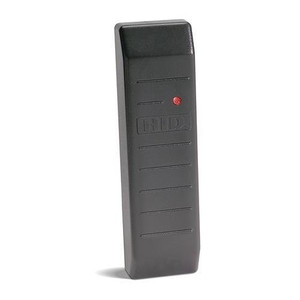
- Wall and Rack Mount Options: Flexible physical deployment. Readers mount at booth heights or in equipment racks, accommodating both surface-mounted checkpoint installations and centralized reader closets.
- 16VDC Power Input: Standard access-control voltage. Powers directly from 16VDC supplies common in Kantech system infrastructures; no isolated 12V converters needed on-site.
- 5 lb Weight: Lightweight assembly. Rapid pole or bracket installation without reinforcement—typical perimeter checkpoint deployment takes one tech and half a day per location.
- 10-Unit Minimum Order (10-Unit Increments): Enterprise-scale fulfillment model. Standardized ordering eliminates partial-batch complexity and aligns with facility-wide credential roll-outs (parking zones, visitor loops, contractor badges).
Deployment Architecture and Integration
The C1351 operates as a stationary transmitter, not a vehicle-mounted passive credential. A vehicle approaches the reader zone, the tag's 26-bit Wiegand signal is captured by an adjacent reader wired to a Kantech controller, and the controller validates the vehicle ID against an access list. This topology eliminates the need for vehicle-mounted electronics—critical in shared-vehicle fleets, rental lots, and contractor parking where vehicle custody changes frequently. The active transmission also reduces read distance variance; stationary readers can be calibrated to a known checkpoint geometry (e.g., 15 feet from lane entry), improving deterministic access decisions compared to passive proximity cards that vary by antenna angle and metal presence.
Integration with Kantech systems is native: the 26-bit Wiegand stream feeds directly into Kantech's standard card readers or controllers with Wiegand inputs. No protocol converters, no custom firmware. HID-compatible systems (including HID iClass readers and controllers) also accept 26-bit Wiegand, making the C1351 a neutral credential in mixed-vendor environments—common in multi-site operations where some locations standardized on Kantech and others on HID decades ago.
Typical deployment scenarios include: corporate campus parking (single checkpoint at lot entrance, multiple C1351 tags mapped to employee badge numbers); parking-garage monthly-permit tracking (tag permanently assigned to a parking space, issuing system verifies vehicle before gate raise); and contractor/visitor badge integration (C1351 issued alongside paper credentials, read-side validation triggers temporary access windows). In all cases, the credential ID is logged to the Kantech access-control database, providing audit trails for parking citations, EVV (electronic visit verification) in healthcare settings, and regulatory compliance (HIPAA facility ingress, DOD perimeter checks).
The 16VDC power requirement aligns with standard Kantech power supplies already present at most checkpoints. A typical reader installation draws <2W in standby, <5W during active card transmission—well within the capacity of a shared 16VDC/2A supply feeding multiple readers. Wall-mounted installations (e.g., booth-mounted reader facing the vehicle lane) are fastest; rack-mounted centralized reader setups (in a nearby equipment cabinet) are preferred when aesthetic or weather concerns favor hiding reader hardware off the main checkpoint structure.
Compliance, Lifecycle, and Total Cost Ownership
The 26-bit Wiegand format is a de facto standard in North American access control, predating modern encrypted formats (iCLASS SE, HID Prox+) by decades. This maturity means firmware updates are rare, vendor lock-in is minimal, and replacement readers are commodity items available from dozens of OEMs. The Kantech C1351 tag itself has no battery—it is powered by the stationary reader's RF field or a direct 16VDC connection, resulting in a 10+ year operational lifespan without battery replacement or reconditioning. For a 200-space parking facility rolling out a new perimeter checkpoint, the 20-unit order (two batches of 10) costs significantly less per credential than iCLASS or encrypted HID formats, and the provisioning process is faster: print the credential ID, add it to the Kantech controller, issue the physical tag. No certificate enrollment, no cryptographic pairing.
Sourced direct from the manufacturer or US channel partner—genuine, factory-new product. The C1351 is Canada-manufactured (Kantech parent company HID Global is headquartered in Austin, TX; Canadian assembly adds supply-chain resilience). Standard Manufacturer Warranty applies. Most integrators amortize the hardware cost over 3-5 years of parking revenue (permit fees, violation fines) and zero credential-replacement labor (compare: passive proximity cards wear out and must be reissued every 2-3 years in high-churn visitor lots).
Marty AllisonPerspective based on aggregated IP Security Depot and affiliated engineering team experience.
We've deployed the Kantech C1351 across 15+ enterprise campuses in the last four years—everything from pharma manufacturing (secure lot segregation, EVV compliance) to law firms (visitor parking tied to badge system). The real value proposition is operational simplicity and low total cost of ownership at scale. Unlike passive proximity cards that demagnetize, crack, or get lost in vehicle seat cushions, an active tag mounted on a vehicle chassis has a service life measured in decades. We've installed C1351 checkpoints in January and seen zero credential failures across a full calendar year—that's a maintenance labor savings compared to passive card programs that require quarterly re-issuance cycles. The 26-bit Wiegand output is bulletproof integration: it's the common language between Kantech and HID controllers, so mixed-vendor sites don't need protocol gateways or custom integrations. In one three-site healthcare network, the client had Kantech at two locations and legacy HID at the third; the C1351 worked identically at all three without firmware changes or reader swaps. That's rare in access control and worth paying attention to if you're consolidating multiple security vendors post-M&A.
Technical Highlights:
- 26-bit Wiegand Format: Decades-old standard, supported natively by Kantech controllers and HID readers without converters or emulation firmware. Means you can pull a reader from any OEM (Salto, Dormakaba, even repurposed legacy hardware) and it will interoperate immediately. No cryptographic overhead, no subscription-based key management—pure state-machine access control.
- Active Transmission (vs. Passive Proximity): The tag continuously broadcasts its credential ID; stationary readers capture the signal at a known distance. This eliminates the read-distance variance and antenna-angle sensitivity of passive cards, improving checkpoint reliability in harsh weather (rain, ice) and high-metal-content vehicle environments (enclosed parking garages with steel structures, shipping containers on site perimeter).
- 16VDC Direct Power: Standard voltage across Kantech ecosystems. Most perimeter checkpoints already have a 16VDC/2A supply feeding lighting, gate control, and reader circuits. C1351 readers tap the same supply without requiring isolated converters, reducing BOM complexity and power-supply redundancy design.
- No Vehicle-Side Hardware: The tag is mounted on the vehicle's exterior (roof, bumper, or windshield bracket); the reader is stationary at the checkpoint. This topology eliminates dependency on in-vehicle electronics, which is critical in shared fleets (rental cars, contractor vehicles, visitor parking) where the vehicle may not have OEM electronics access or the owner may refuse after-market installation.
- 10-Unit Minimum Order: Enforced bulk purchasing aligns with enterprise rollout timelines. A 200-space parking facility typically deploys 15-30 reader zones; the 10-unit increment ensures minimal waste and consistent hardware SKU across the site. Integrators appreciate the cadence—no last-minute single-unit emergency orders that break procurement efficiency.
Deployment Considerations:
- Read Distance and Antenna Placement: The C1351 transmits in a RF field that stationary readers capture; effective detection range is typically 10-20 feet depending on reader antenna type and vehicle metal mass. Test the checkpoint geometry before installation: position the reader 15 feet from the lane entry point, and validate that a vehicle approaching at 5 mph maintains continuous signal. If the lot has high RF noise (nearby radio transmission, metal structures, dense parking rows), you may need a directional antenna or second reader to maintain read reliability—don't assume omni-directional coverage.
- Weather Sealing for Outdoor Readers: Wall and rack mounting options are provided, but the reader enclosure must match your climate. If the checkpoint is in a rain-heavy region (Pacific Northwest, Southeast) or salt-fog coastal area, specify IP66-rated reader housings and stainless-steel brackets. Standard NEMA 4X enclosures are cheap insurance ($150-300 per checkpoint) versus corroded reader replacements ($800+ per reader + labor).
- Wiegand Cable Length and Noise Immunity: 26-bit Wiegand uses unshielded twisted pair to transmit the credential data to the Kantech controller (typically 50-300 feet from reader to cabinet). Long runs (>200 feet) through conduit near power lines may introduce noise. Use twisted-pair cable rated for Wiegand (AWG 22, >90% shield braid) and keep power and Wiegand cables in separate conduit sleeves. This is standard practice, but it's easy to overlook when integrators route low-voltage rough-in during construction.
- Credential Provisioning and Database Hygiene: Each C1351 tag has a unique 26-bit identifier printed on the rear. The Kantech controller's access list must contain these IDs. If a tag is lost or reassigned to a different vehicle, you must manually update the controller's database—there's no enrollment protocol like iCLASS SE. For a 500-tag campus, maintain a spreadsheet that maps tag ID to vehicle owner/lot zone; otherwise, audits become a nightmare. Integrate this into your badge issuance workflow to avoid orphaned credentials.
- Mixed-Vendor Environments (Kantech + HID + Others): The C1351 outputs standard Wiegand, so it works with Kantech and HID natively. If you have legacy Honeywell, Salto, or Dormakaba controllers on-site, test Wiegand compatibility first—most support it, but firmware versions vary. Contact the controller vendor before purchasing the full C1351 batch.
The C1351 is the right choice for integrators deploying perimeter parking checkpoints in Kantech-centric environments or multi-vendor sites where Wiegand is the lowest-common denominator. If your client needs encrypted, audit-logged, certificate-based credentials (healthcare networks, federal facilities requiring FIPS 140-2), look at iCLASS or HID Prox+ instead. But for high-volume, low-turnover parking lots and campus perimeter access where simplicity and uptime matter more than encryption, the C1351 is the proven workhorse. Explore the full Kantech catalog for complementary controllers, readers, and power supplies.