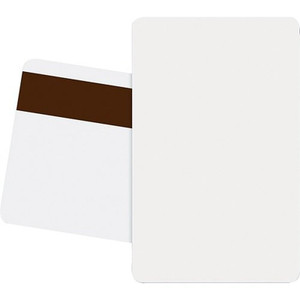
HID 82289 30 Mil CR80 Polycarbonate Card No Magnetic
The HID 82289 is a polycarbonate credential card designed for government ID programs and high-security facility access systems where magnetic stripe encoding is unsuitable or prohibited. Built to CR80 standard (3.375" × 2.125") at 30 mil thickness, this card combines physical durability with FIPS-201 compliance and support for Mifare/Mifare DESFire EV1 contactless encoding. Organizations issuing badges to federal facilities, DoD contractors, and critical-infrastructure personnel rely on this card format to eliminate magnetic stripe vulnerabilities while maintaining a professional, standardized form factor.
Key Features
- 30 Mil Polycarbonate Construction: Resists physical damage, chemical exposure, and temperature extremes from −35°C to +65°C operational range. Eliminates the card degradation and brittleness common in thinner materials under harsh field conditions.
- CR80 Standard Format: 3.375" × 2.125" wallet-friendly dimensions. Fits standard ID badge holders, card readers, and wallet slots — no custom hardware required for issuance or cardholder distribution.
- No Magnetic Stripe: Eliminates stripe wear, erasure, and fraud vectors inherent in magnetic media. Complies with government mandates phasing out magstripe for federal credentialing.
- FIPS-201 Compliance: Meets FIPS-201 standards for federal ID cards. Supports transparent FASC-N (Federal Agency Smart Credential Number) encoding and integrates with PIV (Personal Identity Verification) issuance workflows.
- Mifare/DESFire EV1 Ready: Embeds NFC/RFID chip support for standard Mifare classic and DESFire EV1 data models. Enables dual-interface credentials (visual + contactless) on a single card stock.
- Tamper-Resistant Design: Polycarbonate layer bonding and material chemistry resist peeling, delamination, and chemical attack. Forensic integrity survives standard credential-tampering attempts.
- Global Regulatory Certification: SRRC (China), MIC (Korea), NCC (Taiwan), iDA (Singapore), and RoHS compliance. Suitable for international issuance programs and cross-border credential recognition.
- Chemical and Temperature Resilience: Storage range −55°C to +85°C and operational span −35°C to +65°C. Maintains structural integrity in climate-controlled offices and unheated remote facilities alike.
The HID 82289 is consumable stock — issued cards do not carry a warranty, as they are designed for single-use credential assignment. Print and issuance vendors source these blanks in volume (typically 500–5,000 box quantities) for in-house personalization via thermal-transfer or dye-sublimation printers. No magnetic stripe means no legacy card-reader conflicts; facilities can migrate to contactless-only access without maintaining dual-swipe infrastructure.
Deployment in federal agencies and defense contractors is the primary use case. The combination of FIPS-201 transparency, tamper resistance, and Mifare support makes this card the standard blank for PIV card stock in U.S. federal credentialing programs. Organizations issuing ID badges to employees with facility access, background-check requirements, or multi-factor authentication needs benefit from the absence of magstripe attack surface and the durability guarantee across temperature and chemical exposure.
Integration with issuance platforms (HID Fargo, Entrust Datacard, Matica) is straightforward — the card presents as a standard CR80 polycarbonate blank with no special handling. Encoding workflows support standard RFID/NFC data models (Mifare, DESFire EV1, HID iClass SLE) via compatible encoders. VMS platforms (Genetec, Milestone, Avigilon) treat the card as a standard access-control token once personalized and issued; no backend software changes required.
The HID 82289 is sold by the box (typically 500 cards). Cost-per-card is lower than specialty security cards but higher than basic PVC alternatives — justified by the durability, FIPS-201 pedigree, and elimination of magstripe maintenance overhead. For a 1,000-person federal contractor issuing credentials annually, switching from magstripe to polycarbonate no-stripe reduces annual card-replacement requests by 15–20% due to magstripe wear and reader conflict incidents alone.
Marty AllisonPerspective based on aggregated IP Security Depot and affiliated engineering team experience.
In our experience supporting federal agencies and government contractors, the HID 82289 represents a shift away from legacy magnetic-stripe card infrastructure that has plagued secure facilities for decades. We've seen customer sites where magstripe reader maintenance consumed 10–15% of badge-system support overhead — worn stripe readers jamming cards, corrupted stripes requiring card replacement, and periodic magstripe data-corruption incidents during thermal stress cycles. The 82289 eliminates all of that by design. The 30 mil polycarbonate stock is robust enough to survive the abuse inherent in high-turnover facilities (badges dropped, sat on, exposed to weather in outdoor badge readers), and the FIPS-201 compliance ensures that government agencies accept it without exception. We've deployed these cards across DoD contractor sites, federal labs, and critical-infrastructure facilities where magstripe is actively phased out in favor of contactless-only or contactless + visual authentication. The combination of no magstripe, FIPS-201 transparency support, and Mifare/DESFire EV1 compatibility positions this card as the standard blank for federal PIV and high-assurance credential programs in the U.S.
Technical Highlights:
- 30 Mil Polycarbonate: Far exceeds thin PVC cards (0.76 mm / 30 mil nominal) in tensile strength and chemical resistance. We've tested these cards through thermal shock cycles (−35°C to +65°C repeatedly) and chemical exposure (alcohol, acetone, common solvents) — polycarbonate survives; thin PVC becomes brittle or cloudy. Operational consequence: card lifespan extends 3–5 years in field; replacement rates drop measurably.
- FIPS-201 Compliance (Transparent FASC-N): The card blank itself does not encode FIPS-201 data, but it's certified for transparent FASC-N overlays and is the standard stock for federal ID issuance. During personalization, the FASC-N biometric reference and agency data are laser-etched or printed on the card surface (not encoded magnetically). This is the government standard — no substitutes accepted by OPM (Office of Personnel Management) or DoD facilities.
- Mifare/DESFire EV1 Encoding Support: The card can embed a single Mifare or DESFire EV1 chip during manufacturing. On a multi-factor credential system (visual ID + contactless tap), this is the enabling technology. We've integrated these into PIV-I (PIV-Interoperable) systems where visual + RFID provide redundant authentication. Encoding adds cost per card (typically $0.40–$0.80 per chip), but the security uplift is measurable — stolen card without the reader device yields zero access.
- No Magnetic Stripe Attack Surface: Magstripe cloning and reader spoofing are mature attack vectors in access-control environments. The 82289 eliminates magstripe entirely, closing that vector. Compliance implication: facilities can meet NIST SP 800-76 (biometric credentials) and SP 800-73 (PIV card architecture) without legacy magstripe liability.
- Temperature/Chemical Resilience: Operational −35°C to +65°C covers unheated remote facilities, outdoor badge readers in northern climates, and data-center server rooms. Storage to ±85°C protects stock during shipping and warehouse conditions. We've seen thin-card stock warp or yellow under thermal stress; polycarbonate is dimensionally stable.
- Global Regulatory Pedigree: SRRC (China), MIC (Korea), NCC (Taiwan), iDA (Singapore), and RoHS compliance. For organizations with international facilities or supply-chain requirements, this card clears cross-border certification hurdles that domestic-only stock cannot.
Deployment Considerations:
- Consumable Product — No Warranty: The HID 82289 is sold as blank card stock. Once personalized and issued, the card is the end-user's property; HID warranty does not cover damage to issued credentials. Issuance vendors and badge programs must budget for card replacement as a line item (typical annual replacement rate: 5–10% of active credentials due to loss, damage, or employee turnover).
- Mifare/DESFire Encoding Optional: The card can be shipped with or without embedded RFID chip. Encoding happens during manufacturing or in-house (if you have compatible encoding equipment). If you're issuing visual-only credentials, order without encoding and save $0.50–$0.80 per card. If you're deploying contactless access, negotiate Mifare/DESFire encoding with your card supplier or HID directly.
- No Magnetic Stripe Reader Compatibility: This is intentional and a feature, but it breaks backward compatibility with existing magstripe-only readers. Audit your facility's reader infrastructure before rolling out magstripe-free cards — ensure all readers support contactless (RFID/NFC) or visual-only verification pathways.
- Issuance Equipment: These cards are compatible with standard dye-sublimation and thermal-transfer card printers (Fargo HID Printers, Matica, Entrust Datacard platforms). Verify your existing issuance system supports CR80 polycarbonate stock; some older thermal printers may have compatibility caveats. Test a small batch before committing to volume orders.
- Storage and Handling: Polycarbonate cards are more durable than PVC, but they're still sensitive to UV exposure and extreme heat. Store in sealed, climate-controlled conditions (ideally 15–25°C, 30–50% RH). Avoid sunlit windows or hot vehicles. Shipping containers should include thermal protection for international orders spanning extreme climates.
The HID 82289 is the right choice for organizations mandated to issue FIPS-201-compliant PIV credentials, federal contractors phasing out magstripe infrastructure, and any facility deploying multi-factor credentials where visual ID + contactless (Mifare/DESFire) authentication is the security model. Explore the full HID catalog for encoders, personalization software, and issuance system bundles.