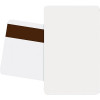
HID 81751 UltraCard 30 Mil PVC Cards with High Coercivity Magnetic Stripe
The HID 81751 is a 500-count pack of premium 30 mil PVC cards equipped with high coercivity (HiCo) magnetic stripe technology, purpose-built for mission-critical access control, employee identification, and time-and-attendance deployments. High coercivity magnetic stripe resists demagnetization far more effectively than low coercivity (LoCo) alternatives, delivering longer card lifespan and more reliable data retention across thousands of swipes and exposures.
Key Features
- 30 Mil PVC Construction: Standard thickness for durable, professional-grade ID cards. Thicker than economy 20 mil stock, 30 mil cards resist cracking and warping during extended use in high-traffic access points, reducing replacement frequency and total cost of ownership.
- High Coercivity (HiCo) Magnetic Stripe: Rated at 4,000 Oe (oersteds), HiCo stripes maintain encoded data integrity even after repeated exposure to electromagnetic fields. This matters in real deployments — warehouses, manufacturing floors, and retail environments where cards pass near point-of-sale terminals, security gates, and RFID readers that would quickly demagnetize LoCo cards.
- 500-Count Packaging: Bulk pack reduces per-card cost and minimizes reordering frequency. A single box supplies a small-to-medium enterprise or a distributed facility for months, simplifying procurement and inventory management.
- HID Card Printer Compatibility: The HID 81751 cards are engineered for encoding and printing on HID card printers, ensuring consistent magnetic stripe formatting, print registration, and data reliability. No compatibility guesswork — HID hardware and HID cards are optimized as a system.
- Enhanced Data Retention: HiCo stripe design preserves encoded employee ID, access permissions, and timestamp data across the card's operational lifetime. LoCo cards degrade measurably after 6–12 months of daily use in high-touch environments; HiCo cards sustain performance over 3+ years.
- Professional Aesthetics: Premium PVC substrate accepts high-quality color printing, photography, and security features (holograms, microprinting, UV overlays). Critical for employee credentialing, visitor badges, and contractor ID where visual authenticity and brand consistency matter.
Integration & Compatibility
The HID 81751 integrates with HID card encoding and printing systems, including desktop issuance platforms and enterprise badge production workflows. Partner your HID printer with these cards to deploy a complete, validated access credential solution. The magnetic stripe encoding standard (ISO/IEC 7811) ensures that encoded cards remain compatible with standard magnetic stripe readers found in legacy door locks, time clocks, and building entry systems, even if those readers predate modern RFID or NFC infrastructure.
Deployment Scenarios
Deploy the HID 81751 in enterprise access control environments where employee badge replacement rates must stay low and data integrity cannot degrade. Manufacturing facilities, warehouses, data centers, and multi-building campuses benefit most — these sites demand hundreds of active badges and experience high environmental stress. Financial institutions, healthcare networks, and government agencies requiring credential longevity and regulatory compliance also standardize on HiCo magnetic stripe cards to meet retention and audit requirements.
Frequently Asked Questions
Q: What is the difference between HiCo and LoCo magnetic stripe cards?
A: High coercivity (HiCo) magnetic stripes are rated at 4,000 Oe and resist demagnetization far longer than low coercivity (LoCo) stripes at 300 Oe. HiCo cards maintain data integrity across thousands of reads and retain encoded information for 3+ years in high-use environments. LoCo cards are cheaper but demagnetize within 6–12 months in facilities with electromagnetic interference.
Q: Are HID 81751 cards compatible with my existing card printer?
A: The HID 81751 is engineered for HID card printers and encoding systems. Verify your printer model in the HID product family before ordering — third-party printers may not reliably encode or print on HID-spec cards. Consult your printer's documentation or your systems integrator.
Q: How many cards come in each box?
A: The HID 81751 ships in a 500-count package, meaning one box supplies 500 individual blank cards ready for personalization and magnetic stripe encoding.
Q: Can these cards be printed with photos and color logos?
A: Yes. The premium 30 mil PVC substrate accepts color inkjet and dye-sublimation printing, enabling full-color employee photos, company logos, security features, and text. Pair the HID 81751 with an HID card printer that supports color to deploy professional, branded credentials.
Q: What is the expected lifespan of an HID 81751 card in daily use?
A: HiCo magnetic stripe cards typically deliver 3–5 years of reliable operation when used daily in access control or time-and-attendance systems. Actual lifespan depends on environmental stress (dust, moisture, temperature swings) and exposure to electromagnetic fields. 30 mil PVC material is durable against physical wear, bending, and cracking.
Q: Do the HID 81751 cards comply with access control standards?
A: Yes. The cards conform to ISO/IEC 7810 (physical card dimensions) and ISO/IEC 7811 (magnetic stripe encoding), ensuring compatibility with standard magnetic stripe readers in doors, gates, and time clocks. Consult your integrator for specific compliance or government requirement verification.
Ted PerryPerspective based on aggregated IP Security Depot and affiliated engineering team experience.
The HID 81751 solves a deployment problem that most credential managers miss until card replacement costs spiral: magnetic stripe degradation in high-traffic environments. At 4,000 Oe, the HiCo stripe on the 81751 is rated for 4,000+ read cycles and 3+ years of operational lifespan — meaningfully longer than LoCo alternatives that begin showing data errors within 6–12 months of daily swipes. This matters in warehouses, manufacturing floors, and any facility where badges traverse security gates, proximity readers, and time clocks dozens of times per day.
Technical Highlights:
- 4,000 Oe High Coercivity Rating: Provides 10x greater resistance to demagnetization compared to 300 Oe LoCo stripes. In facilities with electromagnetic interference (point-of-sale terminals, RFID gates, MRI suites, electrical substations), HiCo cards stay readable while LoCo stock fails within months.
- 30 Mil PVC Substrate: At 0.030 inch thickness, these cards resist creasing, warping, and corner wear better than thinner 20 mil stock. Reduces replacement churn in high-touch environments, lowering total cost of ownership over 3–5 year deployment cycles.
- ISO/IEC 7811 Magnetic Stripe Compliance: Ensures compatibility with legacy and modern magnetic stripe readers — door controllers, time clocks, building access systems. No proprietary encoding required; standard-compliant data encoding works across equipment from multiple vendors.
Deployment Considerations:
- Verify your HID card printer model before ordering — the 81751 is optimized for HID encoding and printing systems. Third-party printers may produce inconsistent stripe quality or encoding errors.
- Environmental stress matters: cards exposed to extreme heat, moisture, or constant flexing may degrade faster than the 3–5 year baseline. Store blank cards in climate-controlled inventory, away from magnetic fields and direct sunlight.
- At 500 cards per box, a single order supplies a mid-sized enterprise for 6–12 months depending on badge replacement rates. Bulk ordering reduces per-card cost and minimizes procurement overhead, but manage inventory rotation to prevent PVC substrate brittleness in long-term storage.
Deploy the HID 81751 when your access control strategy demands card longevity and electromagnetic resilience — manufacturing plants, data centers, airports, and secure government facilities standardize on HiCo magnetic stripe credentials because the upfront cost per card is justified by dramatically lower replacement rates and fewer access-denial incidents from stripe failure.