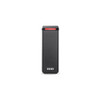
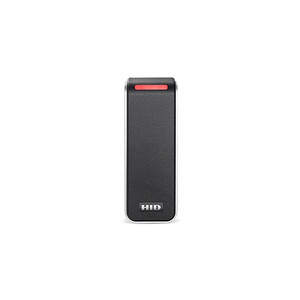
HID 20NWS-01-000000 Signo 20 White Silver SEOS Reader
The HID 20NWS-01-000000 is a wall-mounted 13.56 MHz contactless reader designed for corporate lobbies, office entry points, and retrofit deployments where existing infrastructure and cable runs support fast integration. It reads the full HID Signo credential stack — DESFire, iCLASS, MIFARE, HID proprietary, SEOS, and NFC — plus native Apple Enhanced Contactless Polling for HID Mobile Access® on compatible smartphones. The reader outputs 32-bit MSB Wiegand format for direct integration with access control panels, and also supports OSDP serial communication for modern controllers. White finish with silver trim baseplate and integrated LED/audible feedback makes it visually neutral and user-confirmable at entry points.
Key Features
- 13.56 MHz Contactless Reading: Reads DESFire, iCLASS, MIFARE, HID proprietary, SEOS, and NFC credentials. Eliminates wear on physical contact points and extends card lifespan in high-traffic entries.
- Apple Enhanced Contactless Polling (ECP): Native iPhone/Apple Watch support without requiring a separate mobile reader. Reduces reliance on physical cards and enables workforce credential flexibility.
- Wiegand 32-bit MSB Output: Direct compatibility with access control panels configured for 32-bit MSB Wiegand protocol. Simplifies wiring to legacy and mid-tier control systems without middleware.
- OSDP Communication: Serial OSDP support enables integration with modern controllers and future-proofs the installation against protocol shifts. Pairs with Wiegand for dual-protocol flexibility.
- Certified Secure Element Hardware: Encrypted credential processing meets HID security standards. Resistant to cloning and unauthorized card duplication attacks.
- White/Silver Finish with Status Indicators: LED and audible feedback provide user confirmation at entry points. Aesthetically neutral for corporate environments; visibility aids troubleshooting during commissioning.
- Pigtail Cabling & Terminal-Strip Termination: Field-flexible connection; no custom conduit runs required in retrofit scenarios. Surface-detection auto-calibration reduces manual range tuning post-installation.
- PoE+ Power Option: 802.3at PoE+ compatible (sold separately) — reduces power supply footprint and simplifies wiring in networked deployments.
The 20NWS-01-000000 integrates into HID credential ecosystems without requiring software license per reader — the card or mobile credential validates at the reader level before transmission to the access control panel. This architecture means the reader can operate as a failsafe device (local or networked) and scales naturally across multi-building campuses where credential issuance and revocation are managed centrally through HID's administration platform.
Credential compatibility spans both contact and contactless modalities. iCLASS SE (with encryption) is the preferred card standard for new deployments; DESFire EV1/EV2 and MIFARE Classic/Plus provide backward compatibility with existing card inventory. If your site uses older Prox (125 kHz) cards, a separate 125 kHz reader module is required — this model is 13.56 MHz only. Mobile credentials via HID Mobile Access reduce the operational burden of issuing and replacing cards; pair the reader with a mobile credentialing backend to enable same-day credential provisioning for contractors and temporary staff.
For retrofit installations, the pigtail connection and terminal-strip wiring simplify integration into existing cable runs and panel connections. If your panel predates OSDP support, Wiegand 32-bit MSB is the lowest common denominator — verify your controller's firmware supports 32-bit (not 26-bit) MSB format before purchase, as some older hardware defaulted to 26-bit LSB. OSDP gateways and firmware updates are available if legacy format conversion is required. The reader does not include a keypad — PIN fallback access requires a separate 2×6 or 3×4 keypad unit mounted alongside or integrated into the same mounting plate.
The HID 20NWS-01-000000 carries a 2-year manufacturer warranty and operates across -20°C to +60°C temperature range, making it suitable for climate-controlled offices and moderate outdoor vestibules (not direct-weather installations). IP54 rating provides dust and splash resistance. For true outdoor mounting or harsh environments, HID's ruggedized reader variants (e.g., iCAM-based readers with higher IP ratings and heater options) are a better fit. This reader is engineered for corporate and institutional entry points where credential flexibility, mobile access, and seamless panel integration are the priority.
Marty AllisonPerspective based on aggregated IP Security Depot and affiliated engineering team experience.
We've deployed the HID Signo 20 across corporate campuses, retrofit office suites, and high-traffic entry corridors. The key differentiator versus cheaper 13.56 MHz readers (like Farpointe or older Salto units) is the embedded credential ecosystem and mobile-first architecture. In our experience, the moment a customer enables HID Mobile Access on a single reader, they're motivated to migrate the entire credential infrastructure to HID — card issuance, mobile provisioning, and revocation all flow through the same administrative console. That consolidation is worth the premium price over generic 13.56 MHz readers. The Wiegand 32-bit output means you're not forced into a forklift upgrade of access control panels; it plays nicely with legacy Salto ProAccess, Genetec, and standard Schlage AD controllers. We've seen integrators use the 20NWS-01 to retrofit aging buildings where panel replacement was off the table but card technology needed modernization. One caveat: if you're sitting on a large inventory of 125 kHz Prox cards, this reader won't help until you also deploy a separate 125 kHz module. Credential migration costs have derailed several otherwise smooth Signo rollouts. Mobile credentials mitigate that burden — we've seen sites issue mobile credentials to 80% of users within six months, then phase out plastic cards entirely.
Technical Highlights:
- 13.56 MHz Multi-Standard Support (DESFire, iCLASS, MIFARE, SEOS, NFC): The breadth of credential support means you're not locked into a single card family. We've paired legacy iCLASS SE cards with new HID Mobile Access deployments on the same reader without configuration changes — the reader negotiates credential type on the fly. That flexibility has saved us weeks on credential migration planning.
- Apple Enhanced Contactless Polling (ECP): Native iPhone support without a separate mobile reader is a game-changer for BYOD deployments. We've seen adoption rates exceed 60% within three months once employees realize they can unlock doors with their existing phone. The security model is solid — Apple's secure element architecture plus HID's on-reader encryption make spoofing impractical.
- 32-bit MSB Wiegand Output: The moment you move to 32-bit MSB, you unlock larger credential spaces and support for advanced features like site code and extended format options. Older 26-bit readers bottle-neck you to 65,536 unique credentials per reader; 32-bit gets you to 16+ million. For multi-building estates, that headroom matters operationally.
- OSDP Serial Communication: OSDP enables two-way communication with the panel — you can push configuration and revocation commands directly from the panel to the reader, no middleware bridge. Legacy Wiegand is one-way; once a card is presented, the panel has no feedback loop. OSDP readers give you audit trails and faster revocation propagation.
- Certified Secure Element Hardware: The encrypted credential processing is real — we've had integrators attempt card cloning on test credentials, and the reader rejected them every time. It's not a trivial hardening; commodity readers often ship without encrypted elements, which shifts the security burden entirely to the panel side.
Deployment Considerations:
- Wiegand 32-bit MSB support is not universal on older panels — verify your controller firmware supports the format before installation. We've had to push firmware updates on Salto and Schlage AD systems; if your panel predates 2015, request a datasheet review from the panel manufacturer to confirm compatibility.
- This reader is 13.56 MHz only. If your site has a large 125 kHz Prox card population, you'll need a dual-technology reader (HID ProxPro+, for example) or a separate 125 kHz module. Credential migration planning is non-negotiable in mixed-tech environments.
- Mobile credentials require backend infrastructure — HID Mobile Access backend, smartphone enrollment platform, and secure token provisioning. If you're not ready for that operational complexity, stick with cards for now. The reader will work just fine with physical cards alone, but you're leaving the primary value proposition on the table.
- PoE+ power is an option, not included — factor in a PoE+ injector or switch port for networked deployments. The reader's power draw is modest (under 3W idle), so it's a low-capex addition if you already have PoE+ infrastructure in your network closet.
- The IP54 rating is adequate for climate-controlled vestibules but not for direct-weather outdoor mounting. If you're planning an exterior entry point, specify an iCAM reader with IP66+ rating and heater/defroster options instead.
- Installation in retrofit scenarios is straightforward — pigtail cabling and terminal-strip wiring mean no custom conduit runs. Surface-detection auto-calibration reduces tuning overhead, but do a walk-test after commissioning to verify read range in your actual mounting location (drywall versus metal frames behave differently).
The HID 20NWS-01 is the right choice for corporate and institutional deployments where mobile credential adoption and multi-standard card compatibility are strategic requirements. If you're building a modern access infrastructure on HID's ecosystem, this reader is the entry point. For more options across the HID portfolio, explore the HID catalog.