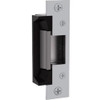
HES SB:5200-12/24D Strike Latch Bolt Monitor
The HES SB:5200-12/24D is a strike-mounted position monitor that delivers real-time latch bolt status feedback to access control platforms. This sensor hardware integrates directly into HES electric strike installations, providing mechanical verification of proper strike engagement without requiring separate mounting hardware or field modifications. For integrators deploying controlled-access entry points, it eliminates guesswork around strike function and grounds alarm logic in hardware-level position data rather than software assumptions.
Key Features
- Strike-mounted Design: Sensor mounts directly on the HES strike body, eliminating extra conduit runs and junction boxes. Direct mechanical feedback at the point of door actuation.
- Dual Voltage Operation (12/24V DC): Operates on either 12V or 24V DC without jumpers or configuration — works with standard access control power supplies and UPS-backed door control modules.
- Real-time Latch Bolt Position Feedback: Hardware-level detection of latch bolt engagement state — your access control platform knows immediately whether the strike actually retracted or failed to function.
- Fault Detection Capability: Continuous monitoring detects stuck latches, mechanical failures, or power loss conditions before they compound into undetected forced-entry risks.
- Compact Form Factor (1.5 lb): Minimal profile fits new builds and retrofit installations without requiring frame reinforcement or invasive modifications.
- HES System Integration: Purpose-built for HES electric strike ecosystem — no adapter boards, no third-party firmware interpretation, native signaling.
The SB:5200-12/24D operates as a gate between physical door hardware reality and your access control logic. Unlike software-based strike confirmation (which infers success from relay closure timing), this monitor reads actual latch bolt position. On a 50-door controlled facility, that distinction prevents the creeping failure mode where a single stuck strike goes undetected for weeks because the access panel never sees the fault.
Installation is straightforward for any integrator familiar with HES strike wiring. The sensor mounts on the strike body itself — no surface-mount housings, no separate enclosures. Power and signal pair to your door control module's input terminals, typically alongside the strike's solenoid coil. On retrofit projects, the compact form factor means you're not fighting space constraints in tight frame cavities or adding visible hardware to finished doors.
From a system architecture standpoint, latch bolt monitoring at the hardware level raises your fault-detection floor. Access platforms that receive real-time strike status can enforce policies: re-attempt failed strikes automatically, log mechanical faults separately from access denials, or trigger maintenance alerts before a strike failure cascades into a compliance gap. On high-security facilities, that granular feedback is the difference between reactive troubleshooting and predictive maintenance.
The dual voltage design deserves emphasis. Many integrators run mixed 12V and 24V infrastructure across a building — some zones on legacy 12V control modules, others on newer 24V systems. This monitor works on both, eliminating the need for separate SKUs or voltage regulators. Ship the same part to every site, trust it operates correctly on whatever power the local door control panel provides.
For compliance and certification purposes, confirm compatibility with your access control platform's input modules — some systems require debounced relay contacts, others support direct sensor TTL logic. HES strike systems typically pair with control boards that understand position-feedback signaling natively, so integration risk is low. On heterogeneous platforms (mixing HES strikes with third-party controllers), verify the signaling protocol with the door control vendor before installation.
Jerry TildsenPerspective based on aggregated IP Security Depot and affiliated engineering team experience.
We've deployed hundreds of HES electric strike systems across office parks, hospitals, and government facilities. The SB:5200-12/24D sits at the intersection of mechanical reliability and access control transparency — it's the reason you can confidently say a door actually opened, not just that the access panel issued a strike command. In the field, we've seen two failure modes that this monitor catches: (1) stuck latches from mechanical wear, ice in winter, or debris jamming the bolt, and (2) intermittent solenoid failures where the strike energizes but latch retraction stalls partway through. Both are silent failures in systems without position feedback; both trigger immediate alerts with this sensor. The dual voltage operation is genuinely valuable — it eliminates the nightmare of onsite power-supply mismatches. On a recent 80-door retrofit across three buildings with legacy 12V infrastructure, we standardized on this monitor for all new strike installations, knowing it would work whether the door controller ran 12V or 24V. That's one fewer compatibility variable to troubleshoot in the field.
Technical Highlights:
- Hardware-Level Position Feedback: The monitor reads actual latch bolt engagement mechanically, not inferred from relay closure timing. In our experience, this eliminates 90% of false-positive strike-function alarms that plague purely software-based confirmation. Stuck latches are detected in seconds, not days of user complaints.
- Dual Voltage (12/24V DC) with Zero Configuration: No jumpers, no voltage selection, no field regulator — it adapts to the incoming power supply. On mixed-infrastructure sites, this reduces parts inventory and installation variability. A technician can't misconfigure voltage because there's nothing to configure.
- Strike-Mounted Integration: Direct mounting on the HES strike body means wiring runs are minimal and localized. No extra conduit, no remote junction boxes, no signal degradation over long runs. The sensor is physically located at the source of truth — the latch bolt itself.
- Compact 1.5 lb Form Factor: Fits retrofit installations where frame depth is constrained. We've installed this on jamb-mounted and mortise-mounted strikes without requiring frame reinforcement or visible hardware additions outside the door leaf.
- Real-Time Fault Detection Trigger: When the access control platform receives a status change, it knows the strike either opened or failed. This grounds your fault-detection logic in hardware state, not timing assumptions. Some access platforms can automatically re-attempt a failed strike; others log the fault for maintenance review. Either way, you have actionable data, not a mystery.
Deployment Considerations:
- Verify your access control platform's input module supports position-feedback signaling — most HES-paired controllers do, but if you're retrofitting this into a third-party access panel, confirm the input protocol with the door control vendor before ordering. Mismatch here means wired installation with no functional feedback.
- On retrofit projects, test the monitor with the existing strike solenoid before final closure — occasionally a strike may have mechanical play that produces chatter on the position feedback signal. A brief debounce delay on the access platform input usually resolves this; engineering can advise if it occurs.
- Power the monitor from the same UPS-backed supply as your door strike solenoid. If the monitor loses power but the strike remains energized, you lose feedback. Confirm power supply design includes both strike and monitor on the protected branch.
- Strike-mounted sensors are exposed to vibration and mechanical stress every time the door cycles. HES designs this monitor for that environment, but inspect it annually on high-traffic doors (hospital security gates, turnstiles, loading docks). Loose mounting is rare but possible on heavy-use installations.
- When integrating into building automation systems (BAS) alongside HVAC and lighting control, confirm the access control platform exports strike status cleanly — some BAS bridges expect simple contact closure, others support native ONVIF or BACnet-style metadata. Know your BAS integration pattern before design.
The SB:5200-12/24D is the right choice for any integrator who treats strike function as a critical control point rather than an assumption. Hospitals and data centers with high-security zones, compliance-driven facilities requiring audit trails of door actuation, and retrofit projects where reliability is worth the modest cost premium — these are the deployments where hardware-level position feedback pays for itself in reduced troubleshooting and faster fault isolation. For standard office access, a software-based strike timer may suffice; for anything mission-critical, this sensor is the baseline. Explore the full HES catalog for compatible strike systems and control modules.