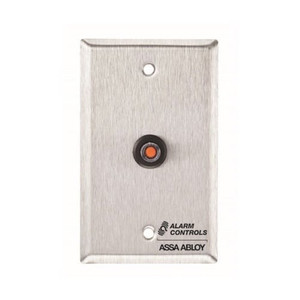
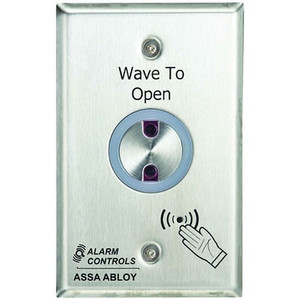
HES NTS-1 Infrared Contactless Access Control Switch
The HES NTS-1 is a contactless access control switch engineered for secure facilities where hands-free door activation reduces contamination risk and maintains operational security. Using infrared-based detection, the NTS-1 eliminates the need for physical contact at access points while integrating directly into existing electronic access control systems and door strike hardware. This switch addresses a real operational concern: high-traffic entry points where repeated hand contact poses hygiene and infection-control challenges — particularly relevant in healthcare, government, and corporate environments managing post-pandemic security protocols.
Key Features
- Infrared Detection Technology: Hands-free activation via infrared sensing means no physical pressure or surface contact required — deployed in hospitals and clinics where infection control directly impacts patient safety and staff confidence.
- Standard Access Control Integration: Connects seamlessly to existing electronic access control systems and electronic locking hardware — you won't need to replace your entire door infrastructure or rewrite access rules.
- Consistent Activation Sensing: Reliable infrared detection triggers door entry with predictable response — important for high-volume facilities where unpredictable switch behavior creates bottlenecks and frustration.
- Indoor-Rated Construction: Designed for temperature-controlled secure facilities (healthcare, government buildings, corporate campuses) — if you need outdoor-grade protection or extreme temperature tolerance, specify an outdoor-rated variant.
- Standard Mounting Compatibility: Fits existing access control door frame installations without extensive modification — reduces deployment cost and downtime compared to custom mechanical rebuilds.
- Security-Grade Build Quality: Purpose-engineered for controlled-access environments where reliability and durability are non-negotiable — suitable for 24/7 high-traffic entry points.
Integration & Compatibility
The NTS-1 (often searched as NTS 1) integrates with standard 12VDC electronic access control systems and door strike hardware commonly found in professional installations. The switch operates independently of network connectivity — no additional software, VMS licensing, or IT infrastructure required. Deployment involves wiring the infrared sensor into your existing door control circuit, then positioning it at the entry point where hand contact would normally occur. For facilities managing access control systems across multiple buildings, the NTS-1's plug-and-play wiring simplifies rollout without requiring centralized reconfiguration.
The infrared activation range and detection envelope are optimized for typical doorway geometry — verify mounting clearance and approach angles during site surveys, particularly in narrow corridors or alcove entries where positioning constraints may affect reliable triggering.
When to Choose a Different Model
If your facility requires outdoor-grade construction with extended temperature tolerances (below 32°F or above 122°F), or if you need integrated access logging and audit trails beyond simple door activation, explore weatherproof variants in the HES product family or hybrid systems that pair contactless switches with network-connected access controllers. If budget allows, some integrators specify redundant switches on high-security doors — a mechanical backup in addition to the infrared primary — to eliminate single points of failure in critical access zones.
Frequently Asked Questions
Q: Does the NTS-1 work with any electronic lock or only specific models?
A: The NTS-1 integrates with standard 12VDC electronic strike hardware commonly used in professional access control installations. Verify your existing strike voltage and wiring before specifying — most fail-secure and fail-safe strikes are compatible, but confirm with your lock manufacturer if using proprietary or non-standard hardware.
Q: What's the detection range of the infrared sensor?
A: The NTS-1 uses infrared detection optimized for typical doorway approach distances (mounting height 36–48 inches is standard). Exact range depends on ambient infrared background and sensor positioning — site-specific testing during commissioning is recommended, particularly in spaces with competing heat sources or direct sunlight entering the vestibule.
Q: Can the NTS-1 be mounted on an exterior door?
A: The NTS-1 is rated for indoor, temperature-controlled installations. Exterior doors, vestibules, or unheated loading areas require weatherproof variants rated for outdoor use — consult the HES catalog for outdoor-capable contactless switch models.
Q: Does the switch integrate with access management software or VMS?
A: The NTS-1 is a passive trigger device — it sends a contact closure to your existing access control panel (like any standard push button would). It does not connect to network cameras, VMS platforms, or cloud-based access management. If you need logging, audit trails, or integration with video surveillance, pair the switch with a network-capable access controller.
Q: What power supply does the NTS-1 require?
A: The switch operates on standard 12VDC supplied by your access control panel — no separate power supply or battery backup required. Confirm your panel provides adequate auxiliary 12V capacity before installation.
Q: Is the NTS-1 suitable for high-traffic entry points?
A: Yes. The infrared detection is engineered for consistent activation under heavy use — hospitals, government facilities, and corporate campuses with dozens or hundreds of daily entries are typical deployments. Watch for false triggers from cleaning staff with warm hands near the sensor or direct sunlight on the detector — positioning and shielding address most issues.
Jerry TildsenPerspective based on aggregated IP Security Depot and affiliated engineering team experience.
I've specified the HES NTS-1 in healthcare and government projects where hygiene standards and infection control are non-negotiable. The infrared contactless activation eliminates a real pain point — repeated hand contact on mechanical push buttons in high-traffic vestibules — and the switch integrates directly into existing 12VDC access control circuits without requiring software integration or network infrastructure. It's a straightforward mechanical solution to a hygiene problem.
Technical Highlights:
- Infrared Detection: Passive sensing requires no physical contact or pressure — critical for infection-control environments where button surfaces can harbor pathogens. The detection envelope is tuned for standard doorway geometry (36–48 inch mounting height), so installation is predictable and repeatable across multiple entry points.
- 12VDC Wiring: Operates on standard access control panel auxiliary voltage — no special power supplies, batteries, or separate circuits. This simplicity reduces deployment cost and avoids power-budget strain on existing panels.
- Standard Mounting: Fits existing access control door frames without frame modification — you're adding a sensor, not rebuilding the mechanical infrastructure. Straightforward for retrofit projects in occupied facilities.
Deployment Considerations:
- Infrared false-trigger risk in spaces with direct sunlight or competing thermal sources — position the sensor to minimize background heat interference, and test activation envelope during commissioning. Narrow alcoves or heavily trafficked corridors where users approach from multiple angles may require shielding or offset mounting.
- The NTS-1 is a passive trigger only — it sends a contact closure, not data. If you need audit logging, access history, or integration with video surveillance, you must pair it with a network-capable access controller. This is a feature limitation, not a flaw — understand your logging requirements before design.
The NTS-1 is the right choice for healthcare facilities, government buildings, and corporate campuses where hygiene and infection-control policies mandate contactless entry, and where your access control infrastructure is already standardized on 12VDC panels. Don't force it into outdoor or extreme-temperature applications — specify weatherproof variants for those roles. For facilities already managing access control infrastructure, the NTS-1 is a low-cost, low-risk hygiene upgrade that doesn't require panel replacement or network reconfiguration.