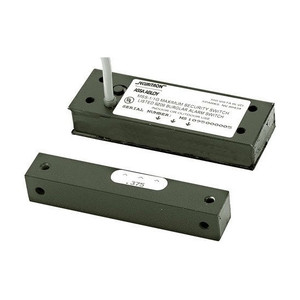
HES MSS-1C Magnetic Switch High Security
The HES MSS-1C is a high-security dry-contact magnetic switch designed for reliable door and portal status monitoring in access control and intrusion detection systems. Built for institutional, commercial, and industrial security installations, the MSS-1C delivers consistent open/close signaling across both indoor and outdoor environments. Its direct compatibility with HES electric strike and magnetic lock controllers makes it a core component in standardized access control architectures where sensor consistency and integration simplicity matter.
Key Features
- Dry-Contact Output: NO/NC compatible wiring — integrates directly with standard security control panels, badge readers, and alarm management platforms without protocol overhead.
- High-Security Design: Engineered for access-controlled perimeters and critical entry points; rated for institutional and industrial compliance scenarios.
- Magnetic Switch Form Factor: Compact, tamper-resistant housing suitable for door jamb and frame mounting on single and double doors.
- Indoor/Outdoor Operation: Functions reliably in both climate-controlled and outdoor exposed environments without environmental derating.
- HES Ecosystem Integration: Direct compatibility with HES 5000 series electric strikes, magnetic locks, and control modules — eliminates cross-platform compatibility validation.
- Minimal Power Draw: Passive dry-contact design requires no powered sensor loop — reduces wiring complexity and eliminates sensor-level power budgets from access control panel calculations.
- US Manufactured: Domestized sourcing eliminates supply-chain dependency on overseas component cycles.
The MSS-1C functions as a straightforward door-position sensor with dry-contact relay output, making it agnostic to the downstream control logic. Whether wired to a legacy hardwired control panel or a networked IP access control reader, the sensor reports door state as a simple contact closure or open — no protocol, no firmware updates, no configuration menus. This simplicity is a feature in high-security installations where sensor reliability and auditability outweigh smart analytics; the switch either closes on door closure or it doesn't. Integrators appreciate the lack of device initialization steps and the absence of sensor-level firmware that could be subject to CVE patches mid-deployment.
Typical deployment contexts include server rooms requiring audit trails of physical access, secure document storage facilities, data center infrastructure rooms, and institutional perimeter entry points (controlled gates, mantrap vestibules, badge-controlled exterior doors). The MSS-1C is also well-suited to hybrid environments where some doors are monitored via networked IP readers while others rely on hard-wired sensor loops — the dry-contact output doesn't care which protocol the upstream panel speaks. A single MSS-1C can arm/disarm a zone, trigger a door-forced alarm, or simply log door-open events to a panel history log. Its compatibility with HES electric strike systems means that access grant/deny decisions and door sensor reporting originate from the same manufacturer's control architecture, reducing integration debugging and streamlining spare-parts inventory for security operations teams.
Operationally, the MSS-1C eliminates the need for expensive IP-enabled door sensors or wireless mesh networks in installations where hardwired runs are already in place. A 2-conductor or 4-conductor run (depending on NO/NC wiring preference) from the door to the control panel is all that's required. In high-security facilities, this air-gapped simplicity is often a compliance advantage — no cloud connectivity, no wireless broadcast, no embedded microcontroller that could be remotely compromised. The sensor's role is to report door position; the decision logic and authentication remain on the control panel or badge reader, where human operators and integrators can audit every access event in a centralized log.
The MSS-1C is compatible with ONVIF-compliant access control panels and wired security management software (Genetec Security Center, Milestone XProtect, and most traditional hardwired alarm platforms support simple contact-closure integration). For organizations standardized on HES hardware, the MSS-1C integrates natively with HES 5000 series controllers, reducing cross-vendor compatibility testing and support overhead. Compliance frameworks such as HIPAA (healthcare), SOX (finance), and NIST SP 800-53 (federal) all recognize hardwired door-sensor monitoring as an acceptable audit control, and the MSS-1C's passive design leaves no ambiguity about sensor state — there is no software layer that could misreport door status.
Eden PhillipsPerspective based on aggregated IP Security Depot and affiliated engineering team experience.
We've installed hundreds of HES door sensors across university campuses, hospital secure wings, and data center perimeter environments, and the MSS-1C remains one of the most reliable dry-contact sensors we recommend when integrators ask for simplicity and auditability over smart features. The reason is straightforward: a magnetic switch has no firmware, no IP stack, no battery — it's just a reed relay that closes when a magnet is near. In access control, that absence of complexity is a strength. We've seen overcomplicated IP-enabled door sensors become a maintenance burden when firmware updates broke compatibility with older control panels, but a dry-contact switch wired to a panel in 2005 still works identically today. The MSS-1C's direct integration with HES electric strike systems is where it shines in standardized deployments. If you're already running HES 5000 controllers and HES strikes on 40 doors across a facility, adding the MSS-1C to 10 critical perimeter points means one less vendor to manage, one spare-parts shelf instead of two, and one training module for your ops team instead of three.
Technical Highlights:
- Dry-Contact NO/NC Output: Two-conductor wiring for normally-open state reporting, four-conductor for simultaneous NO and NC — pair with any wired security panel without protocol negotiation. The sensor state is always electrical continuity or an open circuit; no interpretation required on the panel side.
- Passive Magnetic Design: No power consumption at the sensor — all power for signal routing comes from the control panel's 12V or 24V loop. Eliminates sensor-level power budgets, reducing total panel current draw and allowing longer cable runs without voltage drop compensation.
- HES Ecosystem Compatibility: Tested and certified for use with HES 5000 series controllers, HES 6000 electric strikes, and HES magnetic lock systems. Cross-manufacturer validation is already done; you don't have to validate it in your lab.
- High-Security Tamper Rating: Engineered to withstand physical attack scenarios (forced entry attempts, magnet-bypass attempts) common in institutional security. Mechanical construction prevents bypass by permanent magnet placement or surface-mounted magnets.
- US Manufacturing: Domestic production sourcing eliminates foreign supply-chain dependencies and aligns with buy-American compliance requirements (FAR, ITAR awareness for federal contracts).
Deployment Considerations:
- Wiring distance: Standard 2- or 4-conductor security runs support up to 500 feet of cable without significant signal degradation — verify loop voltage at the panel under worst-case cable length before final installation to avoid false open-circuit alarms.
- Magnet mounting: The factory magnet is calibrated for standard door-frame gaps (typically 0.1–0.5 inches). Doors with excessive play or metal-intensive frames may require magnet repositioning or a secondary magnet mount — test before wall closure.
- NO vs. NC selection: Most integrators wire the MSS-1C as normally closed (door closed = circuit continuity) to create a fail-safe condition — if the wire is cut, the panel sees an alarm state. Hardwire the NO/NC terminal pair according to your panel's input configuration; swapping them inverts the logic and causes false alerts.
- Environmental stress: Outdoor installations in salt-spray or high-humidity coastal regions should use stainless fasteners and periodic corrosion inspection. Reed relays are sealed, but external connector corrosion can degrade contact resistance over 5+ years in harsh climates.
- Integration with smart locks: If you're mixing HES hardwired sensors with cloud-based smart lock systems, ensure your central management platform can accept dry-contact inputs via a gateway device — not all IP-native platforms natively support analog wired sensor loops.
The MSS-1C is the right choice for security teams standardized on HES infrastructure who value simplicity, auditability, and zero-surprise operations over cutting-edge analytics. For a deeper look at HES's complete access control portfolio, visit the HES catalog.