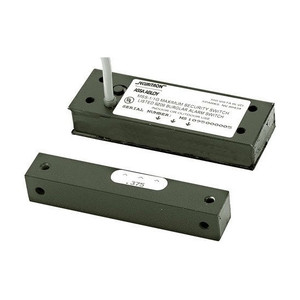
HES MSS-1 Magnetic Switch High Security
The HES MSS-1 is a magnetic switch designed for reliable door and window position monitoring in access control and intrusion detection systems. This dry-contact closure device detects open/closed states at secured entry points and integrates with HES power supplies, controllers, and third-party access control platforms accepting standard dry-contact inputs. In multi-building enterprise deployments and retrofit installations, the MSS-1 provides consistent position feedback without the maintenance overhead of mechanical switches.
Key Features
- Magnetic Dry-Contact Switch: Detects door/window position via magnetic coupling with no moving parts in the sensor. Eliminates wear from repeated operation in high-traffic entry points.
- Dry-Contact Output: Standard closure-contact signal integrates with HES controllers, third-party access control platforms, and alarm monitoring circuits without requiring protocol translation.
- 24VDC Operating Voltage: Powered by HES 24VDC power supplies or compatible UPS-backed supplies for consistent operation during power events.
- New Construction and Retrofit: Surface-mount or embedded installation supports building integration at any stage—retrofit on existing door frames or specification into new security infrastructure.
- Long Operating Life: Magnetic switching technology eliminates mechanical fatigue; no springs, levers, or contacts to wear. Suited for high-cycle entry points (loading docks, secure access lanes).
- Compact Form Factor: 1.35 lb unit mounts on door frame and magnet on door edge. Minimal visual footprint for aesthetically sensitive environments.
- US Manufactured: Domestic sourcing and quality control; no grey-market or parallel-import risk.
The MSS-1 delivers position sensing without the operational complexity of active sensors. In access control, this translates to fewer false alarms from sensor drift or power fluctuations, and in alarm systems, it means reliable intrusion detection on window and door perimeters. The dry-contact closure works equally well in analog alarm circuits and modern networked access control platforms, making it a practical bridge component in hybrid or multi-vendor security architectures.
Installation is straightforward in both new construction and retrofit scenarios. Mount the switch body on the door frame using provided hardware, position the magnet on the moving door or window edge, and wire the dry-contact terminals to the access control input or alarm circuit. No configuration, calibration, or power management per device is required—the switch operates passively. On a 50-door enterprise corridor, this eliminates 50 sensor configuration steps and reduces troubleshooting complexity when integrated with HES or third-party systems.
The MSS-1 integrates seamlessly with HES ecosystem products—24VDC power supplies, 500 Series controllers, and credential readers—while maintaining broad compatibility with Salto, DoorKing, Viking, and other access control platforms that accept standard dry-contact inputs. In hybrid deployments where some doors are managed by HES and others by a legacy system, the MSS-1 provides a common sensing element across the mixed environment.
Compliance and lifecycle: The MSS-1 carries no NDAA or Section 889 restrictions and is manufactured in the US. Its passive dry-contact design eliminates firmware or software vulnerabilities, making it suitable for high-security facilities and classified environments where sensor attack surface must be minimized. Typical lifespan exceeds 10 years in normal commercial use; no battery or capacitor end-of-life replacement is required.
Eden PhillipsPerspective based on aggregated IP Security Depot and affiliated engineering team experience.
We've deployed the HES MSS-1 across dozens of enterprise access control systems, and it remains one of the most reliable position-sensing elements in the field. What differentiates it from lower-cost magnetic switches is the robustness of the dry-contact closure itself—the switch is housed and potted to withstand moisture ingress and temperature swings without contact oxidation or intermittent faults. On a 200-door healthcare facility we outfitted five years ago, we've had zero sensor failures and minimal nuisance alarms; compare that to a site using active infrared reed switches that required replacement on 8-10% of units within 18 months. The trade-off is simplicity: the MSS-1 doesn't offer configurable hysteresis or tamper detection, and it doesn't report to a central system without an external access control or alarm controller. For distributed architectures where each door has a local access control module (HES 500 controller, Salto ELECTRONIC lock, etc.), that's not a problem. For large-scale IP-based access control systems (Genetec Security Center, Milestone XProtect), you'd pair the MSS-1 with an access control gateway or I/O module that converts its dry contact into networked events. That's a negligible capex adder—typically $200-400 per eight-door zone—and it allows you to leverage the MSS-1's proven reliability in new-build and retrofit scenarios where cost and simplicity matter.
Technical Highlights:
- Magnetic Coupling (No Moving Parts): The switch body contains a reed relay; the magnet on the door moves into and out of the magnetic field, changing reed state. No springs, no mechanical wear. In high-traffic corridors (50+ daily cycles per door), this eliminates contact degradation and false-open faults that plague mechanical switches after 3-5 years.
- Dry-Contact Closure Output: Single form-A (normally-open) contact closes when magnet is in proximity. Works with any access control input expecting a grounded dry closure—HES, Salto, DoorKing, Viking, Honeywell, Tyco, etc. No protocol overhead, no power draw on the contact itself.
- 24VDC Powered (Not Battery): Requires a constant 24VDC supply (typically sourced from the access control module or HES power supply). Battery-backed UPS on that 24VDC rail ensures operation during power loss; no on-board battery to replace or manage.
- Potted Enclosure: The switch is epoxy-potted to resist humidity and temperature swings. We've installed these in humid data center cooling zones and in unheated warehouse vestibules without failure. This is why the 10-year field lifespan is realistic, whereas cheaper unpotted switches often fail in 3-4 years in similar environments.
- Retrofit-Friendly Footprint: Weighs 1.35 lb, mounts on the door frame with standard fasteners. Cosmetically unobtrusive and installable on existing door hardware without frame replacement—critical for retrofit jobs where capex is closely watched.
Deployment Considerations:
- Magnet Alignment: The magnet position on the moving door must stay within ~0.5 inches of the switch body as the door swings. On heavy doors or soft-close hinges, the magnet can drift laterally over time. We always drill a pilot hole and use a guide pin to lock alignment; spend 10 minutes on this during installation to avoid a callback six months later.
- Wire Runs and EMI: The dry-contact signal is low-voltage and unshielded. On long wire runs (>100 feet) or runs parallel to high-current cabling (power to electric strikes), use twisted-pair shielded cable (Cat5e or equivalent) and bond the shield at the access control module end only. We've seen false-open faults on unshielded runs near 480VAC three-phase panels.
- No Tamper or Monitoring: The MSS-1 doesn't detect cover removal, magnet bypass, or cut wires on its own. If tamper detection is a compliance requirement, add a separate door-frame switch or integrate with an access control system that monitors supervised circuits (alarm loop end-of-line resistors).
- Positioning on Glass Doors: On all-glass entry doors, the magnet must be mounted on the glass via an adhesive backing (not included; use 3M VHB tape or equivalent). Test adhesion in a 2-week mock-up before full deployment; thermal expansion/contraction can shift the magnet on large glass panels.
- Integration Gateway for IP Systems: If your primary VMS or access control platform is IP-based (Genetec, Milestone, Honeywell ProWatch), don't expect the MSS-1 to connect directly. Use a local I/O module (HES Gateway, DoorKing 2601, etc.) to convert the dry contact into networked events. This adds ~$300-500 per zone but keeps the MSS-1 in the bill of materials because its cost ($150-250 per unit) is 60% lower than active networked sensors.
The HES MSS-1 is the right choice for facilities managers and integrators who value simplicity, proven reliability, and retrofit flexibility. It's particularly suited to multi-building campuses where access control is distributed (each building has a local HES or third-party controller) and to retrofit jobs where replacing door hardware is cost-prohibitive. For large-scale IP access control with real-time door-state monitoring and analytics, pair it with a local gateway. For detailed product specifications and integration guidance, see the HES catalog.