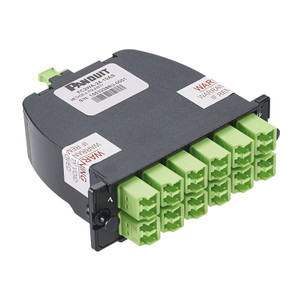
Panduit FHCWA-12-10AF HD Flex™ OM5 Fiber Cassette
The Panduit FHCWA-12-10AF HD Flex™ fiber cassette delivers OM5 wideband multimode connectivity in a compact, pre-terminated module designed for high-density datacenter and enterprise network deployments. This 12-fiber cassette terminates one MPO-12 male trunk connector to six duplex LC ports using Method A modified polarity (pair-inverted) and ships with Ultra Low Insertion Loss performance for extended reach and future-proofing 40GBASE-SR4, 100GBASE-SR4, and emerging 200G/400G short-wavelength division multiplexing (SWDM) applications. Built for IT professionals managing spine-leaf architectures, storage-area networks, or any environment where rack space, port density, and migration path matter as much as Day 1 bandwidth.
Key Features
- OM5 Wideband Multimode Fiber: Lime-green 50/125 µm OM5 supports legacy 10G/40G/100G Ethernet plus four-wavelength SWDM for future 200G/400G upgrades over the same installed fiber plant, eliminating costly re-cabling during technology transitions.
- Ultra Low Insertion Loss: Factory-tuned to <0.35 dB typical IL per connection (vs. standard <0.5 dB), extending usable link budget for longer reaches, additional interconnects, or margin against future transceiver sensitivity degradation.
- Method A Modified Polarity: Pair-inverted pinout aligns with TIA-568 structured cabling standards when paired with standard Method A trunk cables, simplifying polarity management across multi-tier networks and reducing field troubleshooting.
- MPO-12 Male to 6× Duplex LC: Single 12-fiber MPO trunk breakout delivers six full-duplex LC connections in one cassette slot, matching the port count of a 1U 6-port switch or blade while consuming minimal panel real estate.
- HD Flex™ Compact Form Factor: Fits Panduit's high-density modular enclosures, enabling up to 144 LC ports in 1U—ideal for leaf-switch aggregation, SAN fabric edge connections, or converged infrastructure where every rack unit counts.
- Polycarbonate Housing: Black UL 94V-0 flame-rated thermoplastic construction with integrated dust caps and strain relief, designed for repeated plug cycles and thermal cycling in ASHRAE-compliant hot-aisle environments.
- Factory Pre-Terminated & Tested: Each cassette ships with connectors pre-polished, inspected, and IL/RL tested to Panduit's six-sigma quality standard, eliminating field termination variability and DOA risk on Day 1.
OM5 Wideband Multimode Technology & SWDM Future-Proofing: Unlike OM3/OM4 optimized for a single 850 nm laser wavelength, OM5 fiber meets ISO/IEC 11801 and TIA-492AAAE specifications for low differential mode delay (DMD) and effective modal bandwidth (EMBc) across four distinct wavelengths in the 850–953 nm window. This wideband characteristic enables short-wavelength division multiplexing (SWDM), where a single fiber pair carries four parallel data streams on four lasers—effectively quadrupling bandwidth without adding fiber count. In practice, this means your OM5 plant installed today for 100GBASE-SR4 (which already uses parallel optics over eight fibers) can migrate to 200G or 400G SWDM on just two fibers per direction when next-generation transceivers arrive, preserving your cassette and trunk investment while slashing fiber consumption in constrained pathways. The FHCWA-12-10AF's Ultra IL spec further extends SWDM reach by keeping insertion loss below the 0.35 dB typical threshold—critical when you're splitting power across four wavelengths and every tenth of a dB affects whether you hit the full 100-meter OM5 distance or fall back to derated reach.
Method A Modified Polarity & Trunk Cable Pairing: Fiber polarity—ensuring transmit on one end maps to receive on the other—can make or break a multi-tier network rollout. The FHCWA-12-10AF implements Method A modified (also called "Method A with pair flip"), which inverts fiber pairs within each duplex LC port relative to the MPO pinout. When you mate this cassette to a straight-through Method A MPO trunk cable (pins 1–12 map directly 1–12 on both ends), the pair inversion inside the cassette compensates, delivering correct Tx-to-Rx polarity at the LC patch cord without requiring crossover adapters or field re-termination. This approach aligns with TIA-568-C.0 Annex B and is the de facto standard for most switch vendors' 40G/100G QSFP breakout modules. The practical win: you can stock one SKU of Method A trunk cable across your entire datacenter, use these cassettes at every aggregation point, and know that a standard LC-LC duplex patch from cassette to switch will light up correctly on first plug—no polarity testers, no last-minute field flips, no "why is port 3 down" troubleshooting calls at 2 AM during a maintenance window.
Deployment Context & HD Flex Ecosystem Integration: The FHCWA-12-10AF is purpose-built for Panduit's HD Flex modular cassette enclosures (sold separately), which mount in 19-inch racks and accept up to twelve cassettes per 1U depending on enclosure model. A typical use case: spine-to-leaf datacenter fabric where each top-of-rack leaf switch has six 100G QSFP28 uplinks. Run six 12-fiber MPO trunk cables from the spine switch (using a 72-port MPO panel) down to a 1U HD Flex enclosure at the leaf rack. Snap six of these FHCWA-12-10AF cassettes into the enclosure, plug the MPO trunks into the rear, and you've instantly got 36 duplex LC ports on the front—enough for six breakout connections to the leaf switch plus spares for future expansion or A/B path redundancy. The enclosure's sliding tray design lets you service or swap cassettes without disturbing adjacent modules, and the black polycarbonate housing includes molded guide rails that prevent cross-insertion into the wrong slot. For SAN fabrics, consider using two cassettes per server—one for Fabric A, one for Fabric B—and labeling the MPO trunks accordingly; the cassette's compact footprint means you can run dual-path redundancy without burning an extra rack unit. In converged infrastructure or hyperconverged deployments where compute, storage, and management networks share the same physical switches, OM5's SWDM capability means you can allocate some LC ports to today's 10G management traffic and others to 100G storage replication, then shift bandwidth as workloads evolve—all on the same fiber type.
Installation Workflow & Cable Management Best Practices: Installation is plug-and-play once the HD Flex enclosure is mounted. Remove the MPO and LC dust caps (save the MPO cap—you'll need it if you ever demount the trunk), inspect both MPO endfaces with a fiber microscope for contamination (even factory-new connectors can pick up particulates during shipping), clean if necessary with a one-click MPO cleaner, then insert the MPO trunk connector into the cassette's rear port until you hear the click—typical insertion force is under 10 pounds, and the cassette's internal spring latch retains the MPO without requiring a separate clip. Slide the cassette into the HD Flex enclosure from the front, and the enclosure's guide pins will align the cassette automatically; push until the front tab snaps flush with the panel. Label the cassette face with the trunk ID and destination (e.g., "Spine-1 Port 5 → Leaf-3"), and label each LC port with its corresponding switch port or VLAN assignment. Use Panduit's color-coded LC dust caps (aqua for OM5) on any unused LC ports to prevent contamination and provide instant visual confirmation of port status. On the MPO trunk side, dress cables in vertical or horizontal pathways with a minimum bend radius of ten times the cable diameter (typically 3 inches for 12-fiber trunk), and avoid routing MPO trunks across sharp rack edges or through tight grommets where the connector boot can snag. If you're running multiple trunks to the same enclosure, consider using breakout legs or fanout kits at the spine end to spread the MPO connectors across multiple panels—this reduces the risk of a single-panel failure taking down an entire leaf switch.
Ultra Low Insertion Loss Specification & Link Budget Impact: Insertion loss is the optical power penalty you pay every time light passes through a connector, and it directly subtracts from your available link budget. Standard multimode connectors are specified at ≤0.5 dB IL per mated pair; the FHCWA-12-10AF's Ultra IL performance guarantees <0.35 dB typical, tested at 850 nm per TIA-568.3-D and IEC 61300-3-34. Over a typical two-connector channel (cassette to patch panel), that's 0.7 dB best-case vs. 1.0 dB worst-case for standard-grade product—a 0.3 dB improvement that translates to roughly 20% more usable distance on a 100GBASE-SR4 link or the margin to add an extra interconnect (say, a cross-connect patch panel for moves/adds/changes) without violating the IEEE 802.3 power budget. This matters most in extended-reach scenarios: for example, running 100G between buildings on the same campus over OM5, where the fiber span might approach 100 meters and every tenth of a dB determines whether you need to upgrade to OM4 or single-mode. The Ultra IL spec also ages gracefully—connectors degrade over repeated plug cycles and exposure to dust, and starting at 0.35 dB gives you headroom before you cross the 0.75 dB operational threshold that most 100G transceivers require for error-free operation. Panduit achieves this performance through precision ceramic ferrule endface geometry, factory-controlled polish angles under 0.5 degrees, and automated interferometric inspection that rejects any connector with a scratch deeper than 50 nm—all documented in the cassette's serial-number-linked test report available via Panduit's online portal.
Return Loss, Connector Endface Standards & Cleaning Protocol: Complementing the Ultra IL spec, the FHCWA-12-10AF meets or exceeds TIA-568.3-D return loss (RL) requirements of ≥−20 dB for multimode LC and ≥−20 dB for MPO-12 connectors, measured per IEC 61300-3-6. High return loss (less negative number = worse performance) indicates back-reflection from the connector interface, which can destabilize VCSEL lasers in 40G/100G transceivers and introduce bit errors even when insertion loss is within spec. Panduit's factory polish process uses IEC 61300-3-35 geometry standards—physical contact (PC) endface with 7–25 mm radius of curvature and apex offset <50 µm—to ensure the fiber cores make direct contact and squeeze out the air gap that causes reflection. In the field, maintaining this performance requires proper cleaning discipline: inspect every connector before every mating using a 200× or 400× fiber microscope, and clean any connector showing scratches, pits, or particulate contamination using lint-free wipes wetted with >90% isopropyl alcohol (for LC) or a push-type MPO cleaner with built-in solvent reservoir (for the trunk). Never mate a dirty connector "just to test"—a single mating with a particle on the endface can embed that particle into the ferrule, causing permanent scarring that no amount of cleaning will fix. Budget for a fiber cleaning kit and inspection scope as part of every cassette deployment; the $500 cost of the tools pays for itself the first time you avoid a truck roll to replace a cassette damaged by contamination.
Standards Compliance, Environmental Ratings & Warranty: The FHCWA-12-10AF is manufactured to ISO 9001:2015 quality standards at Panduit's vertically integrated facilities and meets TIA-568.3-D, IEC 61754-20 (MPO), IEC 61754-4 (LC), and RoHS 2011/65/EU compliance for hazardous substance restrictions. The polycarbonate housing carries a UL 94V-0 flammability rating for plenum-ceiling or below-floor installation, and the internal fiber routing meets ANSI/TIA-568-C.3 minimum bend radius requirements (7.5 mm for 50 µm fiber) to prevent macrobending loss or long-term fiber fatigue. Operating temperature range is 0°C to +60°C, covering ASHRAE TC 9.9 recommended datacenter envelope and extended-range telco environments; storage temperature is −40°C to +75°C for cold-climate warehousing or outdoor equipment shelter staging. The cassette ships with MPO and LC dust caps installed, plus a serialized test report documenting per-port IL and RL measured at 850 nm and 1300 nm; retain this report for audit trails during TIA-942 datacenter certification or customer acceptance testing. Panduit backs the FHCWA-12-10AF with a comprehensive manufacturer warranty covering defects in materials and workmanship—register the serial number within 30 days of installation via Panduit's online portal to activate extended warranty terms and gain access to technical support, including polarity planning tools, fiber loss budget calculators, and application engineering assistance for complex multi-tier topologies.
The Panduit FHCWA-12-10AF occupies the sweet spot for IT and datacenter teams managing the 10G-to-100G transition while keeping an eye on the 400G horizon: OM5 wideband fiber eliminates the re-cable penalty when SWDM transceivers mature, Ultra Low IL preserves link margin for extended reach or extra interconnects during future expansions, and the HD Flex modular platform compresses 144 LC ports into 1U of rack space—freeing room for the compute and storage gear that actually generates revenue. Whether you're building a greenfield spine-leaf fabric, retrofitting a legacy SAN with 100G, or simply tired of wrestling with field-terminated connectors that fail at random, this cassette delivers the pre-tested, polarity-correct, future-proof connectivity that lets you close the maintenance window on time and move on to the next project.