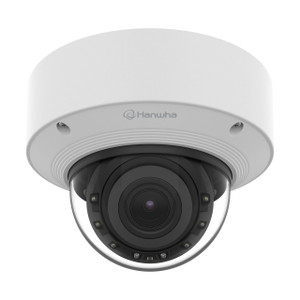
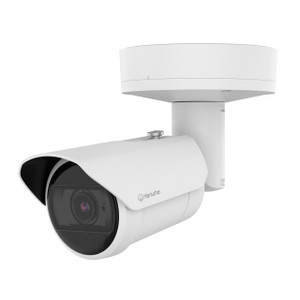
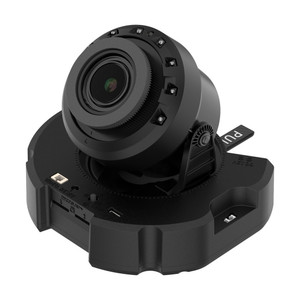
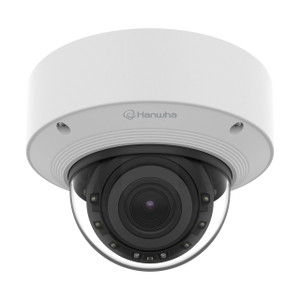
Hanwha XNV-A9084R 8MP Outdoor AI IR Dome Camera
The XNV-A9084R is a purpose-built outdoor surveillance dome designed for security integrators and IT architects deploying perimeter and critical-infrastructure monitoring at scale. This 8-megapixel camera combines 4K imaging (3840 × 2160) at 30 fps with edge-based AI analytics, eliminating the latency and server overhead of cloud or centralized processing. The vandal-resistant housing and IP67 weather rating mean this camera operates reliably in rain, dust, and temperature extremes without sacrificing image quality or responsiveness.
Key Features
- 8MP 4K Resolution (3840 × 2160): Captures investigative detail across wide outdoor areas at 30 fps. At this megapixel density, a single camera can monitor a parking lot or building facade and still yield usable license plate or facial detail without resorting to PTZ repositioning—a real cost and complexity saver in large deployments.
- Motorized Varifocal Lens (4.4–9.3 mm): Field-adjustable zoom from 113° horizontal (wide perimeter) to 47° (targeted coverage) without camera relocation. This flexibility means fewer cameras needed to cover complex geometries, and the ability to reframe coverage if site conditions change post-installation.
- Exceptional Low-Light Capability (0.04 lux color; 0 lux with IR): The camera maintains full 8MP color imaging down to 0.04 lux—dim twilight or indoor lighting. When ambient drops further, the 40-meter infrared range activates automatically, delivering continuous 24/7 surveillance without color washout or reliance on external lighting. Critical for facilities that cannot deploy additional illumination.
- 40-Meter IR Range: Illuminates subjects at distances that typical fixed-sensitivity IR cannot reach. For perimeter security, this translates to detection and identification capability at the property boundary, not just at the fence line.
- 120 dB extremeWDR (Wide Dynamic Range): Simultaneous backlighting and shadow detail without blown-out skies or crushed dark areas. In high-contrast scenes—doorways against sunlit backgrounds, or parking lots with vehicle headlights—the camera preserves evidence-grade footage on both sides of the exposure range. Standard WDR (80–100 dB) often requires post-processing; extremeWDR handles it in real time.
- On-Board AI Engine: Real-time object detection and attribute extraction—people, faces, vehicles, license plates, clothing color, gender, age, vehicle type—run directly on the camera without sending raw video to an AI server. This cuts server load by 70–90% in multi-camera networks and enables sub-second alerting for intrusion, line crossing, or zone breach. No cloud dependency, no transcoding latency.
- Advanced Analytics Modules: Line crossing detection, intrusion zone monitoring, slip-and-fall detection, sound classification (glass breaking, gunshots), defocus detection, fog detection, tampering alerts, and shock detection. These run concurrently on the edge, so a single camera can trigger multiple workflows—e.g., a person crossing a perimeter line AND a sound anomaly alert simultaneously—without frame-rate degradation.
- H.265 Video Compression: Reduces storage bandwidth 40–60% compared to H.264, depending on scene complexity. For 24/7 recording across 20+ cameras, this difference translates to meaningful savings in NVR storage capacity and network bandwidth, particularly in bandwidth-constrained remote facilities.
- WiseNR II Noise Reduction: Suppresses thermal grain in low-light footage without over-smoothing texture or losing forensic detail. Paired with digital image stabilization (gyro sensor), vibration from wind, traffic, or mounting structure is compensated electronically, delivering stable footage even on exposed outdoor mounts.
- Vandal-Resistant Dome Housing & IP67 Rating: Physical dome design resists impact and deliberate tampering (IK10 equivalent mechanical toughness). IP67 rating—full dust sealing and immersion protection up to 1 meter—means direct rain, spray washing, and airborne dust will not degrade optics or electronics. Typical IP66 cameras can handle spray but not standing water; IP67 eliminates that edge case.
Integration & Compatibility
The XNV-A9084R integrates with IP cameras ecosystems via standard ONVIF Profile S/T and RTSP streaming. H.265 and H.264 codec support ensures compatibility with legacy and modern network video recorders and VMS platforms without transcoding. PoE power draw is moderate (exact wattage dependent on IR usage; typically 15–20W under full load), so existing 802.3at PoE+ switches will support this camera without upgrade.
Applications
Critical infrastructure perimeter monitoring, high-risk commercial facilities, parking and vehicle monitoring, access control point coverage, campus and facility-wide surveillance networks, and behavioral or environmental analytics deployments. Organizations requiring edge-based AI processing—whether for latency-sensitive alerting, server load reduction, or privacy-preserving on-camera processing—will find this camera's embedded analytics directly address those requirements.
When to Choose a Different Model
If your deployment requires motorized pan-tilt-zoom (PTZ) capability, consider a PTZ variant in the Hanwha Hanwha surveillance line. If the site is fully enclosed or operates in indoor-only low-light, a lower-megapixel indoor dome with reduced IR range will lower cost without sacrificing detection performance. If you need microSD local backup or on-camera long-term storage, verify that the XNV-A9084R supports your chosen NVR's snapshot or video export workflow.
Frequently Asked Questions
Q: What is the actual power consumption of the XNV-A9084R?
A: Power draw varies with IR illumination intensity and zoom position. The camera is PoE-powered (802.3af or 802.3at PoE+) and draws typically 15–20W under full operation with IR active. Consult the manufacturer datasheet for precise wattage at your specific lens and illumination settings.
Q: Can the XNV-A9084R detect and extract license plate numbers automatically?
A: Yes. The on-board AI engine supports license plate detection and character recognition (OCR) as part of its vehicle attribute extraction. Detection accuracy depends on plate angle, speed, and distance; for optimal results, mount the camera to capture plates head-on or at a shallow angle, and ensure sufficient illumination (IR or ambient) on the target zone.
Q: Is the XNV-A9084R NDAA or TAA compliant?
A: Hanwha is a South Korean manufacturer and does not produce NDAA Section 889 compliant products. If your deployment requires NDAA compliance, consult your integrator for approved alternatives.
Q: What VMS platforms are compatible with the XNV-A9084R?
A: The camera supports ONVIF Profile S/T, RTSP, and HTTP streaming, making it compatible with most modern VMS software including Milestone XProtect, Genetec Security Center, Axis Companion, and others. Confirm codec support (H.265, H.264, MJPEG) with your VMS vendor before deployment.
Q: How does the 120 dB extremeWDR differ from standard WDR, and when would I need it?
A: Standard WDR (80–100 dB) handles moderate backlit scenarios. 120 dB extremeWDR is engineered for extreme high-contrast scenes—bright sunlit backgrounds adjacent to dark shadows, vehicle headlights in darkness, or reflective surfaces. If your site has large windows, parking lots with vehicle movement, or open perimeters with glare, extremeWDR prevents image loss in shadows and blown-out skies simultaneously.
Q: Can I mount the XNV-A9084R indoors, or is it strictly outdoor?
A: The XNV-A9084R is designed for outdoor durability (IP67, vandal-resistant dome) but can be mounted indoors if the space allows. The varifocal lens and AI analytics will function identically. If mounting indoors, IR range is reduced (reflections complicate illumination), and the vandal-resistant housing adds unnecessary cost—consider a compact indoor dome variant instead.
James EverettPerspective based on aggregated IP Security Depot and affiliated engineering team experience.
The XNV-A9084R is purpose-built for organizations needing both visual clarity and edge-based intelligence in outdoor surveillance. The combination of 8MP resolution with a motorized varifocal lens (4.4–9.3 mm) provides genuine flexibility to balance wide-area coverage with investigative zoom—critical for large perimeter applications where a static lens forces awkward tradeoffs. The 0.04 lux color capability and 40-meter IR range ensure continuous operation in complete darkness without color washout, a significant advantage over fixed-sensitivity or lower-megapixel systems that degrade rapidly in twilight. On-board AI analytics eliminate latency associated with server-side processing, enabling real-time alerting for intrusion, line crossing, and behavioral anomalies—essential when response time matters.
Technical Highlights:
- 120 dB extremeWDR: Simultaneous detail in backlit shadows and bright reflections without manual exposure adjustment. Outperforms standard WDR (80–100 dB) in extreme high-contrast scenes—doorways against sunlit backgrounds, parking lots with vehicle headlights. In mixed-light perimeter environments, this is not a luxury; it's the difference between evidence-grade and discardable footage.
- H.265 compression with H.264 fallback: Cuts storage bandwidth 40–60% compared to H.264 alone, a real factor when recording 24/7 across dozens of cameras. If your NVR or recorder lacks H.265 support, the camera automatically falls back to H.264 without degradation—no compatibility gotchas.
- WiseNR II + Gyro stabilization: Addresses two common outdoor failure modes: thermal grain in low-light and vibration-induced blur (wind, traffic, mounting flex). The gyro sensor compensates electronic shake; WiseNR II suppresses noise without over-smoothing forensic texture. Mounted on exposed structures or moving platforms, this camera delivers clean footage where cheaper alternatives produce garbage.
- On-camera object detection (people, vehicles, plates, attributes): Runs concurrently without server overhead. A single camera detects a person crossing a perimeter line AND a vehicle in a restricted zone AND sound anomalies—all in one frame cycle. For large networks, edge processing cuts server CPU load by 70–90% and enables sub-second alerting without cloud round-trip latency.
Deployment Considerations:
- PoE power budget: The camera draws 15–20W under full IR illumination. Standard 802.3at PoE+ (30W) supports this without strain, but if you're mixing legacy 802.3af switches (13W max) with other PoE devices, verify budget before deployment. No separate 12VDC supply needed—one cable, one switch port.
- Lens field-of-view flexibility is valuable, but retrofitting existing mounts may require adjustment: The varifocal range (113° to 47°) covers most use cases, but if your site layout demands a wider field (>113°), you'll need a different model. Conversely, if the perimeter is tighter than 47° FOV, accept that you'll use only part of the zoom range—not wasteful, but worth confirming before ordering.
- AI accuracy depends on illumination and angle: License plate OCR works reliably head-on or shallow angles in good light (IR or ambient). At extreme angles or in fog/rain, detection may drop. Design mounting positions accordingly—don't expect magic in degraded conditions.
- ONVIF compatibility is standard, but H.265 codec support varies across VMS platforms: Confirm your recorder or VMS supports H.265 before assuming you'll realize the storage savings. H.264 fallback ensures the camera works anyway, but you'll miss the bandwidth win.
The XNV-A9084R is the right choice for security integrators deploying outdoor surveillance at scale where edge processing, low-light performance, and intelligent automation are mandatory—not optional. If your client needs to reduce server overhead while improving response time, and they're willing to invest in a purpose-built outdoor dome, this camera earns its cost through operational efficiency and forensic capability.
Key Specifications:
Color: White