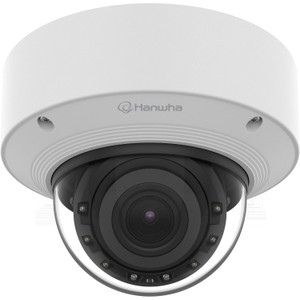
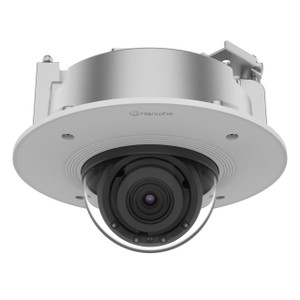
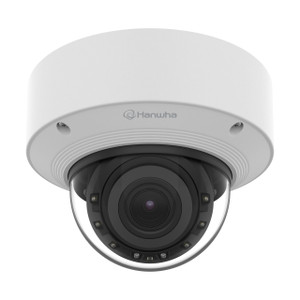
Hanwha XND-A8084RV 5MP AI IR Dome Camera
The Hanwha XND-A8084RV is a 5MP indoor dome engineered for surveillance deployments where onboard AI analytics, image clarity, and cybersecurity matter. Built on Hanwha's platform with dual NPU acceleration, this camera delivers sharp 2560 × 1920 resolution at 30fps while performing real-time object detection and business intelligence analysis directly on the device—eliminating the need for external analytics servers and reducing infrastructure overhead.
Key Features
- 5MP (2560 × 1920) resolution: Sufficient detail for identifying faces and objects at typical indoor distances without driving up storage or bandwidth costs as aggressively as higher-megapixel alternatives would.
- Motorized 3.3–9.3mm varifocal lens: Adjusts remotely without physical access—critical when reconfiguring coverage areas or fine-tuning focus on existing installations. Saves labor and reduces the need to purchase multiple fixed-lens variants.
- 120dB Wide Dynamic Range (WDR): Balances exposure across scenes with both bright windows and dark corners. In retail or banking environments with mixed lighting, you get usable footage from entry areas and interior zones without separate high-speed shutter adjustments.
- 50m IR illumination with integrated WiseIR: Delivers reliable night vision across large indoor spaces—parking garages, warehouses, and after-hours retail floors. The 50-meter effective range means fewer cameras needed in long corridors or open-plan facilities.
- Dual NPU-accelerated AI object detection: Processes people, faces, vehicles, and other objects on the edge. People counting, queue monitoring, occupancy analysis, and heat mapping run locally without sending video streams to a central server. This cuts network load and server CPU overhead—a real advantage when deploying dozens of cameras on bandwidth-constrained networks or in environments requiring fast, local decision-making.
- H.265, H.264, and MJPEG compression: H.265 cuts storage requirements roughly in half compared to H.264 for the same quality level—meaningful when recording 24/7 across multiple cameras. Choose H.264 or MJPEG for compatibility with older NVR systems or when CPU cost on the recorder is a constraint.
- PoE IEEE 802.3af Class 3 power delivery: Draws under 13W, so it will not strain standard switch power budgets. No separate 12VDC supply needed; a single Ethernet cable provides both connectivity and power.
- microSD card storage with encryption: Local backup of video on the camera itself. Useful for edge recording if the network fails or for storing high-value clips without depending on centralized storage infrastructure.
- IK10 vandal-resistant dome housing: Resists impact from tools and blunt force—required in high-risk areas like transit hubs, correctional facilities, or hostile environments. Skip this if your deployment is low-risk and budget-constrained.
- IP52 rated for protected indoor installations: Protects against dust and limited water spray. Suitable for covered loading docks, semi-outdoor atriums, or humid indoor spaces. Do not deploy outdoors in direct rain or submersion scenarios—that requires IP66 or higher.
Integration & Compatibility
The XND-A8084RV supports Hanwha IP cameras ecosystem standards: HTTPS encryption, ONVIF compatibility for third-party VMS platforms, and secure element alignment with FIPS 140-3 Level 3 standards. Encrypted firmware and secure boot protect against tampering—critical for government, financial, healthcare, and critical infrastructure deployments. ONVIF Profile S/T support integrates with Milestone XProtect, Genetec, Exacq, and other major VMS platforms, so you are not locked into Hanwha software if your architecture requires a different recorder.
When to Choose a Different Model
If you need true outdoor operation with weather resistance and higher megapixel density, look for an outdoor IP camera variant in the Hanwha catalog with IP66 or higher. If your scene demands higher zoom capability or motorized pan/tilt, consider a PTZ alternative from the Hanwha line. For low-light scenes where IR is insufficient, evaluate a Hanwha low-light optimized model with larger sensor or faster optics.
Applications
Ideal for retail environments, office buildings, banks, healthcare facilities, and government installations. The combination of varifocal optics, AI analytics, compact dome form factor, and vandal resistance makes it suited for entrances, hallways, reception areas, and retail floors where both situational awareness and operational intelligence are required.
Frequently Asked Questions
Q: Does the XND-A8084RV support remote focus and zoom adjustment?
A: Yes. The motorized 3.3–9.3mm varifocal lens allows remote focus and zoom via the camera interface or VMS. You can adjust framing without physically accessing the camera.
Q: What is the maximum IR illumination range?
A: 50 meters (164 feet) with integrated WiseIR. Effective range depends on scene reflectivity and target size; count on usable imagery out to roughly 40–45 meters in typical indoor environments with average surfaces.
Q: Is the XND-A8084RV (often searched as XND A8084RV) compatible with Milestone XProtect and other third-party VMS platforms?
A: Yes. ONVIF Profile S/T support enables integration with Milestone, Genetec, Exacq, and other standard-compliant VMS platforms. Native Hanwha integration is also available through Hanwha's own management software.
Q: What are the power requirements, and can I use standard PoE?
A: The camera draws under 13W and operates on IEEE 802.3af Class 3 PoE. No additional power supply is required; a single Ethernet run provides both power and connectivity.
Q: What is the difference between H.265 and H.264 compression, and which should I choose?
A: H.265 cuts storage by roughly 40–60% compared to H.264 at equivalent quality. Use H.265 for new installations with modern NVRs or cloud storage. If your NVR or VMS is older and does not support H.265 decoding, stick with H.264. MJPEG is rarely needed in modern deployments unless you have legacy browser-only access requirements.
Q: What makes the AI object detection useful compared to traditional motion detection?
A: AI classification identifies specific object types (people, vehicles, faces) and filters out non-relevant motion like shadows or foliage. This reduces false alarms and enables business logic—people counting, queue length monitoring, occupancy tracking—without sending full-resolution video to a central server. Edge processing also cuts latency for real-time operational insights.
Marty AllisonPerspective based on aggregated IP Security Depot and affiliated engineering team experience.
The XND-A8084RV represents a mature balance between image quality, onboard intelligence, and enterprise security. At 5MP with 120dB WDR and 50m IR range, it delivers usable imagery across typical indoor lighting conditions—entry halls with bright sunlight bleeding through doors, dimly lit warehouse aisles, and after-hours retail spaces all produce forensic-grade footage. The motorized varifocal lens is a practical win: it eliminates the need to stock multiple fixed-angle variants and lets you adjust coverage without a ladder and wrench.
Technical Highlights:
- Dual NPU-accelerated edge analytics: AI object detection runs on the camera itself, not on your NVR or server. For a 50-camera retail or warehouse deployment, this means your central recorder is doing video storage and retrieval instead of burning CPU on analytics. Real-time people counting, queue monitoring, and occupancy heat maps flow directly from the camera without network lag or server overhead.
- H.265 compression with WiseStream: Expect 40–60% storage reduction compared to H.264 for the same quality. On a 30-camera, 24/7 retail operation, that's a material cost savings over time—fewer NVR drives, lower cloud egress fees, or extended retention on the same hardware.
- IK10 dome housing and FIPS 140-3 Level 3 security element: Resists deliberate tampering and environmental stress. Essential for high-risk sites (transit, correctional facilities, government) where camera destruction or firmware compromise is a real threat model. For low-risk office or retail, IK10 is defensive overkill—but cheap insurance against angry customers.
- Sub-13W PoE draw on standard 802.3af: No power budget headaches on a standard managed switch. Pair this with a PoE switch and you can daisy-chain dozens of these without hitting the 95W aggregate limit of a single port group.
Deployment Considerations:
- IP52 rating is indoor/semi-outdoor only. A brief rain or sustained humidity will not kill it, but direct submersion or outdoor mounting in a thunderstorm is out of scope. Verify your ceiling design and HVAC before assuming it will survive a leaking roof.
- The 50m IR assumes reflective indoor surfaces—painted drywall, stainless steel, signage. Long hallways with dark carpet and few reflectors will see effective range drop to 30–35m. Test before committing to a specific spacing plan.
- ONVIF integration is solid, but native Hanwha APIs offer richer feature access (granular AI filtering, advanced WiseStream tuning). If your VMS is third-party only, plan for feature parity trade-offs.
Best positioned for retail operations, bank branches, government offices, and healthcare facilities where AI-driven occupancy analysis, queue management, and people counting add operational value without central server burden. Skip this model if you need true outdoor durability (IP66+) or pan/tilt capability.