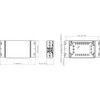
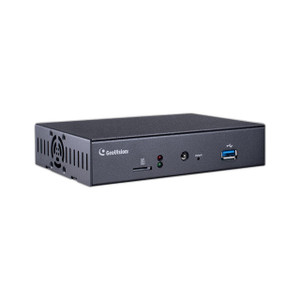
Geovision 89-PN40000-B10U GV-PN400 Network Player
The Geovision GV-PN400 is a dedicated network video player designed for centralized live monitoring and playback of IP camera feeds without relying on PC-based VMS infrastructure. It connects directly to Geovision IP cameras and third-party ONVIF-compliant devices over Ethernet, decoding multi-channel video streams and routing them to standard office or control-room displays via HDMI or VGA. Deployments range from small retail command centers to larger distributed security operations where dedicated, appliance-style video walls replace server-dependent monitoring stations.
Key Features
- Multi-Channel Network Decoding: Handles simultaneous IP video streams from multiple cameras without external computing resources. Simplifies control-room setup by eliminating PC hardware and licensing costs.
- Dual Display Output: HDMI and VGA outputs enable flexible display routing—single monitor or cross-facility feed aggregation on standard commercial displays.
- IP PTZ Camera Integration: Native support for Geovision PTZ models and ONVIF Profile S/T PTZ devices. Pan-tilt-zoom commands issued directly from the player interface.
- Compact Form Factor: Rackmount or tabletop deployment in confined control rooms, retail back-offices, or vehicle command centers. Low power draw reduces operational overhead.
- Network-Native Architecture: No embedded storage or processing bottlenecks. All streams sourced over standard Ethernet; video scaling and output encoding handled internally.
- Remote Monitoring & Control: Ethernet-based access allows remote camera selection, live switching, and PTZ control from mobile or PC clients on the same network or via VPN tunnel.
- Plug-and-Play Interoperability: ONVIF compliance ensures compatibility with third-party IP cameras and encoders, reducing vendor lock-in on multi-manufacturer installations.
The GV-PN400 functions as a mid-scale alternative to full VMS licensing or PC-based monitoring walls. Operators control live camera selection, zoom, and PTZ via intuitive on-screen menu navigation or remote clients. The absence of dedicated storage or compute overhead means installation time is measured in minutes—connect cameras, assign outputs, and monitor. Ideal for retail chains managing multiple locations, warehouses with distributed PTZ coverage, or enterprises deploying temporary command centers for events or emergency response.
Because the player draws video directly from IP cameras over the network rather than from a centralized NVR, there is no recording bottleneck or shared bandwidth contention at playback time. Multiple operators can monitor different camera subsets simultaneously on independent displays. The dual-output architecture supports asymmetric deployment: one display dedicated to zone A surveillance, another to zone B, both fed from a single compact appliance. This topology scales efficiently to 8–16 camera input streams depending on network and codec load.
Integration with Geovision GV-VMS or third-party Milestone Xprotect, Genetec Security Center, or Avigilon Control Center systems is supported via ONVIF streaming and HTTP API calls. The player can be pre-positioned in a secure network segment and fed video from VMS-managed archives or live encoder outputs, decoupling monitoring hardware from recording infrastructure. This separation simplifies disaster recovery and allows control-room refresh without re-architecting camera or storage systems.
The GV-PN400 carries no regional restrictions and integrates with standard commercial IT networking gear. Power consumption and fanless operation (depending on configuration) suit 24/7 unattended operation in industrial or outdoor utility closets. Pair it with a UPS and Ethernet surge protection for deployments requiring high availability.
Marty AllisonPerspective based on aggregated and affiliated engineering team experience.
We've deployed the Geovision GV-PN400 in retail command centers, warehouse monitoring stations, and temporary security operations — and the value proposition is straightforward: you get a dedicated, fanless appliance that streams live IP video to a display without the overhead of a full VMS license or the maintenance burden of a Windows PC sitting in a control room. In our experience, the most common use case is small-to-medium retail or manufacturing operations that have 4–12 Geovision IP cameras spread across a site and want a single, always-on monitor wall that doesn't require a server rack or IT babysitting. The player handles multi-channel decode gracefully, PTZ commands work natively on compatible cameras, and remote access via Ethernet or VPN is straightforward. Against alternatives like running a Windows-based VMS or deploying a PC connected to an IP video switch, the GV-PN400 costs less, consumes less power, and produces fewer support tickets. That said, it's not a replacement for recording and archival — it's a playback and live-monitoring appliance. If you need simultaneous recording, forensic playback, or long-term retention, you pair this with a GV-NVR or third-party NVR and feed the player a live stream. The learning curve is minimal: network-connected personnel can have multi-camera monitoring running in under an hour.
Technical Highlights:
- ONVIF Profile S/T Compatibility: Works with Geovision GV-IP, Axis, Hanwha, and other ONVIF-compliant IP cameras. Multi-vendor camera deployments eliminate the need for separate proprietary playback appliances per brand.
- Dual Video Output (HDMI + VGA): Older displays and distribution amplifiers work via VGA; new commercial displays and video walls use HDMI. Flexibility to repurpose existing infrastructure without video matrix switch hardware.
- Native IP PTZ Control: Pan-tilt-zoom commands embedded in ONVIF or Geovision protocol; no separate PTZ driver or control software needed. Site operators use a single interface for live viewing and camera adjustment.
- Network-Only Architecture: No local storage, no USB or SD card dependencies, no embedded OS bloat. Reduces attack surface and simplifies compliance (no sensitive video cached on the device).
- Remote Monitoring API: HTTP-based remote client access means a supervisor or off-site security manager can switch live views and issue PTZ commands without a dedicated VPN appliance or additional licensing seats.
Deployment Considerations:
- Network bandwidth: At H.264 Full HD 30fps per stream, allocate 3–5 Mbps per camera. With 8–10 simultaneous streams, a dedicated 100 Mbps switch port or VLAN is recommended. Multicast streaming reduces bandwidth if your network supports it; verify with your IT team before installation.
- Display scaling: The GV-PN400 outputs native resolution; if your monitor is lower resolution than the source camera stream, on-screen scaling occurs in real time. No performance penalty, but CPU-bound graphics rendering on very high-resolution sources (4K+) may introduce mild lag on older firmware versions.
- Remote access security: If exposing the player to remote management over the internet, use a VPN gateway or firewall ACL. The device is built for LAN monitoring first; wide-area remote control requires proper network segmentation.
- Integration with existing NVR/VMS: The player sources live video independently. If you have a separate NVR recording the same cameras, the two systems do not conflict — the player simply subscribes to the IP stream from the camera, not from the NVR. This decoupling is a strength but means you manage credentials separately for each system.
- Power and cooling: Fanless or low-noise operation makes the GV-PN400 suitable for unattended closets or retail environments. Verify ambient temperature specs (typically 0–50°C); ensure Ethernet cable strain relief is secure if mounted in high-vibration environments (shipping areas, HVAC rooms).
The GV-PN400 is the right appliance for small-to-mid-scale operations that need dedicated live monitoring without VMS licensing, and for integrators building monitoring stations that prioritize simplicity, low total cost of ownership, and seamless multi-vendor IP camera compatibility. Explore the full Geovision catalog to find complementary encoders, PTZ models, and NVR solutions that pair with this player in larger deployments.