
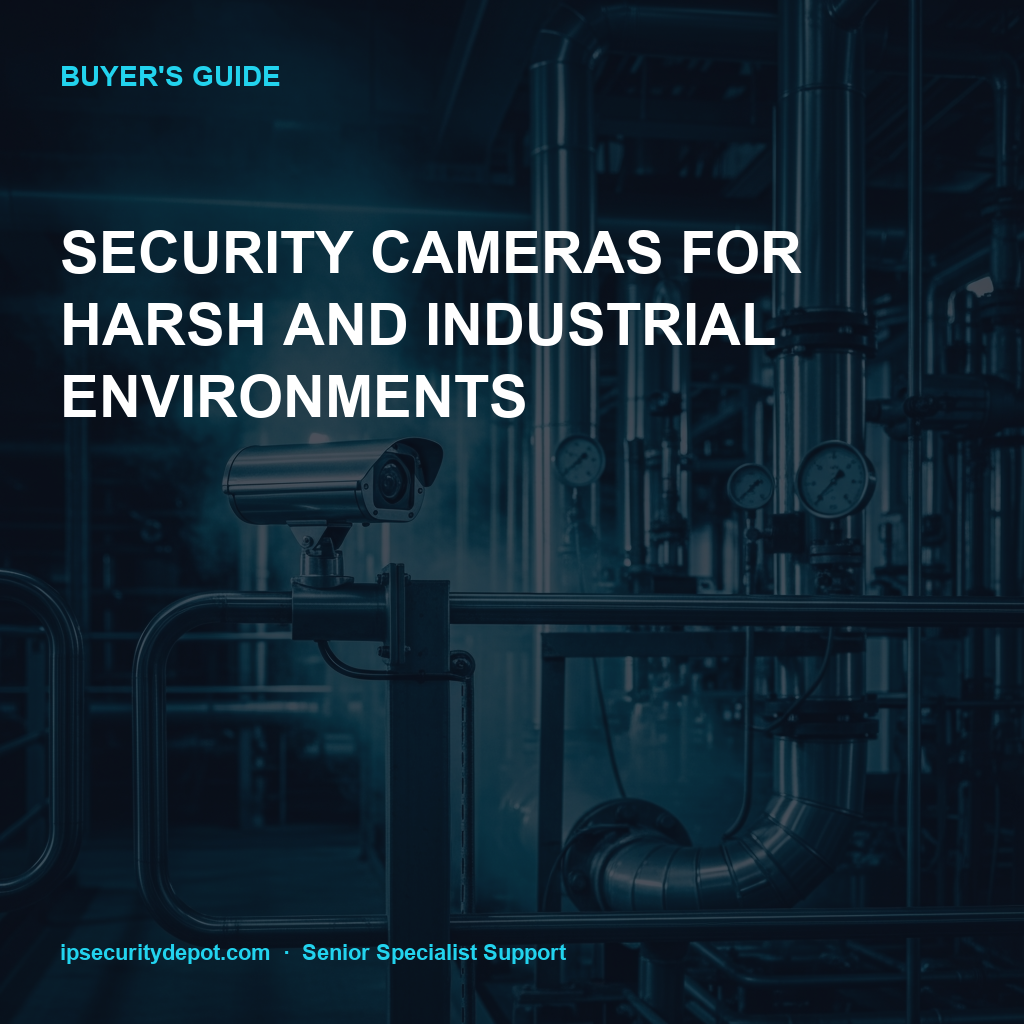
Security Cameras for Harsh and Industrial Environments
Industrial camera deployments live in environments that consumer and commercial-grade cameras can't survive — oil refineries, chemical plants, metal mills, food processing, marine, mining, and water treatment. This guide covers what specs actually matter, which certifications to require, and how to spec cameras that survive the full duty cycle.
- Industrial cameras require ATEX, IECEx, or Class I Div 2 certification for hazardous locations
- Stainless steel (316L) enclosures are mandatory in food processing and marine environments
- Vibration ratings (IEC 60068-2-6, MIL-STD-810G) matter for mining, milling, and rail-adjacent installs
- Plan for 7-12 year camera lifespan in industrial settings — the upfront cost reflects the lifecycle
Certifications and ratings
Certifications you'll see on industrial-camera spec sheets and what each means:
| Certification | Means | Required for |
|---|---|---|
| ATEX (European) | Equipment for explosive atmospheres | EU and global ex-rated zones |
| IECEx | International ex-rating | Global ex-rated zones |
| Class I Div 1 / Div 2 | North American ex-rated zones | US refineries, chemical, oil & gas |
| NEMA 4X / NEMA 6P | Outdoor + corrosion / submersion | Food processing, marine, wash-down |
| MIL-STD-810G | US military environmental durability | Defense, transit, heavy industrial |
| IEC 60068-2 | Vibration and shock resistance | Mining, milling, rail |
| IK10 / IK11 | Impact resistance 20J / 50J | Forklift exposure, vandal-prone industrial |
Industrial camera shortlist
Thermal imaging cameras
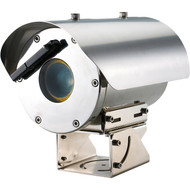
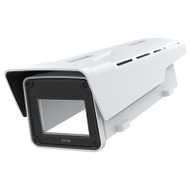
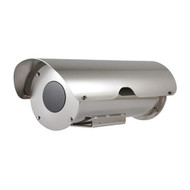
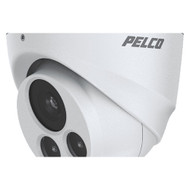
Thermal imaging cameras for hot work, gas detection, perimeter, and process monitoring:
Explosion-proof models
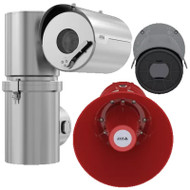
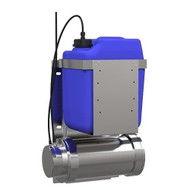
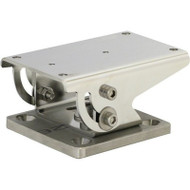
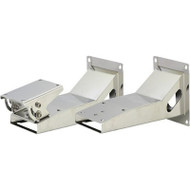
Explosion-proof and hazardous-location cameras:
Environment-specific requirements
Environment-specific requirements
| Environment | Camera requirements | Common deployment |
|---|---|---|
| Oil & gas, refinery | ATEX / IECEx / Class I Div 2, stainless or coated | Perimeter, process monitoring, flare |
| Chemical / pharma | 316L stainless, ATEX, washdown rated | Process tanks, fill lines, clean rooms |
| Food processing | IP69K, 316L stainless, NSF rated | Production line, packaging, cold storage |
| Marine / port | NEMA 4X or 6P, marine-grade aluminum | Dock, pier, ship-board surveillance |
| Mining / quarry | MIL-STD-810G, IK10+, broad temp range | Truck dispatch, conveyor, pit walls |
| Steel mill / foundry | High-temp ratings, thermal pairing | Furnace operations, casting, slag handling |
| Water/wastewater | IP67, anti-corrosion, lightning protection | Pump stations, sludge pits, treatment ponds |
AF Zoom for industrial use
AF Zoom for industrial deployments
Autofocus zoom (AF Zoom) cameras adjust both focus and zoom remotely without physical access. Industrial sites need these for two reasons:
- The camera mount is high or inside a hazardous area — physical adjustment requires hot work permits, scaffolding, or shutdowns
- The view needs change over time (different processes, seasonal vegetation, equipment moves) and the camera must adapt
Look for AF-Z cameras with at least 5x optical zoom and remote-PTZ-capable focus. Examples in the industrial class include Axis Q35-LV/PV series, Hanwha PNB-A series, i-PRO X-Series with PTZ, and Bosch Dinion IP starlight 8000i.
Frequently asked questions
- What's the difference between IP66 and IP69K?
- IP66 protects against powerful water jets (typical outdoor rain and pressure-washing). IP69K adds protection against high-pressure, high-temperature wash — the standard for food processing and pharmaceutical environments where surfaces are cleaned with 80C water at 1500 PSI. If your environment includes pressure washing, specify IP69K from the start. Substituting IP66 for IP69K will cause water ingress within months.
- Do I need explosion-proof cameras at every camera location in a refinery?
- Only inside the ex-rated zones (Zone 0, 1, 2 in IEC; Class I Div 1, Div 2 in North America). Camera locations in admin buildings, fenceline outside the zone, and parking lots can use standard outdoor cameras. The zone map for the facility defines which cameras need certification. Always consult the facility safety officer and local code authority before specifying.
- Can a single camera serve both visual and thermal use cases?
- Bi-spectrum cameras (visible + thermal) are now common — Axis Q1942-E, Pelco Sarix, FLIR FB-Series. They give you two streams from one camera and are typically cheaper than two separate cameras. The visible image quality is sometimes weaker than a dedicated visible camera, so for sites where visual evidence is the primary need, dedicated visible cameras with separate thermal coverage is usually better.
- How does an industrial camera's lifespan compare to a commercial camera?
- Commercial cameras typically last 5-7 years in normal use. Industrial-rated cameras in their intended environment can last 8-12 years. Cameras incorrectly substituted (commercial in industrial roles) typically last 6-18 months. The lifecycle math heavily favors paying for the right rating from the start.
- What's the typical price premium for industrial-rated cameras?
- 2-5x the price of an equivalent-resolution commercial camera. A typical commercial 4MP outdoor dome runs $400-$800; an equivalent industrial-rated camera runs $1,500-$4,000. For explosion-proof or hazardous-location ratings, multiply again — Class I Div 1 cameras run $4,000-$15,000 each. The premium pays for the certification, the materials, and the testing.
Quote industrial camera coverage
Working on a refinery, food plant, marine port, or industrial facility? Senior Specialists can size cameras and quote at channel-direct pricing.
Talk to a specialist Browse industrial cameras