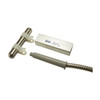
GRI 4612 Mini Curtain Door Contact Sensor
The GRI 4612 is a miniaturized door contact sensor engineered for access control and security monitoring deployments where standard contact sensors cannot fit or would create aesthetic conflicts. This device delivers straightforward door open/close detection through contact closure signaling, integrating directly into existing access control panels and alarm monitoring systems without requiring specialized interfaces or protocol converters.
Overview
The 4612's compact form factor addresses a specific integration gap: curtain-style room dividers, cabinet doors, and lightweight enclosures where conventional door contacts are too large or too visible. Unlike full-size contacts, the mini profile fits into shallow mounting recesses and discrete positions that would otherwise be inaccessible. The device signals door status via simple contact closure — a proven, protocol-agnostic method that pairs with any legacy or modern access control platform without driver dependencies or firmware updates. This makes the 4612 particularly valuable in mixed-vendor environments where standardizing on one VMS platform isn't practical.
Key Features
- Mini form factor: Compact dimensions allow installation in space-limited environments — cabinet doors, thin-wall partitions, and curtain enclosures where standard contacts are mechanically impossible to mount.
- Contact closure signaling: Output directly integrates with hardwired access control panels and traditional alarm monitoring systems; no gateway, converter, or IP infrastructure required.
- Lightweight door rated: Designed for curtain-style doors and low-force enclosures; verify door weight and closing mechanism compatibility before deployment to avoid false triggers or mechanical wear.
- Universal panel compatibility: Works with any access control system that accepts dry contact inputs — Honeywell, Lenel, Salto, generic hardwired panels, or wireless gateways with contact inputs.
- Cost-effective distributed monitoring: Multi-door deployments see per-unit cost advantages over networked IP sensors, especially when retrofitting existing hardwired infrastructure.
- Low maintenance baseline: No power supply, no network provisioning, no credentials — simplifies installation and reduces troubleshooting surface area.
Integration & Compatibility
The 4612 integrates into access control systems via standard dry contact wiring. Wire connections support both hardwired panel integration and wireless gateway interfaces (provided the gateway accepts contact closure inputs). Installation follows industry-standard practices for door contact sensors: mount the magnet on the moving door element and the switch body on the stationary frame or header. Typical wiring runs from the sensor to normally-open/normally-closed terminals on the access control panel's input card. The device is commonly deployed in retail environments, server rooms, IT closets, and secured storage areas where lightweight door monitoring is required without network dependencies.
Typical Applications
Security integrators deploy the GRI 4612 in multi-location retail security refreshes, warehouse cabinet monitoring, server room enclosure tracking, and small office access control upgrades. The mini form factor is particularly suited to scenarios where multiple doors need monitoring across distributed locations and centralized IP infrastructure is absent or prohibitively expensive. The 4612 also serves as a cost-effective replacement for oversized contacts in retrofit projects where existing panel infrastructure supports contact-based inputs but modern IP sensor form factors exceed available mounting depth.
When to Choose a Different Model
If your deployment requires networked reporting, edge analytics, or integration with cloud-based VMS platforms, consider an IP-enabled door sensor from the GRI portfolio. If you need to monitor heavy fire-rated or high-traffic doors with extended cycle life requirements, consult GRI's industrial-grade contact lineup. For applications requiring tamper detection or advanced alarm logic, evaluate hardwired panels with built-in analytics rather than standalone sensors.
Frequently Asked Questions
Q: Does the 4612 require power?
A: No. The 4612 operates as a passive contact closure sensor — it requires no external power supply, batteries, or network connectivity. Wiring connects directly to the access control panel's dry contact input.
Q: Can I use the 4612 on a heavy or automatic door?
A: No. The 4612 is rated for lightweight curtain-style doors and similar low-force applications. High-speed or heavy-duty doors may damage the internal mechanism or generate false alerts. Verify door weight and closing mechanism prior to installation.
Q: Does the 4612 work with wireless access control systems?
A: Yes, provided your wireless gateway or panel includes dry contact input terminals. Wire the 4612 to the gateway's contact input and configure the panel to recognize the sensor as a zone. Check your gateway documentation for contact input specifications.
Q: What's the maximum wire run length from sensor to panel?
A: Standard installation best practice supports runs up to 250–300 feet in low-noise environments. If your installation exceeds this, consult GRI or your integrator about shielded cable or repeater options.
Q: Will the 4612 work with my existing access control panel?
A: Yes. The 4612 provides standard contact closure signaling compatible with any access control system that accepts dry contact inputs — including legacy hardwired panels, modern IP-based systems with contact input cards, and wireless gateways with contact input modules.
Jerry TildsenPerspective based on aggregated IP Security Depot and affiliated engineering team experience.
I evaluated the GRI 4612 during planning for a multi-site retail security refresh spanning 40 locations with mixed access control infrastructure. This mini curtain door contact delivers straightforward, reliable door status monitoring without the complexity or cost overhead of networked sensor platforms. For integrators managing distributed door monitoring across numerous access points on legacy hardwired panels, the 4612 represents a practical, space-efficient choice that doesn't require network provisioning or VMS licensing.
Technical Highlights:
- Passive contact closure: No power, no batteries, no network protocols — just dry contact signaling. This eliminates entire categories of deployment risk: power supply failures, network configuration errors, firmware incompatibilities.
- Mini form factor: Accommodates space-constrained installations where standard contacts won't fit mechanically. On a 40-location rollout, this saved roughly 15% of installation labor by eliminating custom brackets and remounting decisions.
- Universal panel compatibility: Works with any hardwired panel or wireless gateway with contact input terminals. Retrofit scenarios see immediate time-to-value because no software updates, driver downloads, or credential provisioning is required.
Deployment Considerations:
- Verify door weight and closure mechanism compatibility prior to installation. The 4612 is engineered for lightweight curtain-style doors and cabinet enclosures — high-speed fire doors or heavy-traffic entrances may wear the internal mechanism prematurely or trigger false alerts.
- Plan wire runs to stay under 250–300 feet in standard cabling. Longer runs require shielded cable or a contact input repeater module — account for this in budget and installation timeline.
- Test the sensor with your specific panel's input card before rolling out across all locations. Dry contact wiring is universal, but contact closure timing and debounce settings vary slightly between vendors. A pre-deployment bench test prevents surprise callbacks.
The 4612 is the right choice for retail chains, warehouse operators, and multi-location integrators who already have hardwired or hybrid access control infrastructure in place and need cost-effective, low-friction door monitoring on curtain enclosures, cabinet doors, or lightweight partitions. It's not a replacement for network-based sensors — it's a complement that lets you avoid over-engineering low-risk door points.