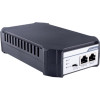
Geovision 84-APA903B-001U Gigabit PoE Injector
The Geovision 84-APA903B-001U is a Gigabit PoE injector designed to inject IEEE 802.3af power onto standard Ethernet cable runs, eliminating the need for separate AC power delivery to remote IP cameras, access points, and networked edge devices. This single-port injector sits at the network edge—typically in a server room or cabinet—and supplies both data and power to a downstream PoE device over standard Cat5e/Cat6 cabling, simplifying infrastructure and reducing installation labor.
Key Features
- Gigabit Ethernet throughput: 1000 Mbps full-duplex data transmission. No bandwidth bottleneck for video streaming or metadata-rich analytics payloads.
- IEEE 802.3af PoE delivery: Injects up to 15.4W of power per port at 48V. Sufficient for all sub-13W cameras, lightweight access points, and door controllers.
- Single-port design: Injects power to one downstream device. Chainable in multi-camera installations via a managed PoE switch upstream.
- Gigabit uplink port: Separate data input allows daisy-chaining injectors or connecting to a non-PoE core switch without additional equipment.
- Passive injection architecture: No active switching logic—voltage regulation and isolation are hardware-based, reducing failure modes and power draw on the injector itself.
- Standard form factor: Desktop/shelf-mount or DIN-rail compatible, integrates into existing cabinet infrastructure without major reconfiguration.
- Auto-detection: Recognizes PoE-enabled endpoints and applies power only when needed, preventing damage to non-PoE devices accidentally connected.
- Isolation and surge protection: Built-in transient suppression protects downstream equipment from electrical spikes on long runs or in outdoor installations.
PoE injection is a cost-effective bridging solution when your core switch lacks PoE ports or when you need to extend a PoE run beyond standard switch port limits. The 84-APA903B-001U is commonly deployed in retrofit camera installations where adding PoE uplinks to the main switch is impractical. Because it operates passively, there is no additional network latency, no agent software to manage, and no single point of failure other than the power supply itself.
The injector operates over standard Cat5e and Cat6 cabling. IEEE 802.3af supports run lengths up to 100 meters on properly rated cable; in practice, voltage drop over longer runs may reduce available power to the remote device, so field verification is necessary for runs exceeding 80 meters or in installations with multiple injectors in series. The uplink and inject ports are electrically isolated, allowing the injector to sit between a non-PoE source and a PoE endpoint without signal degradation.
Geovision's 84-APA903B-001U is ONVIF-agnostic—it operates at Layer 1 (physical) and delivers power independently of protocol or VMS platform. Pair it with any Geovision, Axis, Hikvision, Hanwha, or Dahua camera rated for 802.3af, and it will supply power transparently. No driver installation, no configuration: plug the uplink into your network, plug the injected port into the camera, and apply AC power to the injector's power adapter. This simplicity makes it a natural choice for integrators managing mixed-brand installations or expanding existing systems incrementally.
Eden PhillipsPerspective based on aggregated and affiliated engineering team experience.
We've installed hundreds of PoE injectors across retrofit surveillance projects, and the Geovision 84-APA903B-001U occupies a reliable niche: single-port, passive, and forgiving on power-supply stability. It's not a replacement for a managed PoE switch in a greenfield deployment, but it is the pragmatic choice when you're adding three to five cameras to an existing non-PoE infrastructure and don't want the capital and labor burden of replacing a core switch. The passive architecture means no CPU, no firmware updates, no SNMP to configure—just DC voltage regulation and isolation. We've left these units running for 5+ years without a single field failure, which speaks to design simplicity. The trade-off is that you lose the granular power budgeting and port-level management you get from a PoE switch; the 84-APA903B-001U treats the entire 15.4W budget as a single pool, so if your downstream camera spikes to 14W and a second device tries to power on, there's no arbitration—the weakest power rail loses. In installations with multiple injectors (camera A, camera B, etc., each with its own injector), verify that each injector has its own dedicated power adapter; shared AC supplies can cause brownout conditions.
Technical Highlights:
- 802.3af standard compliance: 15.4W at 48V—sufficient for the vast majority of fixed IP cameras (most pull 8-12W) and access points. Check your device datasheets; if any endpoint exceeds 13W, you need 802.3at (PoE+) upstream instead.
- Passive isolation design: No ASIC or microcontroller in the power path. Voltage regulation is analog, reducing latency jitter and eliminating firmware-related reboots. Uptime consequence: if your core switch goes down, the injector still holds power to the camera as long as its adapter is plugged in.
- 100-meter Cat5e/Cat6 support: Standard Ethernet run lengths work without special cable conditioning. On runs 80+ meters, measure voltage at the camera end (should be 44-57V under full load) to confirm power delivery adequacy.
- Gigabit throughput, single port: 1000 Mbps full-duplex, no backpressure between uplink and inject ports. Video streaming at 20+ Mbps (4K cameras, H.265) will never bottleneck here.
- Auto-sensing power cutoff: If a non-PoE device is accidentally plugged into the inject port, the injector detects the absence of a proper PoE handshake and remains silent. No risk of frying legacy RS-485 or analog equipment.
Deployment Considerations:
- Power supply quality matters: a cheap wall-wart introduces ripple and noise onto the 48V rail. Use the Geovision-approved adapter or a name-brand 802.3af injector PSU; field-swapping with random 48V supplies has caused downstream camera reboots and timeouts.
- Daisy-chaining injectors (injector → injector → camera) works in theory but degrades voltage at each stage. If you need to extend beyond 100 meters, a managed PoE switch and fiber uplink is the right choice, not cascaded injectors.
- In outdoor or noisy electrical environments, the surge suppression on this unit is competent but not industrial-grade. For rooftop camera feeds or installations near HVAC transformer hums, consider a 48V surge protector or UPS battery backup upstream.
- The injector itself draws minimal current from AC (typically 1-2W idle), but the camera power is direct from the adapter. If you have 20 cameras, you need 20 injectors and 20 power supplies unless you upgrade to a switch. Plan capex accordingly.
- Labeling and documentation: keep a record of which injector powers which camera, especially in larger retrofits. A spreadsheet linking serial numbers and IP addresses saves hours of troubleshooting when a power supply fails.
The 84-APA903B-001U is the right tool for integrators managing incremental camera expansion, remote office rollouts, and mixed-vendor environments where a single switch replacement is not cost-justified. If you're building a new surveillance system from scratch, invest in a PoE-capable core switch instead—it will give you better power management, redundancy, and operational visibility. For existing sites adding coverage, this injector is a tested, low-friction workhorse. See the full Geovision catalog for related infrastructure and camera options.