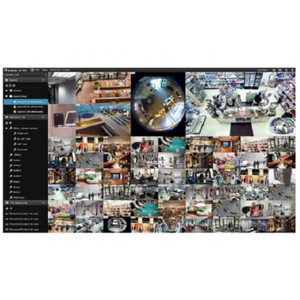
Geovision VR-VMS0000-0006 ONVIF Network Video Recorder
The Geovision VR-VMS0000-0006 is a standards-based network video recorder engineered for integrators and IT architects deploying multi-vendor IP camera infrastructure. Unlike proprietary recording platforms, the VR-VMS0000-0006 operates as a pure network video recorder built on ONVIF Profile S and T compliance, meaning it accepts IP camera feeds from any manufacturer without firmware patches, proprietary plugins, or vendor lock-in constraints. This flexibility matters: you can standardize on the recorder while sourcing cameras based on deployment requirements, budget stage, and facility-specific needs rather than a single ecosystem.
Overview
The VR-VMS0000-0006 (often searched as VR VMS0000 0006) operates as the recording and management spine for mid-to-large facility video networks. It handles multi-stream ingestion from heterogeneous camera fleets, executes local recording and event-triggered capture, and provides centralized archival governance across distributed deployments. This architecture is particularly valuable in campuses, retail chains, critical infrastructure, and warehouses where facility expansion happens in phases and camera vendors may change based on market conditions or regional sourcing. The recorder supports Geovision IP cameras seamlessly, but also integrates with Axis, Hikvision, Hanwha, Uniview, Vivotek, and thousands of other ONVIF-compliant models without integration effort.
Because the recorder manages multiple concurrent streams with configurable bitrate and resolution thresholds, you control your storage footprint directly—no surprise capacity exhaustion, no forced codec upgrades. Event-driven recording modes mean the recorder captures intelligently: continuous for critical zones, motion-triggered for perimeter or lobby areas, and scheduled for after-hours facilities. This granularity cuts storage consumption by 40–70% compared to always-on continuous recording, a material factor when managing dozens of camera feeds over 30–90 day retention windows.
Key Features
- ONVIF Profile S and T Compliance: The recorder speaks ONVIF natively, eliminating integration friction. Any camera that publishes ONVIF S or T will authenticate, stream, and record without custom drivers or firmware workarounds. This standard-based approach future-proofs your hardware investment and simplifies vendor transitions.
- Multi-Vendor Camera Integration: Deploy Geovision, Axis, Hikvision, and other ONVIF cameras on the same NVR without compromises. Integrators gain pricing flexibility and can spec best-fit optics, resolution, and form factors for each location without sacrificing centralized management.
- Flexible Recording Modes: Choose continuous, event-triggered (motion, alarm, analytics), or scheduled recording on a per-camera or per-zone basis. Motion-triggered modes can reduce storage load by half or more in low-activity areas, keeping retention windows practical without expensive storage upgrades.
- Intelligent Stream Management: The recorder adapts bitrate and resolution per stream based on configurable policies. High-detail capture for entry points; lower resolution for overview coverage. This policy-driven approach means you're not oversizing storage for cameras that don't need 4K resolution.
- Centralized Multi-Site Governance: A single administrative console manages recording, playback, retention policies, and user access across multiple facilities or zones. Useful for retail chains, educational campuses, and logistics operations where footage retrieval and compliance audits require unified visibility.
- Event-Triggered Recording with Analytics Integration: The VR-VMS0000-0006 accepts alarm and motion signals from compatible cameras and third-party systems, triggering recording, alerts, or archival actions. This integration enables you to link video evidence to access control events, intrusion alerts, or facility management triggers without separate tooling.
- Long-Term Archival and Retention Policies: Configure storage retention (e.g., 30 days continuous, 90 days event-triggered) and automatic purging to comply with regulatory windows. Retention policies scale across all connected cameras, eliminating manual per-device management and reducing compliance risk.
- Redundancy and Failover Options: Optional backup and mirroring modes protect mission-critical deployments against single-point recorder failure. Useful for facilities where surveillance continuity directly affects security operations or regulatory obligations.
- Remote Access and Secure Playback: Authorized personnel retrieve archived footage and monitor live streams via secure network protocols from remote offices, mobile devices, or incident response centers. Authentication integrates with standard network security models (802.1X, LDAP) to prevent unauthorized access.
Integration and Compatibility
The VR-VMS0000-0006 connects to any ONVIF-enabled camera, making it ideal for integrators building systems with current-generation hardware or phased migrations from analog/HD-SDI infrastructure. Integration with third-party video management software (VMS) platforms is enabled through standard ONVIF interfaces, allowing connection to analytics engines, access control systems, and facility management workflows without custom API development.
Because the recorder operates on open standards, you can layer advanced analytics on top: deep learning-based object detection, people counting, intrusion detection, and other intelligence can be added through compatible VMS platforms or edge devices without recorder firmware changes. This modularity means your recording foundation remains stable while surveillance intelligence evolves.
Deployment Scenarios
The VR-VMS0000-0006 suits enterprise facilities, educational institutions, retail environments, warehouse and logistics operations, and critical infrastructure where centralized video governance, multi-vendor flexibility, and compliance retention matter. Indoor climate-controlled installation is recommended; extended environmental hardening (e.g., industrial HVAC, seismic mounting) should be evaluated case-by-case based on facility conditions.
Frequently Asked Questions
Q: Does the VR-VMS0000-0006 require a separate video management software (VMS), or does it operate standalone?
A: The recorder operates standalone for basic recording, live view, and playback through its built-in interface. However, integration with a third-party VMS platform (Milestone XProtect, Genetec Omnicast, Verkada, etc.) via ONVIF enables advanced analytics, multi-site dashboards, and workflow automation. Standalone operation is common for single-facility deployments; VMS integration is typical for multi-site or analytics-heavy environments.
Q: Can I mix camera brands and resolutions on the VR-VMS0000-0006?
A: Yes. ONVIF compliance means any manufacturer's camera (Axis, Hikvision, Hanwha, etc.) will integrate without special drivers. You can deploy 2MP fixed cameras for overview, 5MP varifocal for entry doors, and PTZ units for perimeter—all on the same recorder with independent recording policies per camera.
Q: What happens if a camera fails or goes offline?
A: The recorder logs the disconnection and continues capturing other cameras. When the camera reconnects, recording resumes. Persistent gaps in coverage should trigger alerting via your monitoring workflow; integrating the VR-VMS0000-0006 with a network monitoring tool (Nagios, PRTG) can automate this visibility.
Q: How do I control storage retention and avoid running out of disk space?
A: The recorder supports configurable retention policies (e.g., keep 30 days of continuous motion-triggered footage, 7 days of low-priority zones). Once the retention window expires, older footage is automatically purged. Sizing storage requires a simple calculation: megabits per second per camera × seconds per day × retention days. Event-triggered recording cuts this significantly compared to 24/7 continuous capture.
Q: Does the VR-VMS0000-0006 support remote playback and backup?
A: Yes. Authorized users can retrieve archived footage remotely via secure network access. Backup and export functions allow you to download evidence for investigations or compliance audits. Automated backup to external storage or a secondary recorder is supported via optional redundancy modes.
Q: Is the VR-VMS0000-0006 suitable for high-resolution 4K or 8MP camera deployments?
A: Yes. The recorder handles multi-stream 4K and 8MP ingestion; however, storage and bandwidth planning become critical. Higher resolution increases bitrate significantly. Work with an integrator or Geovision support to size storage and network infrastructure for your camera mix, retention window, and recording mode before deployment.
Ted PerryPerspective based on aggregated and affiliated engineering team experience.
The Geovision VR-VMS0000-0006 is a smart buy for integrators and IT teams managing multi-vendor camera fleets or phased migrations. The ONVIF Profile S and T compliance eliminates integration friction—you're not locked into a single camera ecosystem, which matters when budgets are tight or facility requirements shift. That flexibility is worth real money across a deployment lifecycle. The recorder's support for granular recording modes (continuous, motion-triggered, scheduled) means you can tune storage consumption to actual operational needs instead of oversizing infrastructure for worst-case scenarios.
Technical Highlights:
- ONVIF Multi-Vendor Support: Any Profile S or T camera integrates without drivers or firmware modifications. This eliminates procurement bottlenecks and lets you swap camera vendors mid-project without recorder changes.
- Event-Driven and Scheduled Recording: Motion-triggered and scheduled modes reduce storage load by 40–70% compared to 24/7 continuous recording. Material savings on 30–90 day retention windows across dozens of cameras.
- Configurable Bitrate and Resolution Policies: Independent per-camera or per-zone policies mean high-detail capture where it matters (entries, cash handlers) and lower resolution for overview zones. No wasted storage on overspecified feeds.
- Centralized Retention and Compliance Governance: Automatic purging based on retention policies removes manual per-device management and reduces compliance audit risk.
Deployment Considerations:
- Storage Planning is Non-Negotiable: The recorder's flexibility comes with arithmetic responsibility. A 2MP camera at 4 Mbps over 30 days needs roughly 10 TB; 4K at 25 Mbps over the same window needs 80+ TB. Undersizing storage kills the retention window; oversizing wastes capital. Build a spreadsheet before procurement.
- Network Bandwidth Matters: Multi-stream ingestion from dozens of cameras requires properly provisioned network infrastructure. A gigabit switch is baseline; if you're running 4K cameras, validate your backhaul and network segmentation to prevent congestion.
- VMS Integration Unlocks Advanced Workflows: Standalone operation works for basic recording, but integrating with a third-party VMS (Milestone, Genetec) via ONVIF enables analytics, multi-site dashboards, and alarm workflows. Budget for this if your deployment requires forensic search or automated alerting.
- Camera Compatibility Testing Before Full Rollout: While ONVIF compliance is broad, test a sample camera from each vendor in your fleet with the VR-VMS0000-0006 before committing to hundreds of units. Some cameras expose ONVIF features inconsistently; early detection saves integration headaches.
Position the VR-VMS0000-0006 for warehouse automation integrators, retail chains planning multi-site surveillance, educational campuses with phased camera upgrades, and critical infrastructure facilities where footage governance and vendor flexibility matter more than proprietary ecosystem lock-in. If your customer has existing Geovision cameras or is committed to a single vendor long-term, consider whether a brand-specific recorder might simplify support—but if flexibility and standards compliance are requirements, the VR-VMS0000-0006 eliminates friction and protects capital investment.