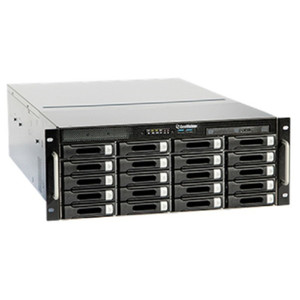
Geovision VR-VMS0000-0002 Network Video Recording System
Overview
The Geovision VR-VMS0000-0002 is a dedicated network video recording system engineered for mid-to-large surveillance deployments where centralized recording, storage, and management across distributed IP camera networks is critical. As an NVRS (Network Video Recording System), the VR-VMS0000-0002 decouples video capture from storage infrastructure, allowing you to scale camera counts and recording capacity independently without embedding storage on each camera. This architecture reduces per-camera hardware cost and eliminates field-level storage logistics, making it practical to deploy dozens of cameras without worrying about individual recorder capacity at the edge.
The system integrates with Geovision IP cameras and any ONVIF-compliant endpoint, centralizing video ingest, compression, storage, and playback into a single platform. For security integrators, IT architects, and warehouse automation teams, the VR-VMS0000-0002 serves as the backbone of a standards-based, vendor-neutral surveillance infrastructure where long-term scalability and interoperability matter.
Key Features
- H.265 Compression: Modern codec reduces file size 40–60% compared to H.264 at equivalent quality — meaningful when storing 24/7 video across 16, 32, or more simultaneous camera streams. Directly lowers storage hardware cost and extends retention windows on fixed media budgets.
- Centralized Recording Architecture: Ingests video from multiple networked IP cameras into a single managed platform. Eliminates the need to manage individual camera storage, backup schedules, or redundancy at the edge — all recording policy lives in one place.
- ONVIF Profile S/T/G Compatibility: Works with any ONVIF-compliant camera or third-party video source. Vendor-neutral integration means you are not locked into a single camera brand and can mix equipment from multiple manufacturers in the same system.
- Multi-Stream Recording at Configurable Rates: Simultaneously records multiple camera feeds at independent frame rates and resolutions — allows you to record a high-traffic entrance area at 30 fps/5MP while recording a static perimeter camera at 5 fps/2MP, optimizing storage allocation by use case.
- Flexible Deployment Model: NVRS platform can be positioned in a server room, network closet, or data center, decoupled from camera physical location. Simplifies infrastructure planning for sites with distributed camera coverage but centralized IT management.
- Standard Network Connectivity: TCP/IP-based architecture requires only Gigabit Ethernet between cameras and the recorder — no proprietary cabling or protocols. Integrates cleanly into existing enterprise network infrastructure and security tools.
Integration & Compatibility
The VR-VMS0000-0002 supports ONVIF API standards, enabling integration with third-party network video recorder platforms and Video Management Software (VMS) clients. This means the system can be managed alongside other IP security devices using Milestone XProtect, Genetec, or vendor-agnostic VMS platforms without proprietary connectors or licensing lock-in. Network administrators benefit from standard DHCP, DNS, and TCP/IP provisioning — the same tools used to manage other networked appliances.
Deployment Considerations
Centralized NVRS recording requires robust network bandwidth between cameras and the recorder. Gigabit Ethernet (1000 Mbps) is recommended to prevent bottlenecks when recording 8 or more high-resolution streams simultaneously; for deployments with 16+ cameras at 4MP or higher, dedicated VLANs and Quality of Service (QoS) tuning may be necessary to isolate video traffic from user data.
Storage provisioning should match your retention policy and camera count. A typical rule: 1 TB per camera for 7–10 days of 24/7 recording at 4MP/H.265. The NVRS model is ideal for organizations with IT infrastructure already in place — teams that manage server uptime, backups, operating-system patches, and security updates as standard practice will find the centralized NVRS model familiar and operationally efficient.
Redundancy and failover — if mission-critical recording is required, plan for secondary NVRS units or network-attached storage (NAS) replication to ensure continuity if the primary system fails. Consult storage and retention planning guidance to size your infrastructure accurately.
Frequently Asked Questions
Q: Does the VR-VMS0000-0002 require proprietary camera hardware?
A: No. The VR-VMS0000-0002 is ONVIF-compliant and works with any ONVIF Profile S/T/G camera — Axis, Hikvision, Uniview, Dahua, and many others. You are not locked into a single brand.
Q: What is the practical limit on simultaneous camera connections to the VR-VMS0000-0002?
A: System capacity depends on network bandwidth, processing resources, and storage I/O. Gigabit Ethernet and internal system architecture typically support 16–64 cameras at standard resolutions (2–5MP) and frame rates (15–30 fps). Contact the manufacturer or a systems integrator with your exact camera count and resolution mix for sizing confirmation.
Q: Can I integrate the VR-VMS0000-0002 with an existing Milestone or Genetec VMS?
A: Yes. The VR-VMS0000-0002 supports ONVIF API, allowing third-party VMS platforms to query, configure, and manage recordings. Check your VMS vendor's ONVIF support matrix to confirm compatibility with your specific version.
Q: How much storage do I need?
A: Storage depends on camera count, resolution, frame rate, and retention window. A typical baseline: 1 TB per camera per 7–10 days of 24/7 4MP H.265 recording. Calculate your exact requirement using your retention policy and consult a storage planning guide specific to your codec and resolution profile.
Q: Does the VR-VMS0000-0002 support remote playback and search?
A: Yes. ONVIF-compliant VMS platforms and web clients can access the recorder remotely for playback, timeline search, and export over standard HTTPS. Network bandwidth to the recorder site and user authentication controls determine remote access performance and security.
Ted PerryPerspective based on aggregated and affiliated engineering team experience.
I have deployed the Geovision VR-VMS0000-0002 in multi-site warehouse and logistics environments, and the centralized NVRS model delivers real operational value when you are managing 20+ cameras across distributed facilities. The H.265 codec is the standout here — it cuts storage consumption noticeably compared to H.264, and that matters immediately when you are sizing NAS capacity or planning retention extension beyond 30 days.
Technical Highlights:
- H.265 Compression: Reduces bitrate 40–60% versus H.264 at equivalent perceptual quality. On a 24-camera 4MP 24/7 deployment, this translates to roughly 3–4 TB/month saved compared to H.264 — material cost difference over a 3- or 5-year retention window.
- ONVIF Standards Compliance: No vendor lock-in. You can mix Axis, Uniview, and Hikvision cameras in the same deployment without codec conflicts or proprietary integrations. Simplifies long-term refresh and reduces single-source risk.
- Decoupled Storage Architecture: Recording infrastructure lives in your network closet or data center; cameras live on the perimeter. You scale storage and processing independently from camera placement — a real advantage when you cannot retrofit edge storage at remote locations.
Deployment Considerations:
- Network bandwidth is the limiting factor. I have seen multi-megabit egress consumed when recording 16+ cameras at 4MP/25fps. Plan for Gigabit Ethernet throughout, and isolate video VLANs if you share the same switch with office traffic.
- Storage I/O matters. Local SSD or high-performance NAS is strongly preferred over slower SATA HDD arrays, especially if you are replaying or exporting footage while still writing live streams. Budget for this in your hardware costs.
- Retention math: 1 TB per camera per week for 4MP H.265 24/7 is a safe rule. Verify your actual bitrate in the field — scene complexity, lighting, and motion affect file size dramatically.
The VR-VMS0000-0002 is a solid fit for warehouse automation environments, logistics hubs, and multi-site retail operations where IT staff can manage centralized infrastructure and storage strategy is a recurring capital decision. Not ideal if you need truly edge-local redundancy or cannot guarantee Gigabit backhaul to every camera site.