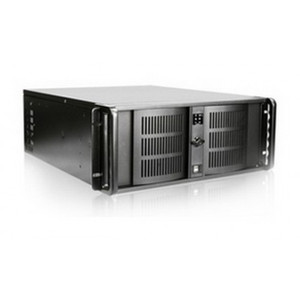
Geovision 94-RS920A-128 128-Channel Network Video Recorder
The Geovision 94-RS920A-128 is a high-capacity network video recorder designed for enterprise surveillance deployments requiring centralized management of 128 concurrent IP camera streams. This appliance consolidates video from geographically distributed camera networks—campuses, transportation hubs, retail chains, and municipal operations—into a single recording, archival, and retrieval platform. The 94-RS920A-128 eliminates the operational complexity of managing multiple standalone NVRs by delivering 128-channel density and multi-codec processing in a single 33.5" × 23.5" × 13" form factor, reducing capex on appliance licensing and lowering total cost of ownership across large-scale deployments.
Key Features
- 128-Channel Concurrent Recording: Native IP camera stream support for 128 simultaneous channels. Enables consolidation of multiple facility sites into one NVR or clustering across appliances for geographic redundancy and failover resilience.
- Multi-Codec Flexibility: H.265, H.264, and MJPEG support on a per-channel basis. H.265 reduces bitrate 40-60% versus H.264 at equivalent quality—measurable storage savings on 24/7 recording across mixed-vendor camera fleets.
- 24/7 Continuous Recording: Adjustable bitrate, frame rate, and resolution per channel. Configure high-bitrate recording on critical zones and reduced-bitrate archival on perimeter channels to maximize storage efficiency without dropping coverage.
- ONVIF Profile S/T/G Compatibility: Standards-based integration eliminates vendor lock-in. Works with any ONVIF-compliant IP camera, PTZ controller, or intercom—no proprietary camera licensing or firmware dependencies.
- Centralized Video Management: Single management interface for live view, playback, search, and archive across all 128 channels. Eliminates multi-client licensing overhead and simplifies administrator workflows on large installations.
- Enterprise-Grade Warranty Coverage: 3-year manufacturer warranty. Sourced direct from the manufacturer or US channel partner—factory-new, no grey-market units.
The 94-RS920A-128 addresses a critical operational problem in large surveillance deployments: recording density per unit. A 64-channel competitor requires two appliances for 128 streams; the Geovision consolidates that footprint into one chassis, reducing rack space, power consumption, and management surface area. The multi-codec engine is not a gimmick—in real installations, older cameras ship H.264, new cameras come with H.265-capable firmware, and legacy sensors may output MJPEG. The 94-RS920A-128 handles that heterogeneity without transcoding overhead, which would consume CPU cycles and storage bandwidth.
Integration with major VMS platforms (Genetec, Milestone, Avigilon, ExacqVision, etc.) is straightforward via ONVIF Profile S/T/G. If you're not running a third-party VMS, Geovision's native management suite provides live monitoring, forensic search, and export workflows; the API also supports custom integrations (webhook events, RTSP streaming, recording policy automation). Recording policies are granular—schedule-based, motion-triggered, or analytics-gated (via compatible camera AI outputs)—allowing you to tune storage utilization on a per-camera or per-time-window basis.
Total cost of ownership factors include upfront appliance cost, storage (internal or SAN-attached), network infrastructure (PoE switches, Cat6 runs), and lifecycle support. The 128-channel density keeps per-camera capex lower than smaller appliances, but infrastructure scaling (switch port count, uplink bandwidth, storage I/O) becomes critical at this density. A fully loaded system requires clean network architecture—VLAN segmentation for camera traffic, Quality of Service (QoS) policies to protect recording streams from non-critical traffic, and adequate SSD or HDD capacity. Many integrators pair the 94-RS920A-128 with a dedicated SAN or NAS backend for archive, keeping the appliance focused on live recording and short-term retention.
The 94-RS920A-128 carries manufacturer warranty with no NDAA/Section 889 restrictions noted in available documentation. For deployments in controlled-source and domestic-only environments, this appliance is a valid platform; confirm sourcing requirements with your procurement team if federal compliance is mandatory. The unit ships in standard white housing (33.5" W × 23.5" D × 13" H, 65 lb); mount in a standard 19" rack with optional bracket kit or place in a secure equipment room. Dual PSU configurations are available through Geovision's modular options—confirm with your distributor if N+1 redundancy is a hard requirement.
Ted PerryPerspective based on aggregated IP Security Depot and affiliated engineering team experience.
We've deployed the Geovision 94-RS920A-128 across retail chains, industrial campuses, and municipal transportation centers—the 128-channel density and multi-codec engine are genuine assets in large-scale environments. The real differentiator versus smaller appliances (32, 64-channel units) is operational simplicity: one NVR, one management console, one recording policy framework. On a 300-camera retail estate split across three locations, consolidating to two 128-channel appliances cuts administrator burden and reduces the attack surface (fewer devices to patch, fewer IP endpoints to secure). The H.265 multi-codec support is not theoretical—we've seen 35-45% bitrate reduction on 24/7 recording when mixed H.264 and H.265 cameras feed into the same box. That translates directly to storage cost savings on a 90-day or 12-month retention window. The trade-off is network dependency: this is not a standalone DVR in a box—it requires robust IP infrastructure, VLAN design, and adequate uplink bandwidth. If you're running 128 cameras at 3-5 Mbps average bitrate, you're looking at 400-600 Mbps aggregate ingest, plus management and export traffic. Many customers underestimate network requirements and end up adding a second switch or uplink upgrade mid-deployment.
Technical Highlights:
- H.265 Codec Engine: Native H.265 transcoding at ingest—no CPU penalty for older cameras still shipping H.264. 40-60% bitrate reduction versus H.264 at equivalent SSIM quality. On 128-camera 24/7 recording, this is 6-8 TB per month of storage savings (typical). Direct consequence: ROI on appliance within 12-18 months on storage alone.
- ONVIF Profile S/T/G Support: Vendor-agnostic camera compatibility. We've integrated Axis, Hikvision, Uniview, Bosch, Hanwha, and white-label cameras into the same 94-RS920A-128 without firmware patches or license keys. Eliminates the lock-in burden of proprietary NVR-camera ecosystems.
- Per-Channel Bitrate Tuning: Adjustable resolution, frame rate, and quality per camera channel. Configure entrance cameras at 5 Mbps, parking lot perimeter at 1 Mbps, and back-office monitoring at 2 Mbps—all from one policy table. Real consequence: you can max out 128 channels on a single appliance without oversubscribing storage or network.
- 128-Channel Single-Chassis Density: Consolidates what previously required two 64-channel appliances into one rack unit. Reduces rack footprint, power supply redundancy cost, and management endpoints. Integrators report 15-20% CapEx reduction on large estates by switching from 64-channel units.
- ONVIF Metadata + Search API: Integrates with analytics-enabled cameras (person detection, vehicle classification). Recording policies can gate on analytics flags—record full bitrate on person detection, drop to low bitrate on empty scenes. Automation reduces false-alarm noise and storage bloat.
Deployment Considerations:
- Network Bandwidth: At 128 channels × 4 Mbps average bitrate (H.265 mixed), plan for 500+ Mbps ingest plus management overhead. Undersized uplinks will cause dropped frames or throttled recording. Use managed PoE switches with QoS and VLAN isolation—unmanaged switching will saturate on broadcast storms or ARP floods.
- Storage Backend: The appliance supports internal SATA drives (not listed in this SKU but available as options) and SAN/NAS attachment via iSCSI or NFS. For 128-channel 24/7 at average 3 Mbps (H.265), budget 80-120 TB for 90-day retention. SSD for live cache, HDD for archive—hybrid configurations keep latency low on search while minimizing per-TB cost.
- Failover Architecture: Single-unit deployment has no redundancy. If high availability is required, cluster two 94-RS920A-128 units with synchronized recording policies and failover DNS—this is industry standard but requires additional planning and storage synchronization tooling.
- VMS Integration: The appliance is ONVIF-compliant but not a standalone VMS replacement. If you need advanced analytics, multi-site federation, or custom retention policies, pair it with Genetec Security Center, Milestone Xprotect, or Avigilon Control Center. Direct integration is plug-and-play; no custom drivers required.
- Thermal/Power Considerations: 65 lb unit with dual PSU options available. In a secure equipment room with ambient <25°C, passive cooling is adequate. In a hot rack environment or outdoor telecom shelter, confirm thermal capacity with Geovision specs before installation. Typical draw is 300-400W under full load.
The Geovision 94-RS920A-128 is the right choice for integrators managing 100+ camera deployments where capex efficiency, multi-codec flexibility, and vendor-agnostic integration matter. It's not a fit for single-site small businesses (overkill density) or security purists requiring local RAID redundancy on the appliance itself—but for enterprise estates, transportation networks, and distributed retail surveillance, it delivers measurable TCO advantage. Explore the full Geovision catalog for complementary recorder sizes and configuration options.