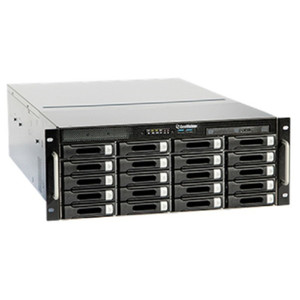
Geovision 94-NU708-32A 32-Channel Network Video Recorder
The Geovision 94-NU708-32A is a 32-channel network video recorder designed for mid-to-large professional surveillance installations. Built to aggregate video streams from compatible Geovision IP cameras and third-party ONVIF devices, the 94-NU708-32A handles continuous 24/7 recording, live playback, and forensic review across a scalable IP infrastructure. Deployments range from office parks and retail chains to manufacturing facilities and critical infrastructure, where reliable centralized recording and local redundancy are non-negotiable.
Key Features
- 32-Channel Input Capacity: Records up to 32 simultaneous IP camera feeds. Scales cost-effectively compared to single-channel or 8-channel standalone encoders.
- ONVIF Profile S/T Compatibility: Works with Geovision cameras and third-party IP cameras supporting ONVIF standards. Reduces vendor lock-in and simplifies mixed-brand integrations.
- Continuous 24/7 Recording: Designed for non-stop recording duty cycles. Storage management (rolling loop, tiered retention) prevents operational gaps and ensures legal compliance on retention policies.
- Professional-Grade Playback & Search: Multi-stream playback, frame-by-frame review, and timestamp-based search accelerate forensic investigations and incident response.
- Modular Storage Architecture: Supports multiple internal drives or external SAN/NAS attachment. Allows capacity planning to match retention window (7–90 days typical) without over-provisioning.
- Network-Centric Design: PoE or 12V power input; Gigabit Ethernet connectivity. Integrates into managed network infrastructure rather than requiring isolated analog cabling runs.
- Local Alarm & Motion Detection: On-board I/O for door sensors, motion detection, and relay outputs. Triggers recording policy changes or alert notifications without requiring external analytics server.
- Remote Access & Mobile Viewing: Web-based and mobile client interfaces enable remote live view and playback from authorized endpoints, subject to firewall and VPN policy.
The 94-NU708-32A occupies a practical sweet spot in the NVR market: it's large enough to consolidate recording across a multi-building campus or regional facility, yet compact enough to fit standard 19-inch rack or cabinet mounting. Its modular approach to storage and I/O means integrators can customize the unit to match site constraints — high-retention archive deployments, low-bandwidth remote sites, or mixed-speed camera feeds.
Network bandwidth planning is critical with 32-channel implementations. The recorder accepts H.264 and H.265 streams; H.265 adoption across your camera fleet cuts bitrate by 40–60% and proportionally extends storage life. Redundancy strategies — dual NIC bonding, failover recording to a secondary NVR, or cloud-backup integration — are common on mission-critical installations. The unit's configuration interface supports granular recording quality and frame-rate policies per camera, so you can dedicate higher bitrate to entry points and perimeter coverage while running lower-quality streams on interior zones.
Integration with Geovision's ecosystem is straightforward via native management software; third-party VMS platforms (Milestone, Genetec, Avigilon) typically interface via ONVIF or proprietary APIs. The 94-NU708-32A does not enforce VMS lock-in, allowing you to choose best-of-breed analytics, access control, or business intelligence layers separately. Backup and archive workflows rely on standard network protocols (FTP, SMB, rsync), simplifying compliance audits and e-discovery retrieval.
Geovision NVRs comply with standard IT security practices: user account controls, password policy enforcement, and log auditing. Review the product datasheet for specific certifications, supported camera models, minimum network bandwidth per channel, and storage sizing guidance. Installation should be performed by qualified integrators familiar with network video architecture, storage redundancy, and backup discipline.
Ted PerryPerspective based on aggregated and affiliated engineering team experience.
We've deployed the Geovision 94-NU708-32A across a range of installations — from distributed retail chains with rolling 30-day retention to industrial facilities running forensic-grade 90+ day archives. What makes this unit practical is its balance between raw capacity and operational simplicity. It doesn't require exotic hardware or specialized IT staff to keep running; it speaks ONVIF, accepts standard Gigabit connections, and stores video on commodity SATA drives. The modular I/O is a real advantage on retrofit jobs where you're integrating door access signals, motion sensors, or emergency call buttons without running separate automation wiring. Against purpose-built appliances like Milestone Husky NVRs or Avigilon control hubs, the 94-NU708-32A costs less and imposes no monthly licensing per channel — a significant factor on large deployments. The trade-off is that you're managing a purpose-built recording box, not a full VMS platform. If your site needs advanced analytics (person detection, vehicle re-identification, crowd density), you'll be adding that layer separately — either on-camera (if the Geovision IP cameras support it) or via a third-party analytics engine. For straightforward recording, forensic playback, and basic alerting, the 94-NU708-32A delivers solid ROI.
Technical Highlights:
- 32-Channel Concurrent Record: No single-camera bottleneck or stream licensing per camera. You pay once for the appliance and scale your camera count freely (within network bandwidth limits). On a 16-camera deployment, that's measurably cheaper than per-camera licensing models used by some enterprise VMS vendors.
- H.265 Native Support: If your Geovision or compatible IP cameras emit H.265, the NVR ingests and stores natively. Storage reduction of 40–60% versus H.264 means a 4TB drive holds 8TB equivalent of older-codec footage — real savings on hard-drive capex and power/cooling on 24/7 duty.
- Local Redundancy & Failover: Support for hot-spare drives and (in some configurations) dual-NVR failover. Critical installations can run two units in parallel with synchronized recording, eliminating single-point-of-failure risk on the recording layer.
- I/O Flexibility: Onboard relay outputs, alarm inputs, and motion detection logic enable autonomous responses — trigger recording at higher quality on alarm, send SMS on unauthorized access, or arm/disarm recording zones on schedule without external logic controllers.
- ONVIF Standards Compliance: Interoperability with third-party cameras reduces future vendor switching costs. You're not locked into a single camera brand, which matters when supply chains are volatile or when a customer has legacy cameras from a previous integrator.
Deployment Considerations:
- Network Bandwidth Planning: A 32-camera NVR at full HD/1080p 30fps H.264 can consume 100–200 Mbps aggregate depending on quality settings. Verify that your network infrastructure — both LAN switching and WAN uplinks for remote viewing — can handle sustained traffic without congestion. Gigabit Ethernet is the minimum; 10GbE recommended on large campus deployments.
- Storage Sizing & Replacement Cycle: SATA drives in 24/7 surveillance duty typically last 3–4 years. Budget for predictable replacement; set SMART monitoring alerts on the NVR to catch failing drives before data loss. Calculate retention window (e.g., 45 days at 2 Mbps per camera) and confirm drive capacity matches — undersizing leads to overwrite of evidence footage.
- Backup & Compliance: On-appliance recording is not a backup strategy. Establish a scheduled export policy (daily, weekly) to network storage, cloud, or offline archive. Many jurisdictions (retail, healthcare, finance) require 90+ day retention and audit trails; test your export and restore workflow before going live.
- Network Security Posture: The 94-NU708-32A connects to your production network. Segregate it on a dedicated VLAN if feasible, enforce strong credentials (non-default admin password), and disable external access unless tunneled through a VPN appliance. Patch firmware on schedule — Geovision releases updates to address discovered vulnerabilities.
- Integration with Existing Access Control: If you're running a separate door access system (Honeywell, Salto, HID), the NVR's native I/O can trigger recording on card swipes or alarms, but correlation of access events with video requires either real-time integration (API polling) or asynchronous log matching in a higher-level analytics platform.
The 94-NU708-32A is the right choice for integrators and end-users who want industrial-grade 24/7 recording without the overhead of full VMS licensing, and who are comfortable managing storage lifecycle and network infrastructure independently. It's less appropriate for organizations that need real-time person detection, behavioral analytics, or cloud-native failover out of the box — those use cases call for a full VMS platform or cloud-native recording service. For details on supported camera models, exact bitrate calculations, and certified backup destinations, consult the Geovision catalog.