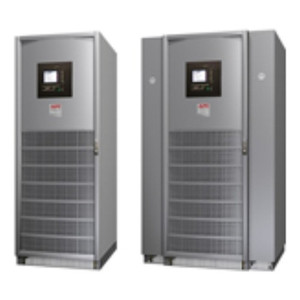
APC by Schneider Electric GVSUPS60K0B5HS Galaxy VS 60kW Online UPS
Overview
The APC by Schneider Electric Galaxy VS GVSUPS60K0B5HS is a 60kW (60 kVA) three-phase, double-conversion online UPS designed for medium-to-large data centers, industrial facilities, and critical infrastructure environments running 400V distribution. Double-conversion architecture means incoming AC is continuously rectified to DC and reinverted to clean AC — your connected loads never run directly off utility power, so grid transients, sags, swells, and frequency anomalies are fully isolated at all times. If you're protecting edge compute nodes, server rooms, or automation equipment where a momentary brownout causes a cascade failure, this is the topology that eliminates that risk.
Configured for up to five internal 9Ah smart modular battery strings, the GVSUPS60K0B5HS keeps battery capacity right-sized to your runtime requirement — start with fewer strings and expand without taking the unit offline, rather than paying upfront for battery capacity you won't use for years.
Key Features
- 60kW / 60 kVA Double-Conversion Output: Full double-conversion at all times means zero transfer time to battery — there is no switchover gap. For PLC-driven production lines or hyperconverged storage nodes that crash on a 4ms transfer, this matters more than any runtime spec.
- 0.99 Input Power Factor: Drawing current at 0.99 PF means the Galaxy VS pulls nearly pure real power from your distribution panel. A 60kW load at 0.99 PF draws only fractionally more apparent power than real power — your upstream transformer and conductors are sized for the load you're actually running, not inflated by reactive current. This directly reduces facility electrical infrastructure cost.
- 3% Input Current THD:
At 3% input THD, the UPS presents a near-linear load to the utility. Older ferroresonant and stepped-approximation inverters commonly push 10–30% THD back onto the supply — that current distortion heats distribution transformers and trips sensitive protection relays. At 3%, the Galaxy VS coexists cleanly with other precision loads on the same MDP.- Input Voltage Range 340–460V / 40–70 Hz: The wide input window — 340V to 460V at 40 to 70 Hz — lets the UPS ride through the kinds of voltage excursions common in industrial buildings without switching to battery unnecessarily. Unnecessary battery cycling shortens battery service life; a wide window preserves it.
- Output Voltage 380–415V, ±0.1% Regulation, Pure Sine: Output regulation of -0.1% and pure sine waveform mean server power supplies, VFDs, and medical imaging equipment all see exactly the voltage they expect. Active PFC power supplies in particular require a true sine wave — a stepped or modified sine output causes them to run hot and can trigger overcurrent protection.
- 2.5:1 Crest Factor: A 2.5:1 crest factor rating means the UPS handles highly nonlinear loads — including switch-mode power supplies that draw peaked current pulses — without the output voltage collapsing. Many 3-phase UPS designs derate significantly under crest factor loads; this rating confirms the Galaxy VS is sized for real server room current profiles, not idealized resistive loads.
- ECO Mode: ECO mode routes power through a static bypass when utility quality is within tolerance, dropping inverter losses and reducing heat dissipation. At 60kW continuous load, inverter losses are not trivial — ECO mode is a meaningful efficiency lever for deployments where utility quality is generally good and efficiency-target SLAs or PUE commitments apply.
- 7,103 BTU/h Heat Dissipation: Thermal planning matters in enclosed spaces. At 7,103 BTU/h, facilities teams need approximately 0.59 tons of dedicated cooling capacity allocated for this unit at full load. Budget that in your CRAC or CRAC-row sizing — undercooled UPS rooms are a chronic reliability issue that rarely appears on pre-commissioning punch lists.
- 108A Maximum Output Current: At 108A across a 400V output, the Galaxy VS feeds a broad range of distribution panel configurations. Verify your output breaker and cable sizing matches this maximum — undersized conductors at 108A in a 3-phase configuration create a thermal hazard that may not trip protection immediately.
- 50/60 Hz Output Frequency: Dual output frequency support means the same unit can be deployed in 50Hz regions (Europe, Asia, Middle East) or 60Hz environments without hardware changes — relevant for multinational deployments or equipment procurement standardization across regions.
Integration and Compatibility
The Galaxy VS platform is designed for integration with building management systems and DCIM platforms via the UPS's network management card ecosystem. The 400V three-phase output suits European and international distribution standards directly; North American deployments require step-down or a facility wired for 400V distribution. The modular battery string architecture supports runtime scalability — up to five internal 9Ah strings — without requiring an external battery cabinet in configurations where internal capacity meets the runtime target. Pair this unit with a compatible APC network management card for SNMP, Modbus, and remote monitoring integration into your NMS or DCIM layer.
For large-scale power protection and UPS systems, pre-deployment load profiling is essential: sum your actual connected load in kW (not kVA), confirm the input feed capacity at your MDP, and verify that your cooling allocation accounts for the 7,103 BTU/h thermal load before commissioning. Explore the full APC by Schneider Electric catalog for complementary distribution, monitoring, and management accessories suited to this platform. For rack and power planning in data center builds, review our network infrastructure and three-phase UPS resources to ensure the upstream distribution, switching, and cooling are sized to match.
Frequently Asked Questions
Q: What UPS topology does the GVSUPS60K0B5HS use, and why does it matter?
A: The GVSUPS60K0B5HS uses double-conversion (online) topology. This means the load always runs from the inverter — there is zero transfer time to battery during a utility failure. For servers, storage arrays, or automation equipment that cannot tolerate even a 4–8ms switchover gap, double-conversion is the required architecture.
Q: How many battery strings can the GVSUPS60K0B5HS support, and can I add more later?
A: The unit supports up to five internal 9Ah smart modular battery strings. The modular design allows you to start with fewer strings and expand capacity as your runtime requirements grow, without replacing the UPS or requiring an external battery enclosure — provided you stay within the five-string internal limit.
Q: What is the input power factor of the GVSUPS60K0B5HS, and why does it affect my facility infrastructure?
A: The input power factor is 0.99. At this rating, the UPS draws nearly pure real power from your distribution panel, minimizing reactive current. This means upstream transformers, conductors, and breakers can be sized closer to the actual kW load rather than a larger kVA figure — a direct cost reduction in facility electrical infrastructure.
Q: Does the GVSUPS60K0B5HS support ECO mode, and when should I use it?
A: Yes, ECO mode is supported. In ECO mode, the UPS bypasses the inverter when utility quality is within acceptable limits, reducing inverter losses and heat output. It is appropriate for environments where utility power is consistently clean and stable, and where PUE or efficiency targets are a priority. It should not be used in facilities with frequent voltage sags, transients, or poor power quality.
Q: What input voltage and frequency range does the GVSUPS60K0B5HS accept?
A: The unit accepts input voltages from 340V to 460V and input frequencies from 40 to 70 Hz. This wide operating window allows the UPS to ride through voltage excursions common in industrial environments without unnecessarily switching to battery, which preserves battery service life.
Q: What is the heat dissipation of the GVSUPS60K0B5HS, and how should I plan for it?
A: The GVSUPS60K0B5HS dissipates 7,103 BTU/h at full load. Facilities teams should allocate approximately 0.59 tons of dedicated cooling capacity for this unit. Failing to account for this thermal load in CRAC or precision cooling design is a common commissioning oversight that leads to chronic reliability issues.
The GVSUPS60K0B5HS is one of the more honest specs I see in the 60kW three-phase segment: a 0.99 input power factor combined with 3% input current THD is genuinely rare at this power class, and it means the Galaxy VS won't pollute your distribution bus or force you to oversize your upstream transformer just to absorb reactive and harmonic current. If you're sizing a new MDP for a data hall and this is on the equipment list, the electrical engineer can work with near-unity PF figures rather than applying a 20–30% derate buffer.
Technical Highlights:
- Double-Conversion at 60kW: Zero transfer time to battery is the non-negotiable for hyperconverged infrastructure — a 4–8ms static-bypass transfer is enough to crash in-flight NVMe writes on some controllers. At 60kW continuous, this unit handles a dense server row without derating.
- 2.5:1 Crest Factor: Modern server PSUs draw highly peaked current waveforms. A 2.5:1 crest factor rating means the Galaxy VS won't collapse output voltage under the real current profile of a full rack — this is where cheaper UPS units fail in practice even when their kVA rating looks adequate on paper.
- 7,103 BTU/h Thermal Output: At full load, you're putting 7,103 BTU/h into the room. That's not something to address after the fact — plan 0.6 tons of dedicated cooling into your room design before the equipment arrives on site.
Deployment Considerations:
- The 340–460V input window is wide enough for most European 400V distribution, but North American 480V three-phase facilities will want to confirm feed voltage falls within spec before ordering — 460V is the hard upper limit.
- ECO mode is a real efficiency gain, but don't enable it in facilities with marginal utility quality. The 40–70Hz frequency acceptance range is generous, but voltage sags below 340V will still force a battery transfer in ECO mode — confirm your utility's worst-case low-voltage excursions before configuring ECO as the default operating mode.
The GVSUPS60K0B5HS fits best in a new-build or major-refresh data hall project where the 400V distribution infrastructure is already in place and the design goal is a low-harmonic, high-PF power chain from utility feed to server PSU — the kind of installation where the facilities engineer and the IT architect are aligned on PUE targets from day one.