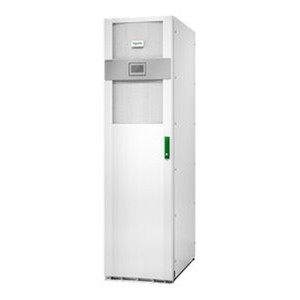
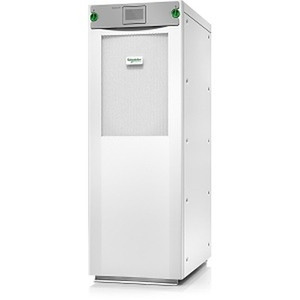
APC by Schneider Electric GVSUPS100K0B5HS Galaxy VS 100kW Modular Three-Phase UPS
Overview
The APC by Schneider Electric GVSUPS100K0B5HS is a 100kW (100kVA) three-phase, double-conversion online UPS designed for data centers, large network closets, and critical infrastructure installations where a power interruption is not an option. Double-conversion topology means the load runs entirely on conditioned inverter output at all times — not just during a utility event — so voltage sags, surges, and frequency deviations never reach your connected equipment. The unit supports up to five internal 9Ah smart modular battery strings, giving you runtime scalability without replacing the base unit as your power demands evolve. If you are sizing critical power for a mid-tier data hall, a manufacturing automation floor, or a distributed campus compute node, the three-phase UPS category is where this unit belongs, and the GVSUPS100K0B5HS is engineered for exactly this class of load.
Key Features
- Double-Conversion Online Topology: The inverter carries 100% of the load continuously. Unlike line-interactive designs, there is no transfer time on utility failure — zero milliseconds of ride-through gap means even the most transfer-sensitive server and storage platforms stay operational. This is the topology to specify for Tier 3 and Tier 4 data environments.
- 100kW / 100kVA Output at Unity Power Factor: Output power factor of 1.0 means rated kW and rated kVA are the same number — 100kW of real power delivery with no derating. Older designs with 0.8 power factor force you to buy a 125kVA unit to deliver 100kW. This unit does not penalize you for that gap.
- 0.99 Input Power Factor: Drawing current at near-unity input PF (0.99) reduces reactive current demand on upstream distribution. For a 100kW load, that is a meaningful reduction in upstream conductor and transformer sizing compared to lower-PF UPS designs. Less wasted capacity in your electrical infrastructure.
- 400V Three-Phase Input/Output (340–460V Input Range): The 120V input window (340–460V) accommodates real-world utility voltage swings common in European and international grid environments without switching to battery. Output holds 380–415V under load, keeping downstream PDUs and IT equipment within tolerance during extended grid disturbances.
- 40–70 Hz Input Frequency Acceptance: Accepts supply frequency anywhere from 40 to 70 Hz. This range covers both 50Hz (Europe, Asia) and 60Hz (North America) grids, and tolerates generator frequency droop during startup — critical when the unit feeds back to a diesel genset during a utility outage. Generators are rarely at a stable 60Hz the moment they start.
- Pure Sine Wave Output: Outputs a true sine waveform with total harmonic distortion held to 3% or less — well below the 5% threshold that begins to affect sensitive motor drives, medical equipment, and precision test instruments. For mixed loads including variable-frequency drives or linear power supplies, this is the specification that matters.
- Crest Factor 2.5:1: Handles non-linear loads (switched-mode power supplies, UPS-fed PDUs, server power bricks) without output voltage distortion. IT loads are almost entirely non-linear; a weak crest factor rating causes waveform collapse under real data center loading. 2.5:1 is the correct spec for this load class.
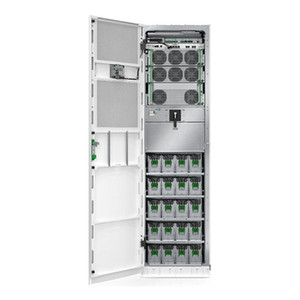
- Up to 5 Modular Smart Battery Strings: Runtime scales by adding internal battery string modules rather than replacing the UPS. This matters in phased buildouts where initial runtime requirements are modest but grow as rack density increases. Modular battery architecture also allows hot-swap replacement without a full system shutdown.
- 12,377 BTU/h Heat Dissipation: Plan for approximately 3.6kW of heat rejection per operating hour at full load. For a 100kW UPS in a sealed room, that is a real cooling load — confirm your CRAC or in-row cooling capacity before commissioning, and factor this into your data center thermal model.
- 180A Maximum Output Current: At 380V three-phase, 180A supports the full rated load with appropriate headroom for inrush events. Coordinate with your upstream breaker and cable sizing accordingly — 180A continuous at 400V requires appropriately rated distribution infrastructure.
Integration & Compatibility
The GVSUPS100K0B5HS operates across the standard international three-phase voltage range (380–415V output) and connects to power distribution units and downstream PDUs configured for 400V three-phase input. The 40–70Hz frequency window supports both utility and generator sources without reconfiguration. Smart battery string architecture integrates with APC's Galaxy VS battery management system for state-of-health monitoring and predictive replacement alerts. For facilities running EcoStruxure IT or similar DCIM platforms, the Galaxy VS family is designed for network card integration enabling remote monitoring, load reporting, and automated shutdown sequencing. Pair with an APC UPS network management card (sold separately) for full SNMP and HTTPS management visibility.
Deployment Context
For edge compute nodes, manufacturing execution systems, and mid-density data halls where a single 100kW UPS covers the critical load block, this unit eliminates the need for an oversized static bypass cabinet by incorporating clean double-conversion conditioning. Facilities engineers specifying commercial-grade battery backup for critical power at the 100kW tier should verify upstream transformer capacity, confirm 400V three-phase distribution to the UPS input, and plan cooling for the 12,377 BTU/h full-load heat rejection before installation.
Frequently Asked Questions
Q: What is the output power factor of the GVSUPS100K0B5HS, and why does it matter?
A: The GVSUPS100K0B5HS has an output power factor of 1.0, meaning it delivers the full 100kW of real power at its 100kVA rating. UPS units with 0.8 power factor can only deliver 80kW from a 100kVA unit — you would need to oversize to reach 100kW of real load. Unity PF eliminates that derating penalty.
Q: Can the GVSUPS100K0B5HS operate on generator power?
A: Yes. The 40–70Hz input frequency window is specifically designed to tolerate the frequency instability common during generator startup and load transfer. This range covers both 50Hz and 60Hz utility grids and provides a significant buffer against generator frequency droop.
Q: How many battery strings does the GVSUPS100K0B5HS support, and can runtime be expanded later?
A: The unit supports up to five internal 9Ah smart modular battery strings. Battery modules can be added incrementally as runtime requirements grow, making this unit well-suited for phased capacity buildouts without replacing the base UPS hardware.
Q: What is the output voltage THD of the GVSUPS100K0B5HS?
A: Output voltage total harmonic distortion is rated at 3% or less — below the 5% threshold that begins to affect sensitive equipment including variable-frequency drives, medical devices, and precision instrumentation.
Q: What cooling capacity should I plan for when installing the GVSUPS100K0B5HS?
A: At full load, the unit dissipates 12,377 BTU/h (approximately 3.6kW). This must be accounted for in your room or row cooling design. Confirm your CRAC, in-row cooler, or HVAC system can handle this heat load continuously before deployment.
Q: What is the input voltage range for the GVSUPS100K0B5HS?
A: The unit accepts 340–460V three-phase input, a 120V window that accommodates routine utility voltage variation without switching to battery, reducing unnecessary battery cycling and extending battery service life.
The spec that defines this unit's deployment class is the unity output power factor — and it is the first thing I check when sizing a 100kW UPS for a mid-density data hall. The GVSUPS100K0B5HS delivers 100kW of real power from a 100kVA chassis, which means no hidden derating, no need to purchase a 125kVA frame to hit your actual load target. That alone changes the infrastructure cost calculation significantly at this power tier.
Technical Highlights:
- Unity Output Power Factor (1.0): 100kW real power from a 100kVA rated unit — eliminates the 20% capacity penalty imposed by 0.8 PF designs. At 100kW load scale, that is equivalent capacity to a 25kVA frame you do not have to buy.
- 0.99 Input Power Factor: Near-unity input PF reduces reactive current on upstream distribution by roughly 14% versus a 0.85 PF UPS drawing the same real power. That translates to smaller upstream conductors, lower transformer loading, and reduced energy waste in the distribution path.
- 40–70Hz Input Acceptance: Generator compatibility is built in — not an afterthought. The 30Hz window absorbs the frequency swings that occur during the first 10–15 seconds of generator operation before the governor stabilizes, preventing a nuisance battery transfer the moment a genset comes online.
Deployment Considerations:
- Plan the thermal envelope before the unit arrives. At full load, you are rejecting 12,377 BTU/h continuously — roughly the equivalent of a 1-ton residential AC unit running nonstop. In a sealed compute room, this is a real design constraint, not a footnote.
- The 180A maximum output current at 400V three-phase requires properly rated downstream distribution. Confirm that your PDUs, branch circuit breakers, and cable runs are rated for continuous 180A service — do not assume existing infrastructure sized for a smaller UPS carries over without a circuit audit.
The GVSUPS100K0B5HS is the right unit for a phased 100kW critical power deployment where the battery runtime requirement may grow over time — the five-string modular architecture means you commission with the runtime you need today and scale internally without a forklift upgrade as rack density increases.