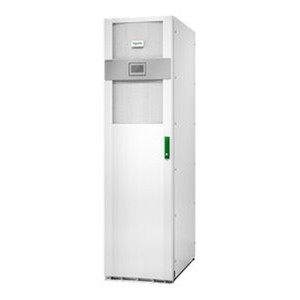
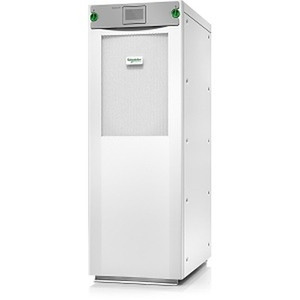
APC by Schneider Electric GVSUPS100KHS Galaxy VS 100kW 3-Phase Online UPS for External Batteries
Overview
The APC by Schneider Electric GVSUPS100KHS is a 100kW (100 kVA) double-conversion online UPS designed for large-scale three-phase power protection in data centers, enterprise server rooms, and critical industrial facilities. Unlike line-interactive or standby topologies, this unit keeps your load running on continuously conditioned inverter output — no transfer time on a utility disturbance, no voltage sag passed downstream. The Galaxy VS is built to accept external battery cabinets, giving you full control over runtime without being locked into a fixed internal battery configuration. If your facility has specific autonomy requirements — 30 minutes, 2 hours, or more — you size the external battery array to match, not the other way around.
For integrators and facilities engineers specifying three-phase UPS systems in the 80–150kW range, this unit positions squarely in the enterprise tier: wide input voltage window, near-unity power factor correction, and efficiency figures that matter when you're carrying this load 8,760 hours a year.
Key Features
- Double-Conversion (Online) Topology: The load runs on inverter-derived power at all times. Utility voltage is rectified and re-synthesized as a clean sine wave — meaning voltage sags, spikes, and frequency excursions on the input side never reach your equipment. For PLC racks, server clusters, or medical imaging systems where even a 20ms transfer gap is unacceptable, this is the topology requirement to specify.
- 100kW / 100 kVA Output at Unity Power Factor: A 1.0 power factor means the kW and kVA ratings are equal — no derating penalty when your load has a high power factor, as most modern IT equipment does. Fully loaded, this UPS handles 100kW of real work, not a padded kVA number that shrinks under actual conditions.
- 96.8% Operating Efficiency: At 96.8% efficiency, heat dissipation under full load is approximately 9,500 BTU/h (2,784W of waste heat). Compare this to older double-conversion designs running 93–94%: at 100kW throughput, that efficiency gap translates to roughly 2,000–3,000W of additional cooling load eliminated annually — meaningful savings on both energy and HVAC capacity.
- Wide Three-Phase Input Window (340–460V): The 120V input voltage range (340V min to 460V max at 400V nominal) accommodates fluctuating utility supply without forcing a battery discharge. Facilities in regions with historically unstable grid voltage benefit from this headroom — the UPS conditions rather than draws down battery on minor events.
- Input Power Factor of 0.99: At 0.99 input power factor, this UPS draws nearly pure real power from the utility — minimal reactive current pollution on your electrical infrastructure. For facilities with generator backup, high input PF also means the genset sees a cleaner, more predictable load at transfer.
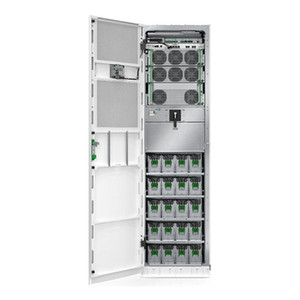
- External Battery Architecture: The GVSUPS100KHS ships without internal batteries by design, pairing with APC Galaxy VS external battery modules. This separation of UPS electronics from battery mass keeps the main unit weight manageable for floor loading and lets you replace or expand battery capacity without taking the UPS offline. Scale runtime from minutes to hours by adding battery cabinets — no UPS swap required.
- Output Voltage Regulation (380–415V, 3-Phase): Output stays within the 380–415V regulated window regardless of input condition. Equipment rated for 400V nominal operates within spec continuously, not just during stable grid periods.
- Output THD ≤ 3%: Total harmonic distortion at the output is held to 3% — below the 5% threshold that begins to affect sensitive electronics and transformers. For mixed loads including variable-frequency drives or precision measurement equipment, low output THD prevents downstream harmonic heating and measurement errors.
- 2.5:1 Crest Factor Tolerance: Crest factor of 2.5:1 means the UPS handles loads with high peak-to-RMS current ratios without output voltage distortion. Switch-mode power supplies in server racks regularly draw crest factors in this range; under-rated UPS output stages clip these peaks, introducing distortion that causes equipment faults.
- 40–70 Hz Input Frequency Acceptance: The wide input frequency window (40–70 Hz) supports operation from diesel generators, which commonly exhibit frequency droop or overshoot during load step events. Your UPS stabilizes output at a fixed 50 or 60 Hz regardless of what the generator delivers.
Integration and Compatibility
The GVSUPS100KHS is engineered for integration into enterprise three-phase power infrastructure, typically feeding downstream distribution panels, PDUs, or directly to high-density server racks via appropriately rated cabling. Three-phase input and output simplifies integration into balanced-load facilities without requiring single-phase conversion.
As an external-battery UPS, this unit requires pairing with compatible APC Galaxy VS battery modules to achieve any meaningful runtime. The battery cabinets connect to the main unit via a dedicated battery bus — consult the Galaxy VS battery compatibility matrix to specify the correct quantity for your autonomy target at 100kW load. For facilities planning large-scale power protection alongside network infrastructure, the Galaxy VS supports network management card integration for remote monitoring, SNMP visibility, and automated shutdown signaling to connected hosts.
Input wiring connects to a 3-phase supply at 400V nominal with a 182A maximum input current draw at full load — verify upstream breaker sizing and conductor gauge against this figure before installation. The 182A figure assumes unity power factor load; actual draw scales with load percentage.
If you're sizing battery runtime or assessing heat load against your existing HVAC capacity, the 9,499 BTU/h figure at full load gives you a concrete number for your mechanical engineer. Partial loads reduce heat output proportionally. Consult a UPS sizing and selection guide for runtime calculation methodology when specifying external battery quantities.
Frequently Asked Questions
Q: What UPS topology does the GVSUPS100KHS use, and why does it matter?
A: The GVSUPS100KHS uses double-conversion (online) topology. This means the load runs continuously on inverter-synthesized power — not utility power passed through a switch. There is zero transfer time on a utility fault: no sag, no spike, no frequency excursion reaches your equipment. This is the correct topology for PLC systems, server clusters, and any load where even a momentary interruption causes a fault or data event.
Q: Does the GVSUPS100KHS include batteries?
A: No. The GVSUPS100KHS is designed for external batteries only. It pairs with APC Galaxy VS external battery modules, which are sized and purchased separately based on your required runtime at 100kW load. This architecture lets you customize autonomy from minutes to hours without replacing the main UPS unit.
Q: What is the heat output of the GVSUPS100KHS at full load?
A: At 100kW (full load), the GVSUPS100KHS dissipates approximately 9,499 BTU/h (roughly 2,784W of waste heat). This figure should be provided to your mechanical/HVAC engineer when calculating cooling capacity for the room. Partial-load operation reduces heat output proportionally.
Q: What is the maximum input current draw for the GVSUPS100KHS?
A: Maximum input current is 182A (three-phase). Upstream breakers and feeders must be sized above this figure with appropriate safety margin per local electrical code. Actual draw at partial load will be lower — the 182A maximum applies at 100kW full load with unity power factor.
Q: What input voltage range does the GVSUPS100KHS accept?
A: The unit accepts three-phase input from 340V to 460V at 40–70 Hz. The wide voltage window (120V span around the 400V nominal) allows the UPS to condition rather than switch to battery during common utility voltage fluctuations, preserving battery life for actual outages.
Q: What is the output power factor and why does it matter for IT loads?
A: The GVSUPS100KHS delivers 100kW at unity (1.0) power factor — meaning the kW and kVA ratings are identical with no derating. Modern IT equipment (servers, storage, networking) typically draws at high power factor, so a unity-PF UPS ensures you get the full 100kW of usable capacity rather than a derated figure that forces you to buy a larger UPS than the load actually requires.
The spec that drives most of my conversations around the GVSUPS100KHS is the 96.8% efficiency figure. At 100kW continuous load, you're looking at roughly 2,784W of waste heat — which sounds like a lot until you compare it to a 93% efficient double-conversion unit pushing nearly 7,000W of heat into the same room. That difference alone can shift whether an existing HVAC plant handles the load or whether you're writing a change order for additional cooling before commissioning.
Technical Highlights:
- 96.8% Efficiency: At 100kW throughput, only ~3,200W is lost to heat — significantly less thermal burden than older-generation online UPS designs at the same capacity, which directly reduces HVAC sizing requirements and annual operating cost.
- 0.99 Input Power Factor: Near-unity input PF means the upstream transformer and switchgear see close to pure real current at 182A maximum — minimal reactive current penalty. For facilities with generator backup, this also means the genset's kW rating translates almost entirely to usable UPS input capacity.
- 340–460V Input Range: That 120V input window is genuinely useful in brownout-prone industrial districts or sites where the transformer tap isn't ideal. The UPS conditions through variations that would otherwise trigger unnecessary battery discharge and cycle count accumulation.
Deployment Considerations:
- This unit ships without batteries — budget and schedule for compatible APC Galaxy VS external battery cabinets separately. Runtime planning should start with your actual load profile (not the nameplate 100kW), which typically runs 40–70% in real deployments, directly affecting battery cabinet count.
- Input wiring at 182A three-phase is not a casual installation: verify conductor sizing, upstream breaker rating, and termination torque specs before energizing. Undersized feeders at this current level create a persistent fire and reliability risk that won't show up immediately.
The GVSUPS100KHS is the right specification for a colocation pod, enterprise server room, or large industrial control room where the operator cannot tolerate transfer-time UPS behavior and has a defined runtime requirement that mandates scalable external battery capacity rather than a fixed internal pack.