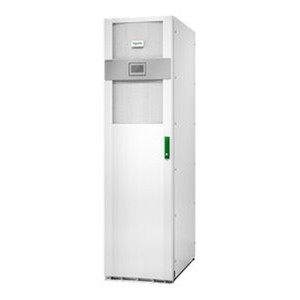
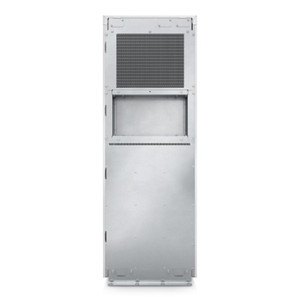
APC by Schneider Electric GVSUPS100KRHS Galaxy VS 100kW Online UPS with N+1 Power Module
Overview
The APC by Schneider Electric GVSUPS100KRHS is a 100kW (100 kVA) three-phase double-conversion online UPS designed for data centers, critical infrastructure, and large commercial facilities that cannot tolerate power interruptions or conditioned-power gaps. Built around a modular N+1 architecture with an external battery cabinet configuration and startup service included, this unit targets installations where power availability is a hard requirement — not a preference.
Double-conversion topology means the load never runs on raw utility power. Every watt is rectified and re-inverted continuously, isolating connected equipment from sags, swells, surges, frequency drift, and total outages. For enterprise UPS systems in this power class, that's the baseline expectation — the GVSUPS100KRHS delivers it across a wide 340–460V input window, making it deployable on non-ideal utility feeds without derating. Explore the full APC by Schneider Electric catalog for complementary infrastructure products.
Key Features
- 100kW / 100 kVA Double-Conversion Output: Full online double-conversion at 100kW means zero transfer time to battery — there is no transfer. The load stays on clean, re-inverted power at all times. At 400V output, this unit slots directly into European and international three-phase distribution without step-up transformers.
- N+1 Modular Power Architecture: The N+1 configuration means one redundant power module is always standing by. If an active module faults, the redundant module picks up immediately with no load interruption. For three-phase UPS deployments covering server rooms or telecom gear, this is the architecture that justifies high-availability SLAs.
- 340–460V Input Operating Range: A 120V input window (340V minimum, 460V maximum) absorbs utility voltage instability without switching to battery unnecessarily. Installations on aging distribution infrastructure or in regions with loose voltage regulation benefit directly — fewer nuisance battery events means longer battery service life.
- 40–70 Hz Input Frequency Acceptance: The 40–70 Hz input frequency tolerance handles both 50Hz and 60Hz utility feeds, plus significant frequency deviation. Diesel generator sources, which commonly drift under load, stay within spec. This matters during extended outages when generator runtime is the only source.
- Lithium-Ion Battery Technology at 576V: Li-Ion chemistry at the 576V battery string voltage offers a significantly smaller footprint and longer calendar life than VRLA alternatives at equivalent capacity. Li-Ion also tolerates higher operating temperatures, reducing HVAC dependency in the battery room — a meaningful OPEX consideration on large installations.
- 3% Input Current THD: Total harmonic distortion at or below 3% on the input means the GVSUPS100KRHS won't inject significant harmonic current back into the building's distribution system. Facilities with sensitive measurement equipment, variable frequency drives, or shared switchgear benefit from clean upstream behavior. Many sites mandate sub-5% THD contractually.
- Maximum 180A Input Current: At 180A maximum draw on a 400V supply, facilities can right-size their upstream breaker and cable infrastructure precisely. No derating guesswork — the 180A figure is the verified ceiling for feeder design.
- 11,373 BTU/h Heat Dissipation: Thermal load is 11,373 BTU/h under full operation. For data center cooling design, this translates directly to CRAC/CRAH capacity allocation — approximately 3.3 kW of cooling required from dedicated precision cooling infrastructure serving this unit.
- 68 dB Audible Operating Noise: At 68 dB, fan noise is comparable to a standard office environment. In operations centers or colocation spaces where staff work in proximity to equipment, this is a meaningful comfort factor versus older-generation high-power UPS systems that routinely exceeded 75 dB.
- 2.5:1 Crest Factor Rating: A 2.5:1 crest factor rating means the UPS handles non-linear loads — switching power supplies, server PSUs, VFDs — without output voltage distortion. Most IT loads present crest factors between 2:1 and 3:1; this unit handles the realistic range without derating.
- Pure Sine Wave Output: Sine wave output is mandatory for any equipment with active power factor correction on its input — which includes virtually all modern server and networking hardware. Square wave or stepped-wave UPS units cause premature failure in these loads. The GVSUPS100KRHS eliminates that risk entirely.
Integration and Compatibility
The GVSUPS100KRHS is configured for external battery cabinets, giving the installation team flexibility to size runtime independently of the UPS frame. Battery string voltage runs at 576V Li-Ion. The unit's 400V output aligns with IEC three-phase distribution standards common across European, Middle Eastern, and APAC data center builds. For facilities integrating this UPS into a broader power protection infrastructure, the modular power module design supports phased capacity expansion — add modules as load grows rather than replacing the entire frame. The included startup service ensures commissioning is performed to manufacturer standards, which matters for warranty validation and initial configuration on a system at this power level. Factor the 11,373 BTU/h thermal output into your precision cooling calculations before deployment — this is not a number to estimate. For guidance on sizing UPS capacity to your actual load, consult a UPS sizing guide before finalizing the specification.
Frequently Asked Questions
Q: What UPS topology does the GVSUPS100KRHS use, and why does it matter?
A: The GVSUPS100KRHS uses double-conversion (online) topology. This means the connected load always runs from the inverter — utility power is never passed directly to the output. There is zero transfer time during a power event because there is no switching action required. This is the correct topology for servers, networking equipment, and any load that cannot tolerate even a brief power interruption.
Q: What battery technology does the GVSUPS100KRHS use?
A: The GVSUPS100KRHS uses Lithium-Ion (Li-Ion) battery technology at a 576V battery string voltage. Li-Ion offers a longer calendar life and smaller physical footprint than traditional VRLA (lead-acid) alternatives and tolerates higher ambient temperatures, which can reduce cooling infrastructure requirements in the battery room.
Q: What is the input voltage and frequency range the GVSUPS100KRHS accepts?
A: The GVSUPS100KRHS accepts input voltages from 340V to 460V and input frequencies from 40Hz to 70Hz. This wide tolerance accommodates unstable utility feeds and diesel generator sources, which frequently drift in frequency under varying load conditions.
Q: What does N+1 mean in the context of the GVSUPS100KRHS?
A: N+1 means there is one more power module installed than the minimum required to support the full 100kW load. If any single active power module fails, the redundant module assumes its share of the load without any interruption to protected equipment. This architecture supports high-availability environments where a single component failure cannot cause a power outage.
Q: Does the GVSUPS100KRHS include batteries?
A: The GVSUPS100KRHS is configured for external battery cabinets — batteries are housed in a separate cabinet, not within the UPS frame itself. This design allows runtime to be scaled independently by adding battery cabinet capacity without changing the UPS unit.
Q: What is the heat output of the GVSUPS100KRHS, and how does it affect facility planning?
A: The GVSUPS100KRHS dissipates 11,373 BTU/h under full operation. Cooling system design must account for this load — it equates to approximately 3.3 kW of dedicated cooling capacity that must be allocated in the UPS installation area. Failure to account for this in HVAC design will result in thermal throttling or equipment faults.
The GVSUPS100KRHS sits in a specific and demanding segment: 100kW three-phase online UPS with N+1 redundancy and Li-Ion battery integration, designed for installations that have moved past lead-acid and need modular scalability without a full frame replacement when load grows. The 3% input THD figure is the one I keep coming back to — at 100kW, a poorly conditioned UPS pushing 8–10% THD back into the distribution system creates real problems for other equipment on the same switchgear. This unit stays clean.
Technical Highlights:
- 3% Input THD: At 100kW, sub-3% harmonic distortion on the input is a genuine differentiator. It protects upstream distribution from harmonic loading that can cause transformer heating, nuisance breaker trips, and interference with sensitive measurement or control systems sharing the same electrical infrastructure.
- 340–460V Input Window: The 120V spread on input voltage tolerance means this unit holds load through utility events that would force a narrower-tolerance UPS to battery. Fewer battery cycles from nuisance events directly extends Li-Ion pack life — which already outlasts VRLA in calendar terms.
- 576V Li-Ion Battery String: At 576V battery voltage with external cabinet architecture, runtime is sized separately from the UPS frame. You're not locked into whatever runtime the integrated battery delivers — scale the cabinet count to your actual runtime requirement without touching the power electronics.
Deployment Considerations:
- The 11,373 BTU/h thermal output must be in the cooling design before the unit ships. At full load, that's roughly 3.3kW of heat that precision cooling infrastructure needs to handle — treat it as a fixed load in the HVAC model, not an afterthought.
- Maximum input current is 180A at 400V. Feeder cable sizing and upstream protective device ratings need to be confirmed against this figure before installation. Under-rated feeders on a 100kW UPS are a commissioning failure point that the included startup service will surface — but plan ahead rather than discovering it on-site.
The GVSUPS100KRHS is the right specification for a colocation edge deployment or mid-size enterprise data center room running 400V three-phase distribution, where N+1 availability is required by the facility SLA and the operations team has already decided to move to Li-Ion chemistry for reduced battery room footprint and longer replacement cycles.