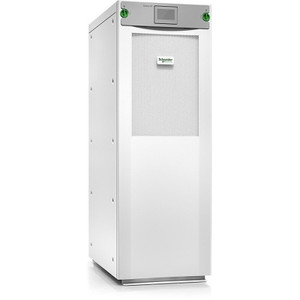
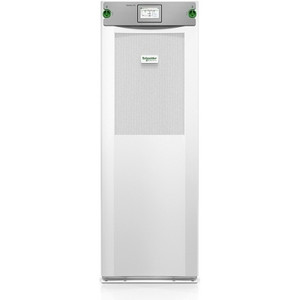
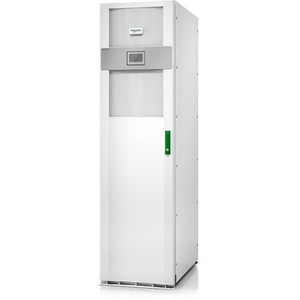
APC by Schneider Electric GVSUPS30KR0B5HS Galaxy VS 30kW 400V 3-Phase Online UPS with N+1 Redundancy
Overview
The APC by Schneider Electric GVSUPS30KR0B5HS is a 30kW (30 kVA) three-phase online double-conversion UPS engineered for data centers, server rooms, and critical infrastructure where power quality, scalability, and availability cannot be compromised. It pairs a modular N+1 power architecture with a near-unity 0.99 input power factor — two specs that directly reduce infrastructure cost and electrical panel loading in dense deployments.
The Galaxy VS line targets facilities engineers and IT architects managing mid-tier critical loads: edge data centers, manufacturing control rooms, broadcast suites, and enterprise server clusters. This specific configuration supports up to five 9AH Smart Modular battery strings and includes a redundant power module slot for N+1 fault tolerance without system shutdown. For a broader view of UPS and power protection solutions, the full category covers single-phase through large-scale three-phase systems.
Key Features
- Double-Conversion (Online) Topology: The load runs continuously on conditioned inverter output — utility power never directly reaches your equipment. Voltage sags, surges, frequency drift, and waveform distortion are all scrubbed before they reach servers or storage. This is the only UPS topology that provides true zero-transfer-time protection; relevant when your SLA has no tolerance for even a momentary interruption.
- 30kW / 30 kVA Output at Unity Power Factor: Because output kW equals output kVA, you're not derated on real-world resistive-capacitive loads. A 30kW rating here is an honest 30kW — no hidden capacity loss common on older designs with 0.8 or 0.9 PF-rated units. That matters when sizing against actual server-draw data from your PDU metering.
- N+1 Modular Power Architecture: The included redundant power module means a single module failure does not interrupt the load. Replacement is hot-swap — no scheduled maintenance window required for module-level service. For facilities running 24/7 operations, this eliminates a class of planned-downtime events entirely.
- 0.99 Input Power Factor: Drawing at near-unity PF keeps reactive current demand on your utility feed low. In practical terms, the upstream distribution panel, cabling, and transformer all see less apparent load than a comparable UPS with 0.9 or lower input PF — you may be able to run more UPS capacity on an existing electrical circuit without panel upgrades.
- Wide Input Voltage Window (340–460V): The 120V spread on the input (340V–460V) means the unit stays on mains rather than switching to battery during utility brown-outs or building distribution fluctuations common in industrial facilities. Fewer battery cycles extend battery life and reduce replacement costs over the system's service life.
- ECO Mode: When utility power quality is within tolerance, ECO mode routes power through a high-efficiency bypass path, reducing heat output and energy cost. The unit monitors the supply and automatically falls back to full double-conversion when anomalies are detected. For deployments with predictably clean utility power, ECO mode can meaningfully reduce annual energy costs at 30kW scale.
- Pure Sine Wave Output (1% Voltage Regulation): Output waveform quality matches or exceeds utility power. At 1% voltage regulation, sensitive loads — including switching power supplies in servers, medical instrumentation, and precision industrial controllers — operate within their design envelope. Choppy or stepped waveforms from lower-grade UPS types can trigger overcurrent protection in modern server PSUs.
- 2.5:1 Crest Factor Tolerance: Handles loads with high peak-to-RMS current ratios without output voltage collapse. Switched-mode power supplies are characteristically high-crest loads; a 2.5:1 rating gives headroom for realistic mixed IT and AV equipment without derating the inverter.
- 3542 BTU/h Heat Dissipation: Facility cooling planning requires accurate heat load data. At full load, this unit contributes 3,542 BTU/h to the room — roughly equivalent to one standard 1-ton supplemental cooling unit. Factor this into CRAC/CRAH sizing for the room; undersizing room cooling at 30kW UPS density is a common installation error.
- Input / Output Frequency Flexibility (40–70 Hz in, 50/60 Hz out): Accepts off-frequency input without faulting — useful in facilities near heavy industrial machinery that causes local frequency variation, or in international deployments where nominal grid frequency differs from output requirement.
- 54A Maximum Input Current: At 400V three-phase, 54A max input draws are the basis for upstream breaker and cable sizing. Plan breaker at 125% minimum per electrical code — a 70A three-phase breaker and appropriately rated conductors are the correct starting point for most installations.
Integration & Compatibility
The GVSUPS30KR0B5HS is configured for a 400V three-phase input/output environment — standard across European, Middle Eastern, and Asian grid infrastructures, and common in North American 480V-step-down industrial facilities. The 380–415V output range covers standard rack PDU and in-row distribution equipment. The system's modular battery design supports up to five 9AH Smart Modular battery strings, allowing runtime to be scaled at installation or expanded post-deployment without replacing the UPS frame.
For facilities integrating this unit into a broader power infrastructure strategy, the Galaxy VS is designed to interface with building management systems and DCIM platforms via standard communication interfaces common to the Galaxy VS product family. Pairing with downstream rack PDUs and remote monitoring enables per-outlet current visibility and remote load control — a practical combination for unmanned edge sites.
If you're evaluating runtime requirements or battery string sizing, consult a UPS battery selection guide before finalizing configuration. Runtime at 30kW depends directly on battery Ah capacity and load profile; the 9AH strings in this configuration are the baseline — additional strings extend autonomy proportionally.
Frequently Asked Questions
Q: What is the input voltage range for the GVSUPS30KR0B5HS?
A: The unit accepts three-phase input from 340V to 460V at 40–70 Hz. This wide range allows the UPS to ride through brown-out conditions and frequency deviations without transferring to battery, preserving battery cycle life.
Q: Does the GVSUPS30KR0B5HS support hot-swap power modules?
A: Yes. The N+1 modular architecture means a failed power module can be replaced while the system continues supplying the load. No planned outage is required for power module service.
Q: What is ECO mode and when should it be used?
A: ECO mode routes utility power through a high-efficiency bypass path when input power quality is within tolerance, reducing energy consumption and heat output compared to full double-conversion operation. It is best suited for sites with consistently clean utility power. The UPS automatically returns to double-conversion mode if input anomalies are detected.
Q: How many battery strings does this configuration support?
A: This configuration is designed for up to five Smart Modular 9AH battery strings. Additional strings can be added to extend runtime beyond the baseline configuration.
Q: What upstream breaker size is appropriate for the GVSUPS30KR0B5HS?
A: The unit draws a maximum of 54A on a 400V three-phase feed. Per standard electrical code, size the upstream breaker at 125% of maximum draw — a 70A three-phase breaker is the correct starting point. Confirm with a licensed electrician for your specific installation jurisdiction.
Q: What is the output voltage regulation on the GVSUPS30KR0B5HS?
A: Output voltage is regulated to within 1%, ensuring stable, clean power delivery to connected loads regardless of input voltage fluctuations within the accepted range.
The spec that consistently drives selection of the GVSUPS30KR0B5HS over competing 30kW units is the 0.99 input power factor combined with the true unity output power factor — in real deployments, that combination means you get an honest 30kW of protected capacity without the upstream electrical infrastructure penalty you'd absorb from older 0.8 PF designs. I've seen facility teams avoid panel upgrades entirely because of this spec alone.
Technical Highlights:
- 340–460V Input Window: A 120V operating band on the input side is meaningfully wider than most competitors in this class. At industrial sites with heavy machinery causing voltage sag, this keeps the UPS on mains rather than cycling batteries — directly extending battery service intervals.
- 3542 BTU/h at Full Load: Don't overlook this in the room cooling budget. At 30kW UPS density, 3,542 BTU/h is a real cooling load — factor it into CRAC sizing before commissioning. Facilities that skip this step often discover insufficient cooling headroom after installation.
- 2.5:1 Crest Factor: Modern server PSUs are notoriously high-crest loads. The 2.5:1 rating gives the inverter genuine headroom to supply realistic mixed IT loads without output voltage droop under peak draw events — which is when you actually need the UPS to be reliable.
Deployment Considerations:
- Plan upstream wiring for 54A maximum at 400V three-phase before the unit arrives on-site. A 70A breaker and correctly rated conductors need to be in place; this is not a last-minute calculation.
- ECO mode is tempting for energy savings at 30kW scale, but validate your utility power quality before enabling it in production. Sites with variable load switching (compressors, elevators, industrial equipment) can see frequent mode transitions that partially offset the efficiency gain.
The GVSUPS30KR0B5HS is the right selection for edge data center builds and mid-tier server room expansions at 400V where N+1 availability is a firm requirement and the facility team needs accurate heat and electrical load numbers for infrastructure planning — not a generic enterprise 'any UPS will do' situation.