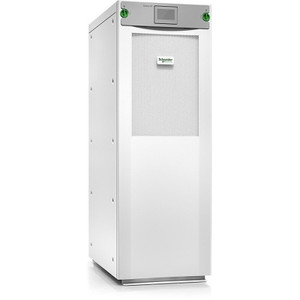
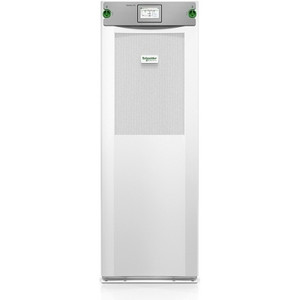
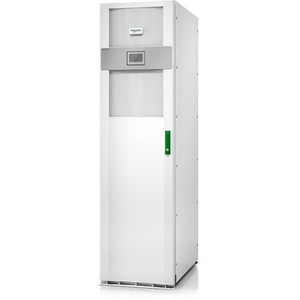
APC by Schneider Electric GVSUPS30KRHS Galaxy VS 30kW Online UPS with N+1 Power Module
Overview
The APC by Schneider Electric GVSUPS30KRHS is a 30kW (30 kVA) three-phase online double-conversion UPS designed for data centers, industrial facilities, and enterprise infrastructure requiring continuous, clean power protection with built-in redundancy. Built on the APC Galaxy VS platform, this unit targets deployments where a single power module failure cannot be allowed to bring down the load — the N+1 architecture keeps the system online even when one module is out for maintenance or has faulted. The external battery configuration means you size runtime independently from the UPS chassis, a practical advantage in space-constrained machine rooms where battery cabinet placement flexibility matters.
Double-conversion online topology means the load never runs directly off raw utility power. Every watt delivered to your equipment passes through rectification and re-inversion, producing a true sine wave output with total harmonic distortion under 1% — critical for power-sensitive loads such as servers, medical imaging equipment, or precision automation controllers that react poorly to voltage artifacts.
Key Features
- Double-Conversion Online Topology: Unlike line-interactive designs that only switch to battery during extreme events, double-conversion keeps the inverter in the power path continuously. Transfer time to battery is effectively zero — there is no switching transient to propagate to connected equipment. For systems running real-time databases or latency-sensitive processes, this is the topology to specify.
- 30kW / 30 kVA Output at Unity Power Factor: The output capacity equals the kVA rating, meaning there is no derating penalty when powering modern server loads that draw close to unity power factor. A 30kW load consumes the full rated capacity cleanly with no headroom loss from a lagging power factor correction.
- N+1 Power Module Architecture: The N+1 module design provides internal redundancy without a second standalone UPS. One module can fail or be hot-swapped for maintenance while the remaining module continues to carry the load — eliminating the single point of failure that conventional single-module UPS designs introduce at the power conditioning stage.
- True Sine Wave Output, 1% THD: Output voltage total harmonic distortion is held to 1%, well below the 5% threshold that begins to stress switch-mode power supplies and motor drives. Input current THD is 3%, which keeps the UPS from becoming a harmonic pollution source on the facility's electrical distribution.
- Wide Input Voltage Range (340–460V) and Frequency (40–70Hz): The broad input window accommodates utility voltage sag and swell events without transferring to battery unnecessarily, extending battery service life. The 40–70Hz frequency range makes this unit compatible with generator sets that hunt during load step changes — a common integration challenge in backup power scenarios.
- 54A Maximum Input Current, 3-Phase: At 54A per phase maximum on a 400V three-phase supply, the GVSUPS30KRHS fits within standard 63A circuit protection without requiring upsized distribution infrastructure in most commercial installations.
- External Battery Configuration: Runtime is determined by the external battery cabinets, not a fixed internal pack. This lets you match battery capacity to your specific autonomy requirement — from a few minutes of bridge time to extended runtime for critical loads — without buying a larger UPS chassis.
- 2.5:1 Crest Factor Tolerance: A 2.5:1 crest factor capability handles the high-peak, low-average current draw of rectifier-input loads (servers, VFDs) without clipping the waveform or triggering overload alarms. Lower crest factor ratings on cheaper UPS units cause premature fault trips under real server loads.
- Overload and Short-Circuit Protection: Integrated overload and short-circuit protection prevents a fault downstream from propagating into the UPS inverter stage, protecting both the unit and the distribution wiring feeding it.
- 68 dB Operating Noise: At 68 dB, this unit is audible in a quiet environment but is within normal range for a 30kW three-phase UPS in a dedicated electrical room or data center floor — plan your installation location accordingly if noise near occupied workspace is a concern.
- 3,122 BTU/h Heat Dissipation: Thermal load of 3,122 BTU/h must be accounted for in your room cooling calculation. In a typical data center row with active cooling, this is manageable, but verify your CRAC or in-row cooler capacity before commissioning in a sealed enclosure.
Integration & Compatibility
The GVSUPS30KRHS operates on a 400V three-phase input with a selectable 50/60Hz output frequency, making it compatible with standard European and international three-phase distribution. The wide input tolerance (340–460V) allows integration with both tightly regulated utility feeds and less stable generator-backed supplies. As part of the three-phase UPS segment of the Galaxy VS line, this unit is designed to connect to APC-compatible external battery enclosures — ensure battery cabinets are matched to this chassis model before ordering. Network management card slots (per the Galaxy VS platform architecture) support SNMP-based monitoring integration with building management systems and data center infrastructure management (DCIM) platforms. Consult the APC EcoStruxure compatibility matrix for specific NMC card compatibility and firmware requirements before deployment.
For load planning, note that high-density PoE switch infrastructure and server clusters represent typical loads in the 20–30kW range that this unit is sized to protect. Factor in future load growth when sizing — a 30kW UPS running at 80% load (24kW) provides adequate headroom and stays within the efficiency sweet spot of most double-conversion designs.
Frequently Asked Questions
Q: What is the input voltage range for the GVSUPS30KRHS?
A: The GVSUPS30KRHS accepts three-phase input between 340V and 460V, with an input frequency range of 40 to 70Hz. This wide window accommodates utility voltage variation and generator frequency hunting without unnecessarily switching to battery.
Q: What does the N+1 power module configuration mean for this UPS?
A: N+1 means the system includes one more power module than required to carry the rated load. If one module faults or is removed for maintenance, the remaining modules continue supplying power to the connected load without any interruption — eliminating a single point of failure in the power conditioning path.
Q: Does the GVSUPS30KRHS include internal batteries?
A: No. The GVSUPS30KRHS is configured for external batteries only. Runtime is determined by separately ordered and installed battery enclosures, which allows you to size autonomy independently from the UPS chassis based on your specific application requirements.
Q: What is the output power factor of the GVSUPS30KRHS?
A: The unit delivers 30kW at 30 kVA, which corresponds to a unity (1.0) power factor output. This means there is no derating when powering modern server and IT loads, which typically draw close to unity power factor.
Q: What protection features are built into the GVSUPS30KRHS?
A: The unit includes overload protection and short-circuit protection. Output voltage THD is rated at 1% and input current THD is rated at 3%, meaning the unit delivers clean power while also minimizing harmonic injection back onto the facility distribution network.
Q: What is the heat output of the GVSUPS30KRHS and how should I plan for it?
A: The GVSUPS30KRHS dissipates 3,122 BTU/h under load. This thermal load must be factored into your room or enclosure cooling capacity calculations before installation. Verify your CRAC, in-row cooler, or room ventilation can accommodate this additional heat load alongside your other equipment.
The spec I keep coming back to on the GVSUPS30KRHS is the 1% output voltage THD combined with the double-conversion topology — that combination is what separates a real online UPS from line-interactive units that only clean up power reactively. When you're protecting 30kW of server infrastructure, that continuous re-inversion is the difference between utility artifacts reaching your load and them being blocked entirely at the rectifier stage.
Technical Highlights:
- Input THD at 3%: The 3% input current harmonic distortion figure means this UPS won't become a harmonic pollution source on your distribution panel. Many cheaper three-phase UPS units push 10–15% input THD, which can trip other sensitive equipment on the same bus.
- 2.5:1 Crest Factor: Server loads routinely present crest factors between 2.0 and 3.0. The 2.5:1 rating here handles real mixed-load data center conditions without false overload trips — a spec that separates units built for IT loads from those optimized for resistive industrial loads.
- 40–70Hz Input Frequency Range: Generator integration is where this spec earns its keep. Generators under dynamic load can hunt between 48 and 62Hz before the governor stabilizes. A UPS with a tight 47–63Hz window will transfer to battery during that transient; the 40–70Hz range on this unit rides it out and keeps battery cycles off your service log.
Deployment Considerations:
- The external battery-only design requires you to specify and order battery enclosures separately before commissioning — confirm battery cabinet compatibility with the Galaxy VS platform before the equipment arrives on site to avoid a delayed startup.
- At 68 dB operating noise, this unit belongs in a dedicated electrical room or data center environment, not adjacent to open office space or in an IDF closet where occupant comfort is a constraint.
The GVSUPS30KRHS is the right specification for a mid-tier data center pod or a critical manufacturing control room where the load runs 20–28kW continuously, the facility has three-phase 400V distribution already in place, and the engineering team needs internal redundancy without the cost and footprint of a parallel UPS pair.