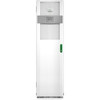
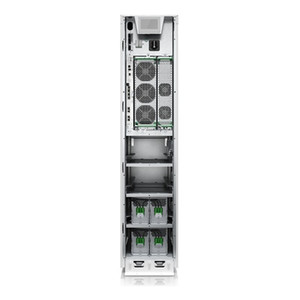
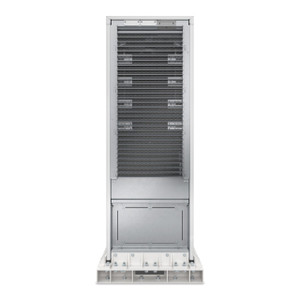
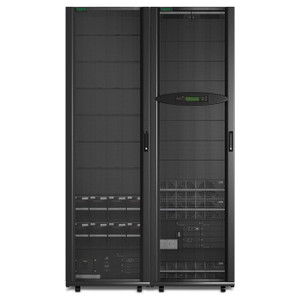
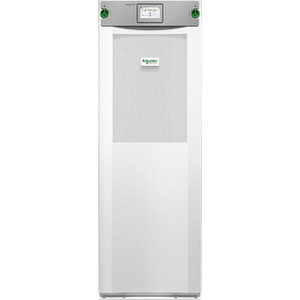
APC by Schneider Electric GVSUPS20KR0B5HS Galaxy VS 20kW Online UPS with N+1 Redundancy
Overview
The APC by Schneider Electric GVSUPS20KR0B5HS is a 20kW (20 kVA) three-phase online UPS built for mission-critical infrastructure deployments — data centers, telecom equipment rooms, and large-scale power protection installations that cannot tolerate transfer time gaps or dirty power. The Galaxy VS uses true double-conversion (online) topology, meaning connected loads run entirely off the inverter output at all times. There is no transfer switch delay, no exposure to input voltage sags, and no passthrough of input harmonic distortion to sensitive downstream equipment.
The N+1 power module architecture built into this configuration means one additional power module is present beyond what the 20kW load requires. If a module fails during operation, the UPS continues supplying full rated power without interruption — a hardware-level redundancy approach that matters in environments where a maintenance window to swap a failed UPS is not an option. For facilities teams managing critical power infrastructure, this distinction between software-managed redundancy and a physically redundant power module is worth the spec comparison before purchasing.
Key Features
- Double-Conversion Online Topology: The load never runs off raw utility power. Every watt passes through the rectifier and inverter continuously, which eliminates voltage sags, swells, and frequency instability from reaching connected equipment. For server rooms and telecom gear running 24/7, this is the only topology that provides full isolation from grid quality issues.
- 20kW / 20 kVA Output at Unity Power Factor: Rated output of 20,000W means the kW and kVA figures match — no derating penalty when connected loads present near-unity power factor. Modern server PSUs and networking equipment typically run at 0.9–1.0 PF, so this UPS delivers its full nameplate wattage to real infrastructure loads without the capacity loss that plagues older 0.8 PF-rated UPS units.
- N+1 Power Module Redundancy: The five-slot modular chassis with one spare power module means a single module failure does not reduce available output power. Replacement can be performed without taking the load offline — critical for organizations that cannot schedule maintenance downtime.
- 0.99 Input Power Factor: An input PF of 0.99 means the UPS draws almost exclusively real power from the upstream electrical system. For facilities with generator backup or limited upstream capacity, this significantly reduces the generator sizing requirement compared to UPS units with 0.7–0.8 input PF. Less reactive current draw also reduces heat in feeders and panels.
- Wide Input Voltage Range (340–460V): The UPS accepts input from 340V to 460V without switching to battery, which covers the full range of 400V three-phase utility variation found in European and international facilities. Narrow input windows force unnecessary battery cycling during routine utility fluctuations — this range avoids that wear.
- Input Frequency Tolerance (40–70 Hz): Accepts input frequencies from 40Hz to 70Hz, making this unit suitable for generator-fed installations where frequency regulation is imprecise, particularly during generator startup and load pickup transients.
- ECO Mode Operation: ECO mode routes power through a bypass path during stable utility conditions, reducing internal losses and improving efficiency. For deployments where grid quality is consistently high and efficiency targets are strict, ECO mode provides measurable energy cost reduction — though it does introduce a brief transfer time on switchover, so it should only be enabled when the connected load can tolerate it.
- Output Voltage Regulation ±3%: Output voltage is held within 3% of nominal under all load and input conditions. Sensitive networking and compute hardware has tighter PSU input tolerances than most industrial equipment — 3% regulation keeps all connected devices well within their operating windows regardless of load step changes.
- Output THD ≤5%, Input THD ≤6%: Output voltage distortion of 5% THD means a clean sine wave to the load — relevant for any connected equipment with switched-mode PSUs that can generate harmonic feedback. Input THD of 6% means the UPS itself presents a low harmonic load to the upstream distribution system, reducing the risk of nuisance tripping on upstream protective devices.
- 54 dB Noise Level: At 54 dB, this unit is appropriate for equipment rooms with normal ambient noise levels. It is not suited to open-office or library deployments, but for a dedicated IDF/MDF room, 54 dB is within the range where other HVAC and equipment noise will dominate.
- Pure Sine Wave Output: Sine wave output — not stepped approximation — is required by most UPS manufacturers to honor equipment warranties. All connected equipment, including motor-driven loads, medical-grade devices, and line-interactive downstream UPS units, will operate correctly without waveform-related compatibility concerns.
Integration and Compatibility
The GVSUPS20KR0B5HS operates at 400V three-phase output (340–460V range), making it compatible with standard European/international three-phase distribution at 400V L-L. The unit is configured for five 9Ah smart modular battery strings — battery runtime will depend on actual load; consult APC's runtime calculators or contact pre-sales engineering with your load profile for accurate runtime estimates before purchasing. Output frequency of 50/60 Hz with 3% regulation makes it straightforward to integrate with any standard downstream PDU or distribution panel in the same voltage class. The audible alarm system provides local fault notification; check manufacturer documentation for network management card compatibility if remote SNMP monitoring is required for integration with your infrastructure management platform.
For large-scale deployments involving multiple UPS units, APC by Schneider Electric's Galaxy VS platform supports parallel configurations — verify supported parallel topologies and required accessories with manufacturer documentation before specifying a multi-unit parallel array. If you are sizing this unit for a new installation, the 36A maximum input current figure is the key number for upstream breaker and feeder sizing at 400V three-phase.
Frequently Asked Questions
Q: What UPS topology does the GVSUPS20KR0B5HS use?
A: Double-conversion (online) topology. The load runs entirely off the inverter output at all times — there is no transfer time on input failure and no utility power passthrough to the connected equipment.
Q: What does the N+1 power module configuration mean in practice?
A: The unit contains one more power module than required to support the full 20kW rated output. If a single module fails, the remaining modules continue supplying full rated power with no load interruption. Failed modules can be replaced without shutting down the load.
Q: What is the input voltage and frequency range for this UPS?
A: Input voltage range is 340V to 460V. Input frequency range is 40Hz to 70Hz. These wide ranges allow the unit to ride through generator frequency variations and utility voltage fluctuations without switching to battery unnecessarily.
Q: Is ECO mode safe to enable for all connected loads?
A: ECO mode improves efficiency by routing power through bypass during stable utility conditions, but it introduces a brief transfer time when utility conditions degrade. It is appropriate for loads that can tolerate a short interruption. Do not enable ECO mode for loads that require zero transfer time, such as certain medical or process control equipment.
Q: What upstream breaker size does the GVSUPS20KR0B5HS require?
A: Maximum input current is 36A at 400V three-phase. Upstream overcurrent protection should be sized per local electrical code and APC's installation documentation — typically 125% of the maximum input current is the minimum breaker rating for continuous loads.
Q: What battery configuration does this model include?
A: This model is configured for five Smart Modular 9Ah battery strings. Runtime will depend on actual connected load — use APC's published runtime data or contact pre-sales engineering with your load profile for accurate runtime estimates.
The GVSUPS20KR0B5HS sits in a specific project tier — 20kW three-phase double-conversion with hardware N+1 redundancy — that rules out most of the Galaxy VS line below it. The 0.99 input power factor is the spec I keep coming back to on generator-backed installations: it means your upstream generator is doing almost no reactive work for this UPS, which directly reduces required generator KVA rating and can save real money on generator procurement. That input PF number is not marketing copy — it is a feeder and generator sizing parameter.
Technical Highlights:
- Unity Output Power Factor (20kW = 20 kVA): No capacity derating for modern IT loads. A 0.8 PF-rated 20 kVA UPS delivers only 16kW to real IT loads; this one delivers the full 20kW. That gap matters when you are sizing for known load budgets.
- Input THD at 6%: Low harmonic injection back onto the building distribution. On shared electrical infrastructure with sensitive lab or medical equipment, a UPS that injects 20–30% THD upstream creates real problems. 6% stays well clear of that range.
- 40–70 Hz Input Frequency Window: Generator installations frequently see 48–52 Hz during startup and load pickup. A UPS with a 47–53 Hz window switches to battery during those transients; this one stays on utility through the full generator ramp cycle, preventing unnecessary battery discharge on every generator test.
Deployment Considerations:
- The 54 dB noise rating is acceptable for a dedicated equipment room but will be noticeable in a mixed-use space. Verify your room's ambient noise baseline before finalizing placement — particularly relevant in smaller facilities without a dedicated MDF room.
- ECO mode should be evaluated carefully: the efficiency gain is real, but the transfer time penalty means it is incompatible with zero-transfer-time requirements. Define your load's tolerance for transfer before enabling it, and document the decision for future facilities staff.
This unit is the right specification for a 20kW three-phase critical load in a co-location edge node, a hospital IDF room with generator backup, or a manufacturing facility's process control infrastructure where both power quality and module-level redundancy are non-negotiable requirements.