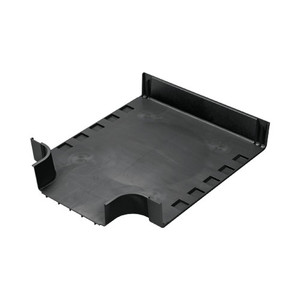
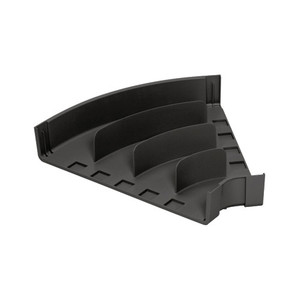
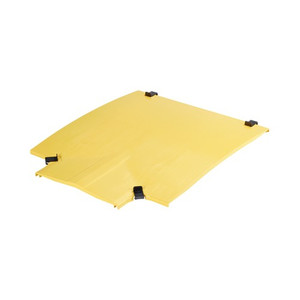
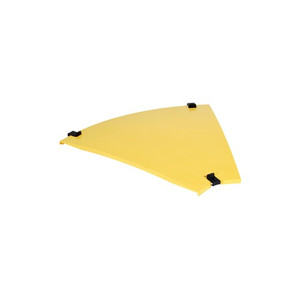
Panduit FRT24X4W12LYL FiberRunner 24x4 Horizontal Tee Fitting
Overview
The FRT24X4W12LYL is a 90-degree horizontal tee fitting for Panduit's FiberRunner cable management system, designed specifically for 24x4 fiber routing systems in data centers and central telecommunications offices. It branches a straight horizontal run into a perpendicular 12x4 outlet — effectively splitting a main 24-inch-wide fiber raceway into a managed 12x4 secondary run without breaking the enclosed pathway. If your structured cabling plan requires a clean horizontal branch at any point in a 24x4 FiberRunner run, this is the fitting that makes it happen in a single, purpose-built component.
Measuring 29.96 inches long, 24.48 inches wide, and 4.48 inches tall (approximately 762 x 621.8 x 113.8 mm), the FRT24X4W12LYL is dimensioned to integrate flush with standard FiberRunner 24x4 sections. The yellow polycarbonate/ABS construction makes it immediately identifiable in mixed-color pathway installations, consistent with Panduit's color-coding convention for fiber routing systems.
Key Features
- 90-Degree Horizontal Tee Geometry: Forms a true horizontal branch with a 12x4 outlet off the primary 24x4 run — so you can redirect a subset of fiber cables onto a secondary pathway without needing external cable guides or unmanaged loops. Every cable stays inside a closed, labeled system from end to end.
- Polycarbonate/ABS Construction: The material combination delivers the rigidity needed to support fiber cable bundles over the full 29.96-inch span while remaining light enough for overhead or wall-mounted pathway installations. Polycarbonate/ABS also resists the mechanical creep that can occur with cheaper thermoplastics under long-term cable weight loads.
- Yellow Color Coding: In multi-pathway environments where copper and fiber runs share the same overhead tray space, yellow immediately identifies this as part of the fiber system. This reduces mis-routing errors during moves, adds, and changes — a real operational benefit in busy data center floors.
- RoHS Compliance: The fitting meets RoHS requirements, which matters for international deployments, government facilities, and enterprise sustainability procurement policies. No special disposal handling required at end of life.
- UL-Listed Optical Fiber Routing Assemblies (to 2024): UL listing for optical fiber cable routing assemblies means the system has been independently evaluated for fire and mechanical safety in the cable routing application — relevant for insurance compliance and building code approval in commercial construction.
- Telcordia GR-63-CORE and NEBS Level 3 Compliance: These standards govern mechanical and environmental performance for network equipment in carrier-grade environments. NEBS Level 3 covers seismic zone 4 requirements, temperature cycling, and airborne contaminants. If your data center or telecom central office must meet carrier-class infrastructure standards, this fitting qualifies — a specification that rules out generic cable trays in these environments.
- System-Native Fit for FiberRunner 24x4: Designed exclusively for the FiberRunner 24x4 system, the FRT24X4W12LYL snaps and integrates with the existing pathway sections without field modification. Forcing a non-native tee into a closed-pathway system almost always creates stress points on fiber bend radius — using the correct fitting eliminates that risk.
- Single-Unit Package Quantity: Sold as individual units (package quantity: 1), giving you precise procurement control on large structured cabling projects where tee locations are mapped in advance. Order exactly what your routing diagram requires.
Integration & Compatibility
The FRT24X4W12LYL is engineered exclusively for use with the Panduit FiberRunner 24x4 system. It does not adapt to other Panduit FiberRunner sizes (such as 12x4 or 6x4) or third-party fiber routing systems — cross-compatibility should not be assumed. All FiberRunner fittings and straight sections for the 24x4 system connect using Panduit's snap-together interface, meaning no tools are required for assembly, but the pathway sections must be the correct size designation. For installations requiring a full branch in a smaller-footprint fiber run, other FiberRunner tee fittings in the 12x4 or 6x4 family would apply instead.
This fitting complies with the same standards suite as the broader FiberRunner system — RoHS, UL-listed optical fiber routing assemblies, Telcordia GR-63-CORE, and NEBS Level 3. These certifications apply to the fitting as part of the system assembly, consistent with how structured cabling compliance is typically evaluated for data center infrastructure. Confirm your project's specific AHJ requirements before substituting pathway components.
Frequently Asked Questions
Q: What size FiberRunner system is the FRT24X4W12LYL compatible with?
A: The FRT24X4W12LYL is designed for use exclusively with the Panduit FiberRunner 24x4 system. It is not compatible with FiberRunner systems of other dimensions (such as 12x4 or 6x4). Check the size designation on your existing pathway sections before ordering.
Q: What does the 90-degree horizontal tee actually do in a cable routing layout?
A: It creates a horizontal branch off a straight 24x4 FiberRunner run, with a 12x4 outlet exiting at 90 degrees. This allows you to redirect a portion of your fiber cables onto a secondary pathway while the main run continues — all within the closed FiberRunner system, maintaining bend radius control throughout.
Q: Is the FRT24X4W12LYL RoHS compliant?
A: Yes. The FRT24X4W12LYL meets RoHS requirements, making it suitable for deployments in regulated environments and for organizations with environmental compliance mandates on infrastructure components.
Q: Does this fitting meet NEBS Level 3 standards?
A: Yes. The FRT24X4W12LYL, as part of the FiberRunner system, conforms to Telcordia GR-63-CORE and Network Equipment Building Systems (NEBS) Level 3 requirements — the standard required for carrier-class telecom central office installations including seismic zone 4 and environmental stress criteria.
Q: What are the overall dimensions of the FRT24X4W12LYL?
A: Overall length is 29.96 inches, overall width is 24.48 inches (621.8 mm), and overall height is 4.48 inches (113.8 mm). Plan your overhead or wall-mount pathway routing with these clearances in mind.
Q: How many units come in one order?
A: The package quantity is 1 unit per order. This is a single fitting, allowing precise quantity procurement matched to your routing diagram.
The FRT24X4W12LYL is one of those fittings that looks simple on a spec sheet but does real work in a structured pathway design. The 90-degree horizontal tee with a 12x4 outlet means you can branch off a main 24x4 FiberRunner run without breaking the enclosed pathway — and in a NEBS Level 3-rated system, that matters as much for compliance documentation as it does for the actual cable protection.
Technical Highlights:
- 29.96-inch overall length: Plan your overhead clearance accordingly — this is not a compact fitting. At nearly 30 inches, it needs unobstructed run space on both the straight-through and branch sides before the next fitting or section joint.
- 24.48 x 4.48 inch cross-section (621.8 x 113.8 mm): The 24x4 form factor is one of the larger FiberRunner profiles, suited to high-density fiber runs. If your pathway only carries a handful of fiber cables, a smaller FiberRunner family would reduce overhead real estate and fitting cost significantly.
- Polycarbonate/ABS construction with yellow color coding: Yellow pathway sections are instantly distinguishable from gray or black copper management systems on the same overhead grid — a practical benefit during any MAC work when you cannot afford to pull the wrong cable.
Deployment Considerations:
- The tee outlet is 12x4, not 24x4 — so the branch capacity is half the main run. If your branch requires a full 24x4 capacity, this fitting does not provide it; you would need a different tee configuration or a reducer transition to a separate 24x4 branch run.
- NEBS Level 3 and Telcordia GR-63-CORE compliance applies to the FiberRunner system assembly as a whole — individual fittings must be used as part of the complete Panduit FiberRunner 24x4 system to claim system-level certification. Mixing non-Panduit pathway sections invalidates the certified assembly.
The FRT24X4W12LYL is the right call for telecom central offices and large enterprise data centers running NEBS-required infrastructure where the 24x4 FiberRunner system is already the standard — specifically in any zone where a horizontal branch to a secondary cabinet row or patch panel field is part of the routing plan.