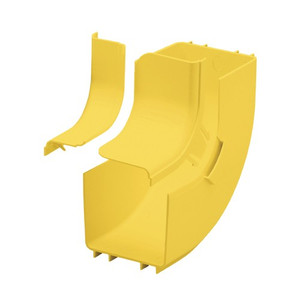
Panduit FRIV456X4LBL FiberRunner 6x4 Inside Vertical 45° Elbow
Overview
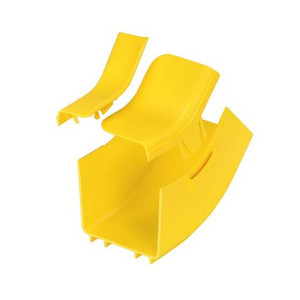
The Panduit FRIV456X4LBL is an inside vertical 45° elbow fitting for the FiberRunner® 6x4 fiber routing system, designed to route fiber optic cables through a 45-degree upward bend from a straight horizontal run. Where a cable pathway needs to change planes — transitioning from horizontal to an angled vertical climb — this fitting creates that geometry without forcing cables into tight, radius-violating bends that degrade signal or damage fiber jackets over time.
Pair the FRIV456X4LBL with the outside vertical 45° connector (FROV456X4LBL) to complete a full plane change within a fiber routing system. The inside and outside elbow work as a matched set: attempting to use one without the other produces a geometrically incomplete transition that won't close the pathway or maintain consistent bend radius protection through the turn.
Built from polycarbonate/ABS — a material combination chosen for dimensional stability and impact resistance in dense cable environments — this fitting is sized for the 6x4 FiberRunner channel (approximately 6-inch width, 4-inch depth). It meets UL listing requirements under standard 2024A for fiber optic cable routing assemblies, and satisfies Telcordia GR-63-CORE and NEBS Level 3 test requirements, making it appropriate for carrier-grade and mission-critical data center deployments where equipment survivability under seismic and environmental stress is specified.
Key Features
- 45° inside vertical geometry (6x4 channel): Creates a precise 45-degree upward bend in a horizontal fiber run without exceeding minimum bend radius — critical for maintaining optical performance in single-mode fiber that fails silently when bent too sharply. This is not a field-bent workaround; it's a factory-engineered transition piece sized to the FiberRunner 6x4 channel cross-section.
- Polycarbonate/ABS construction: This material blend handles the mechanical stress of a loaded fiber tray far better than plain ABS alone — polycarbonate contributes impact resistance and dimensional stability across temperature swings typical in raised-floor and open-frame rack data centers. You're not dealing with fittings that crack during installation or warp under sustained cable weight.
- UL listed (2024A, fiber optic cable routing assemblies): Listing under UL 2024A means the fitting has been independently tested for flammability, structural integrity, and compatibility with fiber routing use. For data centers requiring third-party validation on every pathway component — common in financial, healthcare, and colocation facilities — this is the spec that gets the fitting through the approval process.
- NEBS Level 3 / Telcordia GR-63-CORE compliance: NEBS Level 3 is the benchmark for telecommunications central office equipment — covering seismic zone 4 survivability, airflow, temperature cycling, and more. If you're deploying in a carrier central office, a Tier III/IV colocation, or any facility with NEBS in its equipment specification, this fitting meets the environmental durability requirement without an exception or waiver.
- RoHS compliant: Required for deployments in EU member states and for many enterprise procurement programs that mandate environmental compliance across all installed components, not just active electronics. Keeps the full pathway system RoHS-clean.
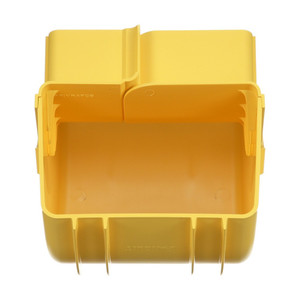
- Overall dimensions — 6.83" H × 8.11" W × 7.04" L: These are the installed envelope dimensions. Verify clearance in your cable trough or overhead pathway before committing — the 8.11-inch width in particular requires adequate horizontal clearance at the transition point. In tight overhead runs or sub-floor trays already loaded with power cabling, this is the dimension to check against your as-built drawings.
- Package quantity of 1, carton quantity of 5: Sold individually. If your design calls for multiple identical plane changes across a row of racks — common in bidirectional fiber runs serving top-of-rack switches — order the carton quantity of 5 to keep the pathway system consistent and avoid per-unit cost inefficiency.
Integration & Compatibility
The FRIV456X4LBL is purpose-built for the Panduit FiberRunner® 6x4 fiber routing system. It is not interchangeable with FiberRunner 4x4, 2x2, or 4x2 channel components — the 6x4 designation refers to the internal channel width and depth, and mixing channel sizes breaks the pathway geometry and defeats the bend radius protection the system provides.
For a complete vertical plane change, this inside elbow must be used together with the matching outside vertical elbow (FROV456X4LBL). Both fittings connect to straight FiberRunner 6x4 duct sections and splice covers using the standard FiberRunner snap-fit or screw-retention connection method consistent across the 6x4 product family.
The system targets data center and telecommunications central office environments — anywhere structured fiber pathways need to route cables between horizontal ladder rack, vertical cable managers, and patch panels without relying on tie-wraps and manual bends. The NEBS Level 3 rating makes it a direct fit for carrier and colocation specifications that require documented environmental compliance for all pathway hardware, not just active equipment.
For planning a complete fiber pathway layout including straight sections, covers, tees, and crosses, reference a cable management planning guide to size channel fill ratios correctly before ordering. Overfilling a 6x4 channel — even with a correctly rated elbow — creates installation problems at every fitting junction.
What’s in the Box
- 1× Panduit FRIV456X4LBL FiberRunner 6x4 Inside Vertical 45° Elbow fitting
Frequently Asked Questions
Q: Does the FRIV456X4LBL work with FiberRunner 4x4 or other channel sizes?
A: No. The FRIV456X4LBL is designed exclusively for the FiberRunner 6x4 system. The 6x4 channel dimensions are not interchangeable with 4x4, 2x2, or 4x2 FiberRunner components. Using this fitting with a different channel size will result in a mismatched pathway that doesn't close properly or maintain consistent bend radius protection.
Q: Do I need to order anything else to complete a vertical plane change with the FRIV456X4LBL?
A: Yes. The FRIV456X4LBL is the inside vertical elbow. To complete a full 45-degree plane change from a horizontal fiber run, you also need the matching outside vertical 45° connector (FROV456X4LBL). Both fittings are required together — the inside elbow alone does not create a complete, closed pathway transition.
Q: Is the FRIV456X4LBL compliant with NEBS Level 3 requirements?
A: Yes. The FRIV456X4LBL meets the requirements for relevant tests in Telcordia GR-63-CORE and is compliant with NEBS (Network Equipment Building Systems) Level 3. This makes it suitable for carrier central offices, colocation facilities, and other deployments where NEBS environmental compliance is specified for pathway hardware.
Q: Is the FRIV456X4LBL RoHS compliant?
A: Yes. The FRIV456X4LBL is RoHS compliant, meeting the European Union's Restriction of Hazardous Substances directive requirements. This is relevant for deployments in EU member states and for enterprise procurement programs that require environmental compliance across all installed infrastructure components.
Q: Is this fitting sold individually or in a case pack?
A: The FRIV456X4LBL is sold in a package quantity of 1 (single fitting). The carton quantity is 5, so if your design requires multiple identical 45-degree inside vertical elbows — for example, along a row of racks with bidirectional fiber runs — purchasing in carton quantities of 5 is the efficient approach.
Q: What material is the FRIV456X4LBL made from?
A: The fitting is constructed from a polycarbonate/ABS blend. This combination provides impact resistance and dimensional stability needed in loaded fiber tray environments, and it supports the UL 2024A listing for fiber optic cable routing assemblies.
The FRIV456X4LBL is one of those fittings that looks straightforward on a spec sheet but causes real installation headaches when it's missing or substituted. At 8.11 inches wide and 6.83 inches tall, this inside 45-degree elbow is a substantial piece — confirm your overhead tray clearances before the fiber pull, not after. I've seen data center builds where pathway fittings were treated as afterthoughts, ordered off-cuts or left to field improvisation, and the result is always bent-beyond-spec fiber and troublesome insertion loss that's a nightmare to trace later.
Technical Highlights:
- NEBS Level 3 / Telcordia GR-63-CORE: For carrier central offices and Tier III/IV facilities that mandate documented environmental compliance on all pathway hardware — not just active gear — this rating is what keeps the spec sheet clean and the AHJ happy. Most generic cable tray elbows don't carry it.
- UL 2024A listing (fiber optic cable routing assemblies): Independent third-party listing specifically for fiber routing — not a generic electrical listing repurposed for fiber. This matters when the commissioning checklist asks for fiber-pathway-specific certification and 'UL listed (general)' doesn't satisfy the submittal.
- Polycarbonate/ABS construction: The blend handles sustained cable load and installation impact better than plain ABS. In a 6x4 channel running at 50–60% fill, the fitting sees real mechanical stress at the elbow junction — material quality here directly affects long-term pathway integrity.
Deployment Considerations:
- The FRIV456X4LBL must be paired with the outside vertical 45° elbow (FROV456X4LBL) to complete any plane change — do not spec one without the other, and verify both are on the BOM before the pathway installation begins.
- The 8.11-inch installed width is the critical clearance dimension: in overhead cable trays already crowded with copper runs or power whips, this fitting may require a dedicated lane or tray offset. Check as-built drawings before committing the pathway route.
The FRIV456X4LBL is the right call for any carrier or enterprise data center running structured FiberRunner 6x4 pathways where NEBS Level 3 compliance is a hard requirement — think hyperscaler edge POPs, carrier central offices, or colocation builds where every pathway component needs a stamped compliance record, not just the active equipment in the rack.