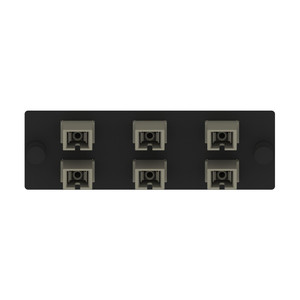
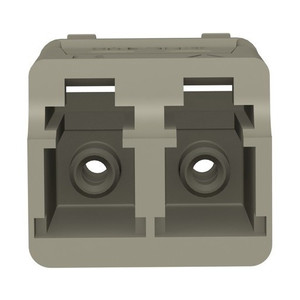
Panduit FAP8WEIDLCZ 8-Port LC Duplex Fiber Optic Adapter Panel
Overview
The Panduit FAP8WEIDLCZ is a front-loading fiber optic adapter panel from the Panduit Opticom™ line, housing 8 LC Duplex adapters in a compact 1U-compatible footprint designed for structured cabling installations in data centers, server rooms, and enterprise distribution frames. At 4.3 inches wide and 1.38 inches tall, this panel slots cleanly into standard EIA-310/IEC 60297-compliant 19-inch rack enclosures — no custom hardware, no adapter plates. The electric ivory (ivoire électrique) adapter color and zirconia split sleeves are the details that distinguish it from budget alternatives: zirconia ferrules maintain tight tolerance alignment across repeated mate/demate cycles, reducing insertion loss creep over the life of the installation.
The FAP8WEIDLCZ supports OM1, OM2, OM3, OM4, and OS2 fiber types, making it a genuinely multi-generation panel — you can deploy it today on a legacy OM1 62.5µm backbone and it will still be the right hardware when that run gets upgraded to OM4 or OS2 singlemode. That flexibility matters in enterprise and campus environments where fiber plant upgrades happen incrementally, not all at once.
Key Features
- 8 LC Duplex Ports (16 fiber terminations): LC is the dominant small-form-factor fiber connector in modern data centers and enterprise backbones. Eight duplex ports per panel means 16 individual fiber terminations in a 4.3 × 1.38-inch footprint — high density without requiring a full 1U blade. For fiber optic switch uplinks or patch bay aggregation, this gives you meaningful port count in minimal rack space.
- Zirconia Split Sleeves: Zirconia ceramic split sleeves offer tighter bore tolerance than phosphor bronze, which translates directly to lower and more consistent insertion loss over repeated connection cycles. In high-availability links where degraded insertion loss triggers alarms or link drops, the sleeve material is worth specifying. Phosphor bronze is cheaper; zirconia is the right call for permanent or frequently patched runs.
- OM1/OM2/OM3/OM4/OS2 Multi-Mode and Single-Mode Compatibility: Supporting the full range from legacy OM1 62.5µm through current OM4 50µm and OS2 singlemode means this panel doesn't lock you into a single fiber generation. Migrate your fiber plant at your own pace — the panel stays in the rack through multiple upgrade cycles, protecting the infrastructure investment.
- EIA-310 / IEC 60297 Rack Standard Compliance: These are the governing standards for 19-inch equipment rack dimensions. Compliance here means the panel physically fits and mounts in any standards-compliant rack or enclosure without modification — relevant when deploying into third-party rack cabinets or co-location environments with strict hardware qualification requirements.
- RoHS Compliance: The panel meets RoHS (Restriction of Hazardous Substances) requirements, which matters for enterprise procurement in regulated industries (healthcare, education, government) and for any installation destined for export to EU markets. Many IT procurement frameworks require RoHS documentation at the component level.
- Front-Loading Design: Front-access adapter installation simplifies panel maintenance in densely populated racks. Technicians can swap adapters or reposition cables from the front without pulling the panel or disturbing adjacent equipment — a practical advantage in production environments where rack access time is constrained.
- Opticom™ Sub-Brand Ecosystem: The FAP8WEIDLCZ is part of Panduit's Opticom™ fiber optic systems family, which means it's designed to integrate with Panduit's complementary enclosures, cassettes, and cable management hardware. If your structured cabling infrastructure is already Panduit-based, this panel carries the same dimensional and compatibility guarantees as the rest of the system.
- Plastic Housing, Commercial-Grade Construction: The plastic housing keeps weight down in rack installations where cumulative panel weight is a factor, while still meeting the mechanical requirements for a passive patch panel application. This is standard for this class of fiber panel — the performance-critical component is the zirconia sleeve, not the housing material.
Integration & Compatibility
The FAP8WEIDLCZ is a passive component — it introduces no active electronics and has no firmware, management interface, or power requirement. Compatibility is determined entirely by physical and fiber-type matching. The panel accepts standard LC Duplex connectors; any LC-terminated fiber cable (whether pre-terminated pigtail or field-terminated) mates directly. The electric ivory adapter color is a visual coding convention — in multi-panel installations, color coding helps technicians identify fiber type or circuit group at a glance, reducing patching errors.
Rack integration requires an EIA-310 or IEC 60297-compliant 19-inch rack or patch panel housing. At 4.3 inches wide and 1.38 inches tall, the panel fits standard front-loading fiber enclosures. Verify that your target enclosure supports front-loading adapter panels at this width before ordering — not all fiber enclosures accept modular adapter panels; some require pre-configured cassettes instead.
Fiber type compatibility spans OM1 through OS2, so the panel works across both multimode and singlemode plants. The one constraint: LC Duplex adapters are single-connector-type — you cannot mix LC and SC or LC and ST on the same adapter panel. If your infrastructure uses mixed connector types, plan accordingly with separate panels per connector type or use hybrid adapter panels from the Opticom™ line.
What's in the Box
- 1× Panduit FAP8WEIDLCZ Fiber Optic Adapter Panel (8 LC Duplex, Electric Ivory, Zirconia Sleeves)
Frequently Asked Questions
Q: What fiber types does the FAP8WEIDLCZ support?
A: The FAP8WEIDLCZ supports OM1, OM2, OM3, OM4, and OS2 fiber types — covering both legacy multimode (including 62.5µm OM1) and current singlemode OS2 infrastructure. You do not need to match the panel to a single fiber generation; it works across all five.
Q: What rack standard does this panel comply with, and will it fit in a standard 19-inch rack?
A: The panel meets EIA-310 and IEC 60297 rack standards, which govern standard 19-inch equipment rack dimensions. At 4.3 inches wide and 1.38 inches tall, it is dimensioned for front-loading installation in any EIA/IEC-compliant 19-inch rack or enclosure. Verify that your specific enclosure model supports front-loading modular adapter panels before ordering.
Q: Why does the FAP8WEIDLCZ use zirconia split sleeves instead of phosphor bronze?
A: Zirconia ceramic split sleeves hold tighter bore tolerances than phosphor bronze alternatives, which results in lower and more consistent insertion loss — particularly important on links that are patched and re-patched frequently. For permanent or rarely disturbed runs, the difference is marginal; for active patch environments or high-availability links, zirconia is the recommended specification.
Q: Is the FAP8WEIDLCZ RoHS compliant?
A: Yes. The FAP8WEIDLCZ meets RoHS (Restriction of Hazardous Substances) requirements as stated by the manufacturer. This is relevant for enterprise procurement in regulated sectors and for installations or exports subject to EU RoHS directives.
Q: How many fibers does this panel support in total?
A: Eight LC Duplex adapters means 16 individual fiber terminations per panel. Each duplex adapter handles two fibers (Tx and Rx), so a fully populated panel supports 8 duplex links or up to 16 individual fiber strands depending on your patching configuration.
Q: Can this panel be used with both multimode and singlemode fiber in the same installation?
A: The adapters are physically compatible with both multimode (OM1–OM4) and singlemode (OS2) LC connectors. However, mixing fiber types on a single optical link is not recommended — multimode and singlemode fiber are not interoperable and will produce signal loss if mixed on the same end-to-end run. Use separate panels or adapter positions if your rack aggregates both fiber types.
The FAP8WEIDLCZ comes up regularly when integrators are building out structured fiber backbones for IP video or access control deployments that span multiple floors or buildings — the zirconia split-sleeve spec is the one I always point to first. Most budget panels use phosphor bronze, which is fine for terminations that never move. But in a head-end rack where you're regularly swapping connections during system expansions or troubleshooting, phosphor bronze sleeves wear faster and insertion loss climbs. Zirconia holds its tolerance longer, which matters when you're running long fiber runs to cameras or access control panels at building edges.
Technical Highlights:
- Multi-generation fiber support (OM1–OS2): Supporting OM1 through OS2 in a single panel means this hardware doesn't become a stranded asset when you upgrade your fiber plant. Campuses on legacy 62.5µm OM1 can deploy it now and carry it forward through an OM4 or OS2 migration without replacing the panel.
- 8 LC Duplex ports (16 terminations) in 4.3 × 1.38 inches: That density is meaningful in crowded IDF/MDF enclosures — you get 8 full-duplex links without consuming a full 1U panel slot, leaving room for cable management and adjacent panels in the same enclosure bay.
- EIA-310/IEC 60297 compliance: These aren't optional standards — they're what every qualified 19-inch rack is built to. Compliance here means no surprises at installation: the panel mounts, the dimensions fit, and there's no improvised adapter hardware needed to make it work in a third-party or co-location rack.
Deployment Considerations:
- Before ordering, confirm your target enclosure explicitly supports front-loading modular adapter panels at 4.3-inch width — some Panduit Opticom™ enclosures accept adapter panels directly, but cassette-style enclosures do not. The two are not interchangeable.
- The electric ivory adapter color is a visual coding convention used in Panduit's system — if your installation uses multiple fiber types or circuit groups in the same rack, document your color-coding scheme before populating the panels to avoid patching errors during maintenance windows.
This panel is the right fit for IDF/MDF fiber aggregation points in enterprise campus or multi-floor commercial building deployments — particularly where the fiber plant is mid-life and management wants infrastructure that survives the next upgrade cycle without a full panel swap.