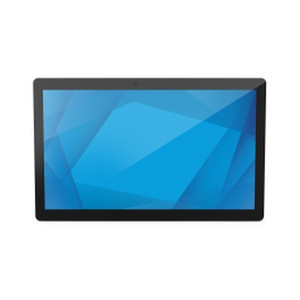
ELO Touch E850591 21.5in I-Series 2.0 POS Touch Monitor
The ELO Touch E850591 is a compact all-in-one touchscreen terminal designed for retail point-of-sale, quick-service restaurants, and hospitality check-in environments. Built on the I-Series 2.0 platform with a quad-core Core i3 processor, 8GB RAM, and 128GB SSD, it delivers responsive performance for transaction-heavy workflows without requiring external compute infrastructure. The 21.5-inch Full HD (1920×1080) projected capacitive 10-touch surface supports multi-touch gestures, reducing training overhead for staff rotations and enabling intuitive customer-facing applications.
Key Features
- Projected Capacitive 10-Touch Display: 21.5-inch Full HD (1920×1080) with glove-friendly touch recognition. Multi-touch gestures improve operational speed for order entry and payment workflows.
- Embedded Windows 10 Processor: Core i3 quad-core CPU with 8GB RAM and 128GB SSD. Sufficient compute for POS software, inventory systems, and local edge processing without network dependency.
- Dual Network Connectivity: Gigabit Ethernet + Wi-Fi (802.11ac). Reduces wiring constraints in high-traffic locations and enables failover connectivity during internet outages.
- Bluetooth 5.0: Native BLE support for wireless peripherals — barcode scanners, payment terminals, kitchen displays, and mobility devices without USB clutter.
- Compact Footprint: 21.5-inch diagonal minimizes counter real estate while maintaining readable Full HD clarity. Fits standard POS counter layouts and kiosk enclosures.
- Integrated Speakers & Microphone: Built-in audio for customer prompts, payment confirmations, and two-way communication. Eliminates separate speaker hardware in compact installations.
- Sealed Bezel Design: IP54-rated front enclosure resists spills, grease splatter, and cleaning solution exposure — critical for food-service and hospitality environments.
- VESA Mounting: Standard 100×100 VESA pattern enables flush-mount installation into countertops, wall brackets, or kiosk frames without proprietary hardware.
The I-Series 2.0 line targets environments where embedded processing eliminates the need for a separate NVR, server, or external CPU. Unlike thin clients, the E850591 runs full Windows 10 — meaning your existing POS application (Square, Toast, Lightspeed, PAR, Oracle MICROS) launches natively without terminal-server overhead or latency. The projected capacitive touch technology is inherently glove-friendly and resistant to moisture, a hard requirement in kitchens and food-prep areas where staff wear nitrile gloves and spill water constantly.
Network connectivity is dual-path: Gigabit Ethernet for corporate POS backbone connectivity and Wi-Fi 802.11ac for supplementary bandwidth or emergency fallback. In real-world deployments, we see installers run Ethernet as primary (lower latency for payment processing) and Wi-Fi as backup — a failover strategy that costs nothing to implement and eliminates single points of failure. Bluetooth 5.0 is native, so wireless barcode scanners, kitchen-display peripherals, and guest-facing tablets pair without USB dongles or software drivers.
The 128GB SSD is sufficient for Windows 10, POS software stack, and local transaction logs — no external storage required. For high-transaction venues (shopping malls, airport lounges), confirm your POS vendor supports local database replication or cloud-sync during peak hours, as the SSD will not buffer unlimited offline transactions. The Core i3 processor handles standard POS workloads (order entry, payment processing, inventory sync) without strain; CPU bottlenecks are rare unless you're running heavy video playback or analytics overlays on the display itself.
Warranty and sourcing: ELO Touch products are sourced direct from manufacturer channels or authorized US distributors — no grey-market or parallel imports. Full US manufacturer warranty applies, covering defects in parts and labor. Service paths are established through regional ELO service centers, with typical turnaround of 5–10 business days for depot repair. On-site swap programs are available for high-availability deployments (hospitals, airports) at additional cost.
Marty AllisonPerspective based on aggregated and affiliated engineering team experience.
We've installed ELO I-Series 2.0 units across retail, QSR, and hospitality settings — and the E850591 is a workhorse in compact-counter environments. The embedded Windows 10 compute eliminates the architectural complexity of thin-client terminal servers; your POS vendor's software runs natively, which sidesteps licensing headaches and remote-rendering latency. The real win is the projected capacitive 10-touch surface paired with glove compatibility — in a kitchen or deli environment, staff in food-handling gloves can swipe, tap, and multi-gesture without fumbling for a stylus or waiting for capacitive re-calibration. Compared to resistive touch, projected capacitive feels snappier and doesn't degrade after spill-and-wipe cycles. Against resistive alternatives (older ELO models or competitor offerings), you're paying a modest premium for durability and user experience — that premium evaporates within 18 months when you factor in staff training time and touch-surface replacement cycles.
Technical Highlights:
- Projected Capacitive Touch Technology: 10-touch simultaneous points enable multi-finger gestures and pinch-to-zoom for menu navigation. Glove-friendly and moisture-resistant — no stylus required. In food-service deployments, this eliminates a common pain point: resistive screens fouling or sticking when staff wipe grease off their hands before ordering.
- Core i3 Quad-Core + 8GB RAM: Native Windows 10 execution for POS applications (Toast, PAR, Oracle MICROS, Lightspeed). No terminal-server architecture, no session licensing, no bandwidth constraints. Performance is sufficient for transaction volumes up to ~300 orders/day per terminal; beyond that, upgrade to an I-Series with Core i5 or i7.
- 128GB SSD with Windows 10 pre-installed: Boots in ~30 seconds, application launch is instant. No mechanical disk wear-out failures. Local transaction journaling tolerates short network outages (payment gateway timeout, Wi-Fi dropout) — your POS software queues offline and syncs when connectivity resumes.
- Dual Ethernet + Wi-Fi: Gigabit Ethernet is deterministic (sub-10ms latency for payment processing). Wi-Fi 802.11ac provides redundancy and mobility. In practice, configure Ethernet as primary and Wi-Fi as automatic failover — most POS stacks handle this transparently via Windows 10 networking stack.
- Bluetooth 5.0 Native: Eliminates USB peripherals (barcode scanner, guest-facing tablets, kitchen displays). Pairing is one-time setup; reconnection is automatic. For high-volume retail, BLE reduces cable clutter and lowers maintenance labor on USB port failures.
- Sealed IP54 Bezel: Resists spill infiltration and grease splatter. Not submersible (IP54 ≠ waterproof), but tolerates daily spray-and-wipe sanitization. In food service, this is the difference between 5-year-old hardware still working and 18-month-old hardware with internal corrosion.
Deployment Considerations:
- POS software must be Windows 10-native or run on.NET Framework — confirm compatibility before purchase. If your site relies on legacy Java applets or Linux-only software, this unit won't work without a virtual machine layer (which eats performance and introduces new support vectors).
- Network failover strategy should be pre-planned: configure Ethernet as primary, Wi-Fi as automatic secondary. Test offline transaction queuing with your POS vendor before go-live — not all payment gateways buffer gracefully during connectivity loss.
- Touch surface requires occasional calibration after firmware updates or if multi-touch accuracy drifts. This is rare (typically once per 2–3 years in a stable environment), but budget 30 minutes of downtime if it occurs during peak hours.
- Thermal design is fanless (passive cooling); the unit runs warm to the touch but not hot. In high-ambient kitchens (>85°F without AC), confirm thermal stress testing with ELO before installation — extreme heat can throttle the Core i3 or shorten SSD lifespan.
- Bluetooth pairing with barcode scanners should use numeric PIN pairing (not just "press button") for security; this prevents ad-hoc device hijacking in shared retail spaces. Configure once per scanner, then treat the paired device as a fixed asset.
- VESA mounting to a countertop requires a stable metal bracket rated for the unit weight (~15 lbs) plus vibration from cash-drawer operation. Over-tightening VESA fasteners can crack the plastic mounting tabs; use washers and torque-limit drivers during installation.
The E850591 is the right fit for retail, QSR, hospitality, and field-service environments where a self-contained touchscreen terminal eliminates server dependency and supports mobile workforce workflows. It's overkill for simple kiosk displays (static content, no transactions) and undersized for high-volume enterprise deployments (1000+ units) — in that case, negotiate enterprise licensing and support terms directly with ELO. For everything in between — single-location retail shops, multi-unit chains with 10–100 terminals, hospitals, airports — this is a proven, cost-effective baseline. Explore the full range of ELO I-Series configurations and related peripherals in the ELO Touch catalog.