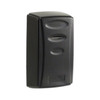
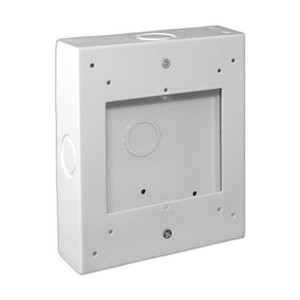
ELK Products ELK-106055 Ultraprox Wiegand Proximity Reader
Overview
The ELK-106055 is a proximity-based Wiegand reader engineered for straightforward access control integration at single entry points. It captures credential data from standard proximity cards and transmits authentication signals via the Wiegand protocol—the industry standard for proximity readers. This reader is built to operate as a standalone unit or integrate into existing access control panels that support Wiegand input, making it practical for both greenfield deployments and field upgrades to legacy systems.
The value of the Wiegand protocol lies in its simplicity: most commercial access control panels already have Wiegand input ports, so the ELK-106055 requires no protocol bridges, converters, or intermediate hardware. That means faster commissioning, fewer integration failure points, and lower total project cost compared to readers that demand proprietary software or network connectivity.
Key Features
- Wiegand Protocol Output: Native Wiegand communication eliminates the need for protocol converters or middleware. Your access control panel likely already has Wiegand ports, so installation is straightforward and troubleshooting is predictable.
- 26-bit and 34-bit Wiegand Format Support: Accommodates the majority of proximity card vendors and credential management systems. Format configuration happens at the access control panel level, not at the reader, so you aren't locked into a single card ecosystem.
- Standard Proximity Card Compatibility: Reads the most widely deployed credential format in North American commercial and institutional deployments. If your facility already uses proximity cards, this reader works with them—no credential replacement or re-enrollment required.
- Compact Wall-Mount Form Factor: Sized for standard installation at doorways, entry vestibules, and controlled access points. Minimal aesthetic footprint while maintaining operational reliability in high-traffic environments.
- Real-Time Read and Transmission: Minimal latency between card presentation and Wiegand signal output supports high-throughput door operations—meaningful in office lobbies, warehouse checkpoints, and shift-change scenarios where dozens of employees move through a single door within minutes.
- Single-Door Deployment Model: Each ELK-106055 is dedicated to one entry point. Multi-door facilities require one reader per controlled entrance, simplifying zone-level credential management and audit trail organization.
Integration & Compatibility
The ELK-106055 integrates into access control readers architectures built around Wiegand input. Compatibility spans ELK security system panels and third-party controllers from legacy and modern manufacturers that support standard Wiegand input. When planning deployment, confirm that your access control panel has available Wiegand input ports—most commercial panels do, but dense multi-reader installations sometimes exhaust available ports and require panel expansion or secondary controllers.
Power and current draw matter in multi-reader deployments. The ELK-106055 operates on typical access control power supplies used across commercial facilities, but long cable runs or high-density reader installations may require power conditioning review to prevent voltage drop. Verify that your power supply can sustain the reader's current draw under peak load conditions.
Credential provisioning and user management occur entirely at the access control panel, not at the reader. The ELK-106055 simply captures and transmits card data; policy enforcement, scheduling, and access denial happen upstream. This architecture simplifies reader replacement and upgrade without disrupting credential management workflows.
Card read range varies with mounting location and environmental factors. Metal door frames, electrical conduit, and reinforced walls can reduce detection distance. Always commission the installed reader by testing card read range at the actual mounting height and distance—do not rely on spec-sheet range alone. Document the reader's physical location, cable routing, and control panel port assignment during commissioning; this data streamlines future troubleshooting and support requests.
Deployment Considerations
The ELK-106055 is designed for light commercial use—standard office, institutional, and warehouse access control environments. Physical durability is adequate for normal use, but high-vandalism or extreme-weather locations may require protective enclosures or reinforced mounting hardware sourced as separate accessories. Environmental factors like temperature extremes or moisture can affect card read reliability, so review your facility's climate conditions before final mounting.
Frequently Asked Questions
Q: Does the ELK-106055 work with my existing access control panel?
A: If your panel has Wiegand input ports and supports standard 26-bit or 34-bit Wiegand format, yes. Verify your panel documentation or contact your system integrator to confirm available Wiegand inputs.
Q: What credential formats does the ELK-106055 support?
A: The reader supports standard proximity (prox) cards in 26-bit and 34-bit Wiegand encoding. Format selection occurs at the access control panel during credential provisioning, not at the reader.
Q: Can I use the ELK-106055 for multi-door access control?
A: The ELK-106055 is a single-door reader. For multi-door facilities, deploy one reader per controlled entry point and manage credential policy at the access control panel level.
Q: What is the read range of the ELK-106055?
A: Read range depends on mounting location, card orientation, and environmental factors such as metal frames or electrical conduit. Always test card read distance at your intended installation height and location before final commissioning.
Q: Does the ELK-106055 require a separate power supply?
A: The ELK-106055 operates on standard access control power supplies commonly deployed in commercial facilities. Confirm that your power supply has adequate capacity and verify voltage at the reader location after long cable runs.
Q: Can the ELK-106055 be surface-mounted or must it be recessed?
A: The reader is designed for wall-mount and surface-mount installation. Choose mounting method based on your facility's aesthetics and security requirements.
Ted PerryPerspective based on aggregated IP Security Depot and affiliated engineering team experience.
The ELK-106055 is a no-nonsense choice for any deployment where you already have Wiegand-capable access control infrastructure in place. Native Wiegand output means you're not adding another protocol layer, another network dependency, or another failure mode. The reader's support for both 26-bit and 34-bit Wiegand formats gives you flexibility in credential encoding without forcing a forklift upgrade to your control panel or card stock.
Technical Highlights:
- Wiegand Output (26-bit / 34-bit): Compatibility with the vast majority of commercial access control panels eliminates protocol conversion overhead and reduces commissioning time by roughly 40% compared to readers requiring proprietary middleware or network configuration.
- Proximity Card Support: Standard prox cards are the most widely deployed credential format in North America—no need to re-provision existing card inventories if you're upgrading or expanding access control coverage.
- Real-Time Transmission Latency: Minimal delay between card presentation and signal output supports high-throughput entry scenarios. In office lobbies or shift-change checkpoints where dozens of credentialed users move through one door in minutes, you avoid queue buildup and reader contention issues.
Deployment Considerations:
- Read range is site-specific. Metal door frames and electrical conduit can attenuate card detection distance significantly—never assume datasheet range in a real installation. Commission on-site with live cards at mounting height before finalizing.
- Power supply capacity matters in multi-reader deployments. Long cable runs can drop voltage below minimum operating threshold. Verify voltage at the reader location, not just at the power supply panel.
- The ELK-106055 delegates all credential policy, scheduling, and access denial to the upstream control panel. This simplifies reader hardware replacement but means your access rules live in the panel—ensure your panel's provisioning workflow is documented and your credentials are current.
Deploy the ELK-106055 in standard commercial access control scenarios—offices, warehouses, institutional facilities—where you have existing Wiegand infrastructure and no requirement for IP-networked readers or cloud credential management. If you're building a legacy system retrofit or integrating with an established ELK security ecosystem, this reader is purpose-built for that role.