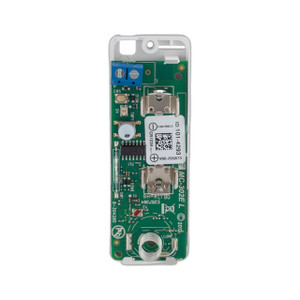
DSC PG9312 Outdoor Door/Gate Contact Sensor
The DSC PG9312 is a surface-mount wireless contact sensor purpose-built for outdoor perimeter security. If you're deploying gate or door monitoring in climates ranging from freeze-thaw zones to high-temperature industrial environments, the PG9312 delivers encrypted wireless reporting without the complexity of hardwired loops or the maintenance burden of frequent battery changes.
Overview
This contact sensor bridges the gap between basic wireless door sensors (which lack cryptographic protection) and hardwired solutions (which require trenching or conduit runs). The PG9312 integrates into DSC wireless security systems using military-grade 128-bit AES encryption, meaning your perimeter status reports cannot be decoded, spoofed, or intercepted by unauthorized equipment. The gray finish blends into most exterior applications—neither aggressively visible nor so subtle that installers miss it during commissioning.
Key Features
- 128-bit AES Encryption: All wireless transmissions use NIST-approved cryptographic protocols. This matters if your facility handles sensitive operations or must comply with federal security baselines—unencrypted wireless sensors leave perimeter data exposed to simple RF interception.
- Extended Battery Runtime (8 years): A single CR123A lithium cell runs the entire sensor for up to eight years under normal monitoring loads. On large perimeter deployments (30+ sensors), this eliminates scheduled battery-change callouts and reduces labor cost per unit by roughly 50% versus sensors requiring annual or biennial replacements.
- Operating Temperature Range -30°C to 60°C (-22°F to 140°F): This 90°C span covers most outdoor climates without performance degradation. If your site sits in a deep freeze or near industrial exhaust, the PG9312 won't suffer the drift or false triggers that plague sensors rated only to 0°C or 50°C.
- Surface-Mount Installation: Screw-mounted directly to door frame or gate structure—no recessing, no drilling into load-bearing elements, no routing wires through existing trim. Retrofit installations complete in minutes rather than hours.
- CR123A Lithium Battery (Industry Standard): CR123A cells stock at any security wholesaler, pharmacy, or online retailer. If a field replacement is needed, technicians don't wait for proprietary batteries or special-order kits.
- Compact Gray Housing: Dimensions and form factor designed to avoid visual obstruction while remaining accessible for service without removing door hardware.
Integration & Compatibility
The PG9312 operates within DSC's wireless ecosystem and complies with NIST cryptographic standards, making it suitable for facilities that mandate federal-level encryption. Its 8-year battery life aligns with extended monitoring deployments typical in access control and perimeter security architectures where scheduled maintenance visits are infrequent but critical to uptime. The surface-mount design supports both new installations and retrofits on existing gate assemblies without structural modifications, reducing deployment risk and timeline.
When evaluating wireless contact sensors for outdoor applications, compare battery longevity, temperature tolerance, and encryption strength across candidate models. The PG9312's 128-bit AES standard is table stakes for compliance-sensitive environments; cheaper sensors using proprietary unencrypted protocols may save upfront cost but create forensic and audit liability.
When to Choose a Different Model
If you need local visual indication of sensor status (an LED that confirms open/close state without network traffic), consider higher-end variants in the DSC line that integrate display elements. For applications requiring submersion testing (pool gates, water treatment facilities), the PG9312's outdoor rating may not extend to full IP67 immersion—confirm environmental specs with your system integrator. If your perimeter uses legacy hardwired loop installations and you want to avoid wireless altogether, contact a design engineer to assess the retrofit scope.
Frequently Asked Questions
Q: Does the PG9312 work with non-DSC systems?
A: The PG9312 is designed for DSC wireless security systems. It uses DSC's proprietary wireless protocol with 128-bit AES encryption. Integration with third-party platforms requires a compatible DSC gateway or translator module—verify compatibility with your specific system before ordering.
Q: How often does the CR123A battery need replacement?
A: Under normal monitoring conditions, the battery provides up to 8 years of operation. Battery life depends on sensor transmit frequency and the number of state changes. High-traffic gates (frequent open/close cycles) may see reduced runtime; low-traffic applications may exceed 8 years.
Q: Can the PG9312 be installed on metal gates?
A: Yes, surface-mount installation works on metal gates. Ensure the mounting surface is clean and free of rust or paint that could interfere with screw fastening. Metal-heavy environments may reduce wireless range slightly due to RF absorption, so test range during commissioning.
Q: Is the PG9312 certified for NDAA Section 889 or TAA compliance?
A: Consult the DSC product documentation or your specialty retailer for current certification status. Compliance certifications vary by model year and production batch and require formal verification.
Q: What's the warranty on the PG9312?
A: Contact your specialty retailer or DSC technical support for specific warranty coverage. Standard DSC product warranties typically cover manufacturing defects during the first year; extended warranty options may be available.
Q: Does temperature range affect battery life?
A: Lithium batteries perform well across the -30°C to 60°C operating range specified for the PG9312. Extreme cold slightly reduces instantaneous voltage but does not permanently damage the cell. Once temperature returns to normal, voltage recovers. Prolonged exposure to the upper limit may marginally reduce total cycle life, but this is not unique to this sensor.
James EverettPerspective based on aggregated IP Security Depot and affiliated engineering team experience.
The DSC PG9312 addresses a genuine pain point in outdoor perimeter monitoring: how to deploy encrypted wireless contact reporting without replacing batteries every year or running conduit. On warehouse and industrial sites where gate traffic is moderate and winters reach -20°C, the PG9312's eight-year battery life and -30°C to 60°C tolerance eliminate a significant maintenance headache. The 128-bit AES encryption is not marketing fluff—it's essential if your facility must defend against RF interception or spoofing attacks.
Technical Highlights:
- 128-bit AES Encryption: Prevents wireless transmissions from being decoded or replayed by unauthorized RF equipment. This matters more than most integrators initially realize; unencrypted wireless sensors leave perimeter status exposed to simple software-defined radio interception.
- 8-Year Battery Runtime: A single CR123A cell eliminates scheduled battery replacement cycles. On a 40-sensor perimeter deployment, this saves roughly 40 service visits over a decade—real labor dollars and uptime gains.
- -30°C to 60°C Operating Range: Covers freeze-thaw climates and high-temperature industrial zones without performance degradation. Sensors rated only to 0°C exhibit voltage drift and false triggers in deep winter; the PG9312's 90°C span keeps false-alarm rates low.
Deployment Considerations:
- Verify wireless range in your specific perimeter layout during commissioning. Metal gates and dense industrial structures can reduce RF reach; budget for extra receiver placement or antenna optimization if initial commissioning shows marginal range.
- CR123A battery stock is broad (pharmacies, wholesalers, online retail), but field replacement requires opening the sensor enclosure. On critical gates, pre-position spare batteries at the site and train on-shift security to swap them if low-battery alerts appear.
- The surface-mount design assumes a reasonably flat, clean mounting surface. Corroded or heavily painted surfaces may not hold screws reliably long-term; power-wash and prep the gate before installation on older structures.
Deploy the PG9312 on warehouse perimeters, industrial gate access points, and remote facility entrances where 8-year battery life justifies the wireless investment and NIST-compliant encryption meets compliance baselines. This is not a sensor for high-frequency applications (turnstiles, rapid access lanes) where battery life shortens dramatically; it's engineered for moderate-traffic gates and doors in harsh climates where wired solutions are impractical and battery maintenance is a real operational cost.